Masha

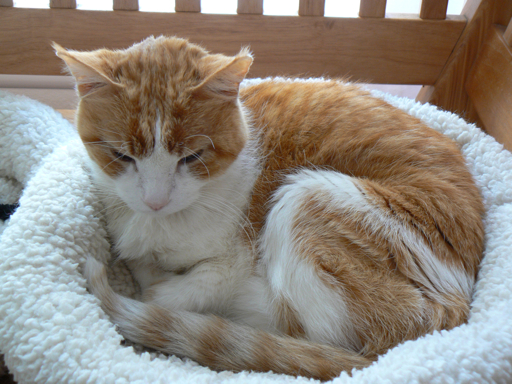
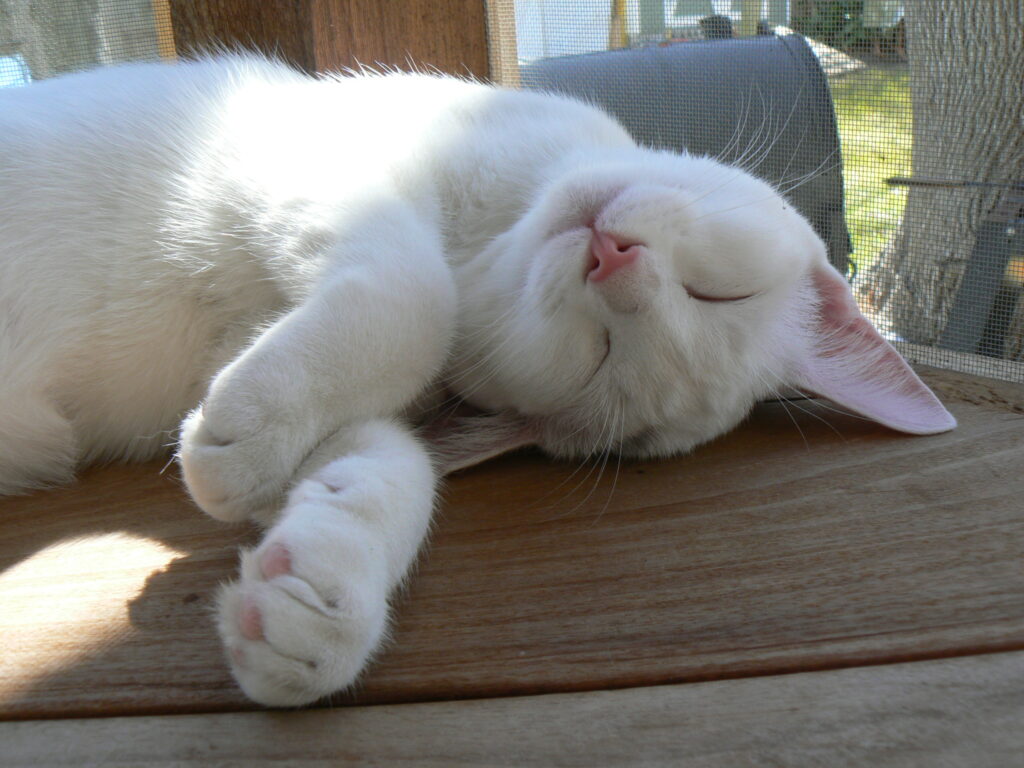
We adopted Masha and her sister Bubka in November of 2008, when they were both about three months old. Gwen and I each brought our own cats to the relationship, but these were the first cats we adopted as a couple. They had both been separated from their mother before they were weaned, and as a result, had permanently infantilized behaviors: in Masha’s case, that meant that she liked to suckle on your armpit—mostly on Gwen’s armpit. She had a voracious appetite, and would nose other cats away from their food bowls. She didn’t particularly like sitting on people’s laps, but she had a morning ritual where she would jump up on the rim of our bathroom sink for what I thought of as her “daily adoration.” She would always seek out a beam of sunlight to warm herself in. She always seemed happy.

She spent most of her life living with a chronic health condition: cholangeo-hepatitis, inflammation of the gall bladder and liver. This resulted in a couple of serious health scares before we had it correctly diagnosed and treated. We followed the vet who diagnosed her from one practice to another to another. A couple of years ago, her blood sugar seemed to indicate that she’d also developed diabetes, but we were able to control that with diet. More recently we needed to increase the dose of one of the drugs we gave her. And she was becoming less mobile, so the daily adoration could not take place on the sink.

On Sunday, her normally robust appetite deserted her. She’d had low spells before and bounced back after a few days. This time, Gwen took her to the vet, and the vet just gave Masha a look, and gave Gwen a look. Diagnosis: multiple organ failure. Our vet had previously marveled that Masha seemed unstoppable—she’d have one problem after another and keep going. But in the end, the best we could do for her was not good enough. In the end, it never is.
Bubka

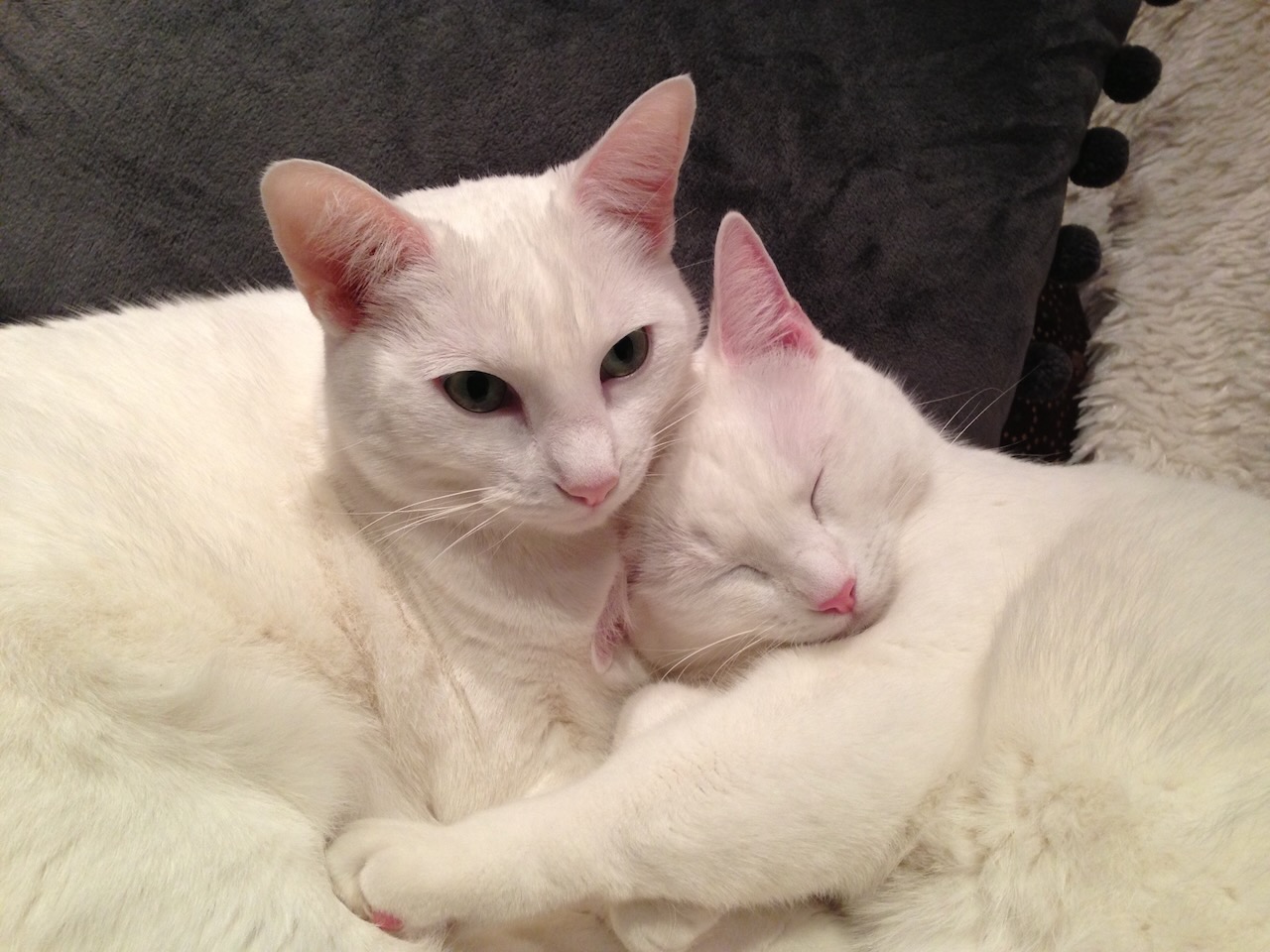
Bubka and Masha

Gwen and I adopted Bubka (left) and her sister Masha in November 2008, when they were about three months old. When Gwen and I got together, she had two cats and I had one; by the time we adopted the girls, old age had taken two of our old cats and the surviving cat, Kevin, was lonely.

On our way to the cat-rescue place, Gwen said, “I don’t want to get a kitten.” We wound up with two. They were both so easygoing and affectionate it seems inevitable in hindsight. We named Bubka after the famous Ukrainian pole-vaulter, Sergey Bubka, because she was such an energetic jumper when she was little. She grew out of that eventually and became mostly placid.

Bubka took to Kevin immediately. He was initially stand-offish toward both the new kids, but she wore him down after just a few days, and her companionship made his remaining years much happier.

Because they looked so much alike, it was hard to tell them apart at a glance, and we took to calling both Masha and Bubka “kitten,” especially when they were being naughty. And because they were separated from their mother before they were weaned, they continued to exhibit kittenish behavior all their lives. We never stopped calling either of them “kitten.”

Gwen insists I was Bubka’s favorite person, and she’s probably right. She would jump up on the bed in the morning and swat at my nose or bite my ear to get my attention. Once I was up, she would insist on being carried around for a few minutes. If Gwen and I were watching TV from the couch, she’d often be perched on the back cushion behind my head.

Bubka had been diagnosed with kidney disease years ago, but her condition had been stable up until about March, when she had a health crisis. She spent a few days at the vet and we learned that her kidney function had declined suddenly. We managed her health aggressively with drugs and subcutaneous fluids we administered at home, but we knew her condition was only going to get worse. For a while, it seemed she was getting worse very gradually, but by the time it was ready for us to go to Flipside, we could tell her decline was accelerating. On the Saturday of Flipside, Gwen came home, and the day after, I returned for the day so that we could euthanize her. It was clear the moment I saw her that it was time. She was very weak—she couldn’t walk more than a few steps at once. She had no interest in food. Her meow was all wrong. Her life wasn’t as long as it should have been, but it was the best possible version of her life.

Masha and Bubka were inseparable, cuddling together or tussling in what we called “pillow fights” due to their well-cushioned physiques. I have no idea how Masha will cope with her sister’s absence, but she had been avoiding Bubka as she declined over the past couple of months, perhaps out of some instinct to avoid disease.

Gwen and I are both wrecked. We’ve had a fair amount of practice with this. It never gets easier. I’ve been thinking about grief a lot, and why it is that we feel it so intensely with the death of a pet. I don’t know that I have the answer, but maybe it’s this: we’re responsible for everything in the lives of our pets. We make all the decisions, and want all of those decisions to be in their best interests. In this respect, they’re like children. But unlike children, we generally outlive them, and when the time comes to make the last decision—to euthanize them—there is no option that doesn’t feel like a betrayal. They’re constant presences in our lives for a long time, and love us uncritically, and when the end comes, there’s nothing we can do for them.

Kevin

We buried Kevin today.

A freight train hits you just as hard, whether you’re blindsided by it or you saw it coming from miles away. Kevin is the third old cat that Gwen and I have had to euthanize, after Oscar and Squeaker. In Kevin’s case, we had a better sense that he had little time left, but being mentally prepared doesn’t lessen the impact.

Kevin came into Gwen’s life as a young, scrawny tomcat in 1994, not long after she moved to Austin. Gwen already had Oscar and didn’t want another cat, but he kept hanging around in her garden until she took him in. After Oscar established that she was the boss, the two of them were buddies forever. Once a part of Gwen’s household, Kevin filled out to a majestic 17 lb.

Every cat has his or her own personality, and, apart from his fear of small children, Kevin’s was always unceasingly sweet and happy. He would start purring the moment anyone picked him up.

Four years ago, Kevin lost his best buddy Oscar, and it was clear that he was lonely. When we got a pair of kittens two and a half years ago, one of the two, Bubka, decided that Kevin was her new best friend, and so happily he had another excellent cuddlebuddy in his later years.

We’re not sure how old Kevin was—we estimate he lived to be 19. Old age was not easy on him. He developed an allergy that could only be treated with prednisone (though for a full year the previous vet insisted it was behavioral). He became completely deaf and his vision deteriorated. He suffered a herniated disk in his spine that left his hind legs wobbly. He was recently diagnosed with intestinal cancer. But his sweet disposition remained unchanged. It seemed that he never stopped enjoying life.

This morning he was too wobbly to even sit up, and was not purring. He was clearly having intestinal distress. His condition improved a little as the day went on, but we knew it was time. He spent the day lying on the back porch with Gwen, with friends dropping in to say goodbye.

(Gwen here.) One of Kevin’s nicknames was “Kev-Dog”—after his entirely endearing trait of simply following me around the house like a good dog so he could always be in on the action. His favorite thing was to enjoy a good book with me, stretched out on my legs on the couch. And sleeping all night as near to my head as I would allow. He was loved by many, and his sweet nature won over more than a few cat-dislikers. He had a bad spell once that involved a urinary catheter and a move from the vet to an emergency hospital—when we saw the vet after a miserable long wait, she looked at him and said “This must be Kevin,” and he started purring loudly. He was that kind of guy.

A word of grateful thanks to our excellent vets at Austin Vet Hospital (especially Dr. Besch) and their caring staff. They looked out for him in a way that I would wish for animal friend.

Kevin & Oscar

Kevin & Bubka

My gripes about translation memory

I recently tweeted that I was experimenting with OmegaT, a translation-memory tool. When asked by one of its proponents how I liked it, I responded

@brandelune do not like omegaT. really only works with plain text. ugly. burdened w/ typical java on mac shortcomings. not customizable.

That barely begins to cover what I don’t like about OmegaT. I’ve been thinking about what I would like in a translation tool for a while now. My desires break down into two categories: the translation-memory engine, and the environment presented to the translator.

Squeaker

I buried Squeaker today.

When people ask me how she came into my life, I would say “she came with the house.” It sounds glib, but it’s true.

When Jenny and I bought the house on Avenue G at the beginning of 1997, Squeaker was already living there as a street cat. She had been looked after by the previous occupants. When we showed up, she initially kept her distance (hanging out at a neighbor’s place instead), but after a few months, she warmed up to us. When the first freeze of the winter came at the end of ’97, Jenny and I agreed to let Squeaker spend the night indoors, just for that one night. Apart from a couple of forays into the back yard, she never went outdoors again.

Squeaker was already an adult when we took her in—our best estimate is that she was born in 1990. She was compact, stout, and stiff-legged, never jumping but frequently clambering up onto whatever surface she wanted to occupy. She enjoyed surprisingly forceful head-butts, and never played with toys when anyone was watching.

A lot happened to me over the intervening years—one marriage ended, another begun. I broke my pelvis. I sold the house on Avenue G and bought the one I live in now with Gwen. Squeaker was with me through all of that.

She was not unmarked by time. In 2004, she developed a growth on one foot that ultimately required two toes to be amputated. That growth re-appeared on her foot, but never obviously went beyond that.

Over the past few months, her stiffness of leg turned into painful arthritis. She developed hyperthyroidism, meaning her pulse was always racing, she was constantly hungry, and losing weight. I put her on a painkiller for the arthritis. She still seemed to be generally happy, but I realized she was in the endgame.

Over just the past few days, she declined precipitously. She lost her appetite and even had trouble drinking water. Her meow, which had always been stentorian and scratchy, became pathetic and weak. She smelled awful. It was time. I had the vet make a housecall to euthanize her. If anything, I should have done it a few days earlier. Her last day was peaceful.

Gwen and I went through this about a year and a half ago with the cat she’d had for even longer, Oscar. It doesn’t get easier with practice.

Oscar: 1991–2007

Oscar

We put Oscar in the earth today.

Despite the name, Oscar was a girl, and every inch a princess. Gwen tells the story of when she first got her. Gwen was living in Minneapolis, and the mother cat’s owners (who called Oscar “Whiner”), brought her over to Gwen’s place. Oscar was the runt of the litter, but as soon as she was released in Gwen’s apartment, she walked around the room, sniffed everything, jumped up on a table, knocked something over, and then came over to Gwen, got up on her hind legs, and gave Gwen an affectionate head-butt. This was her most endearing habit, and often used in the years that followed to defuse anger at, say, knocking something over. In that moment, Oscar became Gwen’s cat.

A year or so later, Gwen moved to Austin, and moved around in Austin quite a bit after that. Oscar was her one constant companion. She added another cat, Kevin, to her household, and when Gwen and I got together, we wound up with three cats between us. Hence the king-sized bed.

Oscar had been a svelte 17 pounds in her prime, but once she hit a certain age, she started losing weight, and her kidneys started shutting down. Ironically, the weight loss made it easier for Oscar to get into trouble, which she did, jumping up to places she couldn’t reach when she was heavier but younger. She often found ways of getting into trouble specifically to push our buttons, to let us know it was time for a snack or something. As infuriating as she could be in these moments, she always made us laugh (either at her or ourselves) because her needling was so transparent, and yet so effective.

Over the past four days or so, she lost interest in eating (apart from barbecued chicken from Hoover’s) and became much quieter. Gwen took her to the vet and found that her blood urea nitrogen level (an indicator of kidney function) was off the scale. The vet said Oscar had “days or weeks.”

With much grief and second-guessing, we made the decision to euthanize her, and this afternoon, after a snack of barbecued chicken, the vet came over and ended her life. We are both wrecked.

It’s a hell of a thing, having pets. You take them in as cute companions, knowing in the back of your mind that some day, a day like this will arrive. And when it happens, you’re completely unprepared.

(from Gwen) It’s impossible to sum up a life together in a few paragraphs. Oscar has slept by my side (or, more often, on my pillow) for 16 years. She’s made me laugh, pissed me off, purred in my ear at 5 a.m., and today licked my tears while we were hanging out together for her last few hours. I hope I can always remember the smell of her head, in the sweet soft spot between her ears that tickled my nose at the beginning of endearing-for-life head-butt. And I hope her cat friend Kevin, who has always been “Kevin and Oscar” will find some way to be Kevin. Rest well, Oscar. Piggy. Pig Pig. Muffin. Pig-a-Muff. Muffy. Muff Muff. Schmooky. Schmook.

Scroll to Top