Cilantro lime ginger sauce

People seem to be interested in this, so here’s how to make it.

  • Take one bundle of cilantro and cut off the stemmiest parts. Chop coarsely into smaller bundles.
  • Juice four limes.
  • Peel a fat chunk of ginger about one inch long and chop coarsely. Enough to fill the palm of one’s hand.
  • Take one or two jalapeños (depending on intensity) and cut off the stems.
  • Throw all this in a blender and puree. See if you need that second jalapeño. Add about a tablespoon of oil and salt to taste. Run the blender for a few more seconds.

This is especially good on fish or shrimp, but will work on just about anything. We typically pan-fry some kind of white fish, pour the sauce over it when it’s about halfway done, let it cook in the sauce for a while, and serve over rice.

Search tip

A couple of nights ago, Gwen used the phrase “Googling for something on America’s Test Kitchen” instead of “searching for…”, which just reinforces that Google has become a synonym for search.

Google search results are often polluted by irrelevant links to commercial websites like bizrate and dealtime, though. Wouldn’t it be nice if there were a way to avoid that? There is: use Give me back my Google.

It would be even nicer if you could search via GmbmG right from the search field in your browser. And in fact you can, but you’ll need to set it up first

Safari

Safari does not let you customize your search field out of the box, but there are some hacks like Glims that add this capability. Once you’ve done that, you’ll need to add GmbmG to Glims as a custom search engine and teach it the specific search syntax that GmbmG uses. It is:
http://www.givemebackmygoogle.com/forward.php?search= search key

Firefox or Internet Explorer 7+

These browsers support something called the “open search description document,” which makes adding a new search engine dead-simple. I have no idea how this works in IE, but in Firefox, just install this plugin (which I created, not the creator of GmbmG—the plugin is currently listed as experimental, but it’s perfectly innocuous, I promise) and it will add that site to the list of search engines your browser uses.

Moving forward and circling back

zenit-3

I recently resolved a nagging issue in my life that had been like an albatross around my neck for years.

Back in ’97, I visited the Netherlands, and became interested in recumbent trikes. I’ve always been drawn to the mechanically obscure, and if recumbent bikes are weird, recumbent trikes are way out there. As is my wont, I researched them obsessively when I got back home, and eventually homed in on a model that, even by the rarefied standards of recumbent trikes, was exotic. It was the AS Engineering Zenit. Made in Russia by former Illyushin Aircraft engineers, it had front-wheel drive, a box-section aluminum frame, hydraulic drum brakes, and other unusual features.

I ordered one. It took forever to arrive—the better part of a year. I may have been the last customer to have an order filled. I know that AS Engineering stiffed several customers. It didn’t come as a finished product, but it didn’t come as just a frame (the way many custom bikes do) either: because of its many custom parts, it was somewhere in between. I began putting it together with quality parts, but after a while, I got bogged down. I had routed the hydraulic lines poorly, and didn’t want to redo them. One of the lines also needed to be re-bled, which was a massive pain. The shifting was erratic, and I had trouble getting that dialed in.

So it sat in the shed. For a decade.

Every time I went into the shed, there it was, mocking me. Eventually Gwen gave me the ultimatum “ride it or get rid of it.” and I eventually decided to get with the program. I took it to Austin’s recumbent bike store, and had the proprietor deal with its various shortcomings. At the same time, I found a website for recumbents that included a classified section. Someone saw it listed and told a friend, who had been looking for a Zenit for years. I sold it.

Putting that trike behind me was an illuminating life-lesson. I had let a molehill grow to a mountain in my mind: I had become frustrated by some minor problems and intimidated by the prospect of fixing them. Ironically, in the ten or so years that had passed, those problems became much more difficult to solve (the hydraulic parts needed for the trike had become much harder to obtain, and there was a new leak somewhere).

But revisiting the trike reminded me of an idea I had for it when I first got it: to use it as the vehicle for a transcontinental bike ride. I had completely forgotten about that goal after the tumult of breaking my pelvis, getting divorced, and getting into firedancing in 1999–2000. But reminded of it, I realized that I still wanted to do it. I mentioned it to Gwen and she said “You’re not getting any younger!” So that’s going to be my big project in 2010.

Ironically, I still think that a recumbent trike is the right vehicle, but I have no regrets about having sold the Zenit, and would shy away from using it for this purpose if I hadn’t: a trike with critical parts that simply cannot be replaced if they break is a bad vehicle for a 3,000 mile journey. And at this point it would be bad mojo to ride a trike that symbolized my own inability to complete a project.

Mueller ramble

Gwen and I went for a walk through Mueller today, and because it’s Sunday, there were a lot of open houses. We stopped in six. It was educational.

The first two we stopped in were of a small number of showcase, architect-designed, “parade of homes” houses facing the park. These all have seven-digit pricetags. The others were all builder houses. The contrast between them was interesting. The architect-designed houses were profligate in their use of fancy materials and construction techniques. One of them had a floating staircase where each tread was supported from the ceiling by a serpentine square-section tube, and slatted overhangs above the windows that in total consisted of many hundreds of small tubes, each screwed down in four places. Swingarm mounts for flat-panel TVs abounded. Another had a rooftop porch (accessible by elevator!) with a sink shaped like a martini glass.

The builder homes, in contrast, were all swaddled in carpeting that could charitably be described as “disposable,” and generally had cheap finishes and cheap materials except on certain bullet-point features. We were struck by one home, listed for $608K, that had pine cabinets stained to look like walnut, but a vast expanse of marble countertops in the kitchen practically equal to our house’s floor space. On a house that was listed for more than $500K, the interior doors were plastic. Most the builder houses felt very suburban, with fussy trim, “great rooms,” and upstairs playrooms for kids. There was only one house that had a (sort of) open-plan first floor. While all the homes have some level of LEED certification and meet some kind of green-building standards, this struck me again as a bullet point to be checked off rather than as an actual design goal. Houses had incredibly high ceilings (whose main purpose seems to be making lightbulb-changing difficult), but no ceiling fans. None of the homes made any provision for rainwater collection, and when Gwen quizzed the realtor at one of the architect-designed homes as to why, she answered “there wasn’t room.” Which struck me as unlikely—I doubted it had ever been contemplated.

I was struck by the way quantity is prioritized over quality: maximum floor space seems to be the number one priority. Yard space was very limited—I know that short setbacks were mandated for Mueller, and I can’t really complain about small back yards in a city, but those are some of the very few features of the development that feel urban. All of the houses were at least twice as big as our house, and were clearly not designed with people like us in mind. Something that traded space for quality of construction, without going overboard on showy, labor-intensive features, and that reflected a more urban aesthetic. There is a single row of boxy, modern townhouses, but that’s the only part of Mueller like that, and we didn’t get a chance to look inside them.

Finding translations

Wil Shipley wrote about how coders can organize their software projects for localization. But what happens on the other end—once those files of strings to be localized get handed off to those “errrr… whatchacallums. ‘Polyglots!'”

I’m a translator. I’ve done a small amount of coding, so I can appreciate the issues involved on that side, but it’s not my strength. I’ve done a little software localizing, and a lot of translations of software manuals.

Suppose you’ve got an application that you want to make available in other languages in addition to your native language. You’ve got the technical aspects of the problem solved. How do you get it translated? I will assume that you want every localized version to produce the same delight and satisfaction in speakers of other languages that you are trying to create with your own-language version, and that you are willing to go to some trouble to do so.

Your first decision, from which many other tradeoffs will follow, is whether to give the project to a translation agency or to act as your own translation coordinator. There are pros and cons to each approach.

When you hand a job off to an agency, they will act as a buffer between you and the translators. In fact, they will insist on it. If the translators have any questions in the course of the work, they’ll footnote it and the agency will try to resolve the question either on their own or by contacting you.

Most large agencies will claim to handle any language combination; for any relatively common language combination, they probably have access to dozens or hundreds of translators. The coordinators at these agencies often have no ability to evaluate the quality of translation work themselves. Some of these large agencies farm work out on a first-come, first-serve basis, some farm them out to whichever translator is in their database as handling that subject matter at the lowest rate. Large jobs on tight deadlines will likely be split up among multiple translators, perhaps with some effort at harmonization after the fact. Editing work is also usually farmed out using the same methods.

One point that Shipley makes is not to use pictures of words, since they are so much more work to localize. While this is unquestionably good advice, bigger agencies may have tools for stripping text out of Photoshop/Illustrator files to be translated, and substituting the translated text back in (if it’s styled text, this could obviously get sticky).

There are smaller agencies that specialize in only one language, or only a few. These typically have bilingual people on staff, do the editing in-house, have some kind of personal relationship with the freelance translators they work with, and have a pretty clear understanding of each translator’s strengths and weaknesses. These agencies will also act as buffers between you and the translator.

Finally, there is dealing with individual translators. This will allow (or require) you to work more closely with the translator, which should in theory permit them to do higher quality work. Dealing directly with the translator will expose you to a wider range of rates: on the one hand, you’re not paying the agency’s vig (which can be anything from 15% to 200% in my experience). On the other, you may be dealing with translators who have priced themselves out of agency work. Dealing with individuals does place you at risk if one of them flakes out (rare but possible), and will take some work just to find suitable candidates. You should also arrange for someone to edit the work. You should be able to ask the translator to do this, although some translators might be reluctant to let their colleagues see their work. Any freelancer worth his salt who is working for a direct client will do a meticulous editing job, but the more eyes that look at it the better. Mistakes can always slip by.

Let’s assume that, one way or the other, your localizable strings file has reached the translator. I’ve seen agencies send these as Excel files, with each text chunk in its own row, the source in one column and the target to be translated in another. I hate doing extended typing in Excel, but this at least has the virtue of clarity. I usually wind up moving the table into Word, which is a friendlier place to type.

The problem with these chunks of text is that they are disembodied. Out of context. And context matters. Knowing that a chunk of text is going to appear as a menu item, as opposed to a dialog box, tooltip, or whatever, will influence how the translator expresses that idea. For that matter, knowing that several menu items are all clustered in the same menu, between separator bars, would also influence how each of them was translated. A keen-eyed translator will often be able to figure out some context based on hints the text provides, but there are limits. The result of this lack of context is that the localized version will be prone to seem a little disjointed to native speakers. Screenshots of the most common interface elements would be one way to ameliorate this. Actually giving the translator the software to play around with (in addition to the strings file) would be even better, but this restricts you to working with translators who use the same platform as you (which wouldn’t be a bad idea, since they are more likely to be conversant with platform-specific lingo), and probably rules out working through an agency.

Let’s jump ahead and assume that you’ve received the translated strings file. Now what?

Well, you could blindly assume that the work has been done to your satisfaction, and you might get lucky. Or not. Regardless of whether you are working with a big agency, small agency, or individual translators, you should line up native speakers of the target language to critique the translation and make sure that if you incorporate it into your product, you’ll be happy with the way it appears in that language.

It would be prudent, regardless of who you’re working with, to request an early delivery of a fraction of the work, and have that go past your native informants to make sure the work is up to snuff. Sometimes, prospective translation clients will ask an agency to have a sample translation done on spec. In cases like this, some sleazier agencies have had a known-good translator do the sample (or many translators do a sample so they can pick and choose), and then pass the job on to the cheapest translator. Many reputable translators resent being asked to do spec work at all, so the use of spec work as a selection method is clearly fraught with problems. Better to suck it up and gamble on 10% of the project.

You should also provide as much information up front about the job as possible. Make a list of special terminology that needs to be handled consistently, and give a glossary if possible. Explain your expectations regarding style and voice.

Update: See also the response by Ryan Ginstrom, a real-live programmer and translator.

Dean Keaton restriping

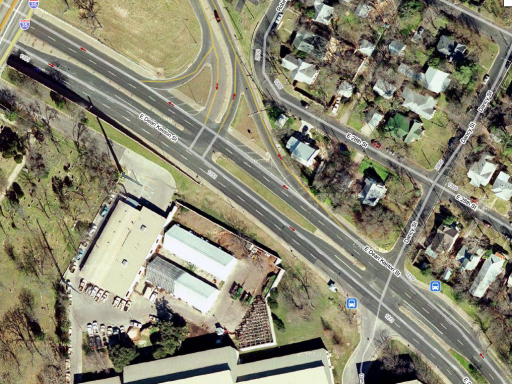
Google Maps image of Dean Keaton at I-35

When I got home from the recent road trip, I discovered that Dean Keaton had been restriped, adding reverse-angle parking, bike lanes, zebra stripes, and a generally dizzying array of new road markings. On the day of David Byrne’s recent talk about bikes, I rode this newly restriped stretch of road and found it to be a disaster for bikes.

The image above shows how the street looked before restriping. To be fair, this is an inherently difficult situation to make bike-friendly, especially westbound: there is a pullout for a city bus, an offramp, an onramp, and two places where traffic is turning across the lane. Not visible here is the fact that this is all happening on a downhill, so both bikes and cars are likely to be moving relatively fast (this stretch is signed as 30 mph, but the limit is rarely observed). Also not visible is another intersecting offramp just to the west.

As shown here, the street has two lanes, with a third lane for merging offramp traffic. After restriping, there is one lane on the left, a no-man’s-land denoted by zebra stripes, and a bike lane on the right; there’s a second lane for merging offramp traffic.

The way the bike lanes have been striped makes them an absolute hazard. The bike lanes zig-zag across onramp and offramp traffic in a way that minimizes the crossing distance. This runs contrary to both my own intuition and effective cycling methods, where the cyclist holds a straight line across the onramp/offramp. Worse perhaps is the quality of the pavement: although the pavement in the main travel lanes is in good shape, pavement in the bike lane is very rough.

As a cyclist, I am skeptical of bike lanes in general. They seem to be designed to cater naïve riders, who don’t know how to conduct themselves in traffic, and more than that, to motorists, who don’t want to be forced to deal with bikes at all. Many motorists will interpret the existence of a bike lane as a requirement that bikes ride in it, even when it is impassable. And naïve riders will follow bike lanes, even when they’re laid out poorly. That said, there can be good bike lanes and bad bike lanes. This is a bad one. A motorist taking the onramp or offramp will come up fast on a cyclist staying inside the lane, who is swerving and cutting perpendicularly across the motorist’s path at the same time. The choppy road surface set aside for the cyclist clearly reflects our second-class status. And the plethora of dashed lines, zebra stripes, chevrons, etc, all serve to confound everybody.

That night, I went to David Byrne’s presentation. One of the speakers was the City of Austin Bicycle Coordinator, Annick Beaudet. She spoke proudly of some of the city’s new bike facilities. Including this one. I can understand a city bureaucrat taking pride in seeing a project to completion, but I have to wonder: has she actually ridden this stretch of road?

See also: How not to design a bike lane.

Highball observations

After seeing The Informant at Alamo South, Gwen and I stuck our heads in at The Highball. A few observations:

1. The place looks great. Seriously, like some kind of Rat Pack fantasy.
2. If Tim & Co don’t do a good job keeping the place up, it’s going to look like shit in three years.
3. I predict it will be the site of the Hipster Singularity.

The Temple Burn

Burning Man was too big to fit into one blog entry. I’ve got a few ideas for things to say, but for now, I’m going to focus on the Temple and the Temple burn.

The Temple was finished on Tuesday, and we spent Tuesday evening getting rid of temporary scaffolding and cleaning up the work site so that we could open it to the public. Finally, Dave and Marrilee, the project leads, called all the crew up to the top floor of the Temple for a champagne toast and to hand out T-shirts. Fine words were spoken. The fire tornado was lit up. We all got to experience the Temple as it had been designed—for the last time.

Once this brief celebration was over, the safety perimeter was dropped and the Temple was instantly flooded with visitors. In that moment, it became a gift to the community, and became transformed into something else.

I later spoke to Johnny 5 about how he felt about the Temple, and he admitted to having complicated feelings about it: the Temple, to him, was about happiness. But to the community, the Temple has always been a place to seek solace—to say goodbye to people who have died or to let go of some negative personal trait. When we dropped the perimeter on Tuesday night, that’s what the Temple became. People immediately began writing on it and leaving memorials. There was at least one box of cremains left there. There were several elaborate memorials to pets, which left me especially choked up and which cause me to mist up just recalling. There was a message from a grandfather to his lost grandchildren. How could one not be moved?

After it had been open for a day or two, it was impossible to walk around in the Temple without being moved by the emotions there. I’m not a spiritual person, but I do believe that artifacts can be sanctified by the labor that goes into them. That definitely happened at the Temple, but it was sanctified far beyond that by the emotional outpouring for which it was the medium. The memorials were like a new skin on the Temple that made it impossible to see it in its original form.

We all knew in advance that there would be plenty to do on the day of the Temple burn, so Gwen and I got out there around noon with our work gloves. When we got there we learned that the plan was to set up a safety perimeter around the Temple pretty soon, to prepare it for the burn that night: the fire tornado at its center needed to be removed, another art piece that was going to be burned needed to be lifted into place (both these operations requiring a really tall crane), and the structure was going to be filled with as much scrap wood as possible, plus accelerants. When we got there, the upper floors were already cordoned off and other crew people were up there being industrious. A young couple arrived with a small chest. It was full of toys that had belonged to their infant son. Everybody there was wrecked.

Shortly after that we set up a safety perimeter, which Gwen and I and several other people maintained. People kept showing up, wanting to leave a message or memorial in the Temple. We couldn’t let them in, but we had offcuts from the panels and sharpies so that they could write messages, which we carried into the Temple on their behalf. We carried in other things too: I scattered the ashes of three people that afternoon. That’s a hell of a thing, to have a complete stranger walk up and give you the ashes of his brother to leave in the Temple. The same went for someone else working perimeter: we both knew in the abstract what the Temple was about, but we hadn’t realized what we were in for when we volunteered. It may have been the most emotionally intense day of my life.

A deaf woman approached me and whipped out a Sidekick, on which she deftly typed out a question asking if she could leave a message in the Temple. I less-deftly typed out a reply telling her what I told everyone else. She came back a few minutes later with a wood scrap bearing her message, gave it to me, and immediately walked away. I imagined she was frustrated communicating through the gadget, and wondered if she wanted someone she could talk to directly.

The people kept coming. We generally didn’t have any trouble with people trying to get past the perimeter, although I recall one couple blithely stepping over the yellow CAUTION tape and when I pointed out that we had a perimeter up, acted surprised. Yes, it does apply to you too. I held back on the sarcasm—it wasn’t the occasion for it.

At about 3:00 PM, Gwen took a bathroom break and found that the cable locking my bike to hers had been cut. My bike was stolen, and so was her headlight. I decided not to let that get to me, but being forced to confront behavior that shitty at Burning Man was a real disappointment.

At about 7:00 PM, we headed back to camp to have a bite and a bit of rest. By this time, a bunch of Rangers had arrived, as had the Temple Guardians. At 9:00 or so, we rode out on Blinky the art car with a bunch of other members of the Temple crew to work perimeter during the burn. I wound up standing in front of a few members of the Pyronauts, and had a chance to chat with them before the burn.

The burn itself was fast and quiet. The burning of the effigy the night before had been a huge party—all the art cars were there with sound systems going full blast. There were fireworks. It was fun. The Temple burn was different. Parachutists trailing fireworks circled down. A single firedancer performed. Only a few minutes passed from the time that the fire started inside the structure until it was completely engulfed, and it was reduced to a pile of embers in less than half an hour, I estimate. Dust devils spun off downwind every few seconds once it got going. Most remarkable was the crowd—there were probably 30,000 people present, and they were all silent.

There were so many people that came to the Temple looking for solace and catharsis. I hope they found it.

Scroll to Top