On the road to El Paso

Gwen and I got on the road at about 10:00 AM today, only an hour behind our desired start time—pretty good for us. Ever since a road trip back in ’96 or so that was plagued with mechanical troubles, every road trip I’ve embarked on since has made me anxious. This one included, even though we just had the car checked out. We were in Junction before my stomach settled down and I settled into driving.

This trip is also special in that it almost feels like a religious pilgrimage. I don’t exactly expect to be changed by it, but I expect that I might be.

I handed the reins to Gwen in Fort Stockton. Our destination for tonight is Tucson. A long way away.

The Temple

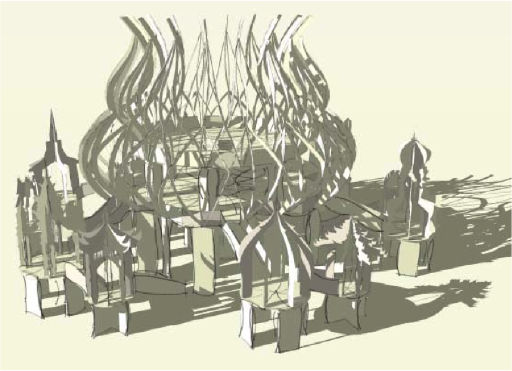
temple sketch

Today is a minor milestone for me.

I’ve been talking about going to Burning Man for about ten years. Every year I’ve come up with a perfectly reasonable excuse not to go. In the meantime, I’ve become an active member of the local burner community. I’ve been to the regional burn, Burning Flipside, six times, and have become at least a medium-sized fish in a medium-sized pond.

The longer I’ve been involved in the local burner community, the more Burning Man has become freighted with diverse significances. I’ve heard all the stories of how harsh the environment is (I’ve seen playa dust stuck to seemingly impervious surfaces for years), how astounding the art is (I’ve seen the pictures), how corporatized, mainstream, and Californicated that Burning Man is (everybody likes to complain). I know that if I go, I’ll be a small fish in a big pond. A newbie.

And then Dave and Marrilee, two stalwarts of the Austin burner community, were awarded the Temple build this year. With an inadequate budget and half the normal amount of time to finish. Shortly after this year’s Flipside they held a fundraiser. David Best, the artist behind the first few Temples, was present, and a documentary about his work was screened. A whole bunch of burners were there. Before that event, Gwen and I had been talking about how this, too, was not a good year to go to Burning Man. After we got home, we just started making plans, without ever explicitly discussing the fact that we had suddenly decided to go. The decision had become inevitable.

The Temple as Marrilee and Dave envisioned it required a huge amount of new design work, which would be cut into of plywood panels using two robotic routers. They had a wiki to sign up. I dived in and wound up designing 11 panels. There was also a huge amount of manual labor that needed doing: assembling pieces, moving stuff around to make room, or just sweeping away the torrents of sawdust spewed out by the Shopbots. Gwen and I made our way up to the work site as much as we could.

The Temple is being loaded in pieces onto a number of large trucks even as I write these words. Along with dozens of Austin burners who have committed to spend a month living in incredibly harsh conditions, the pieces of the Temple will head out to the Black Rock desert in a few days, where the rest of the construction work will happen.

Tomorrow, Gwen and I are going out to San Francisco to celebrate a friend’s wedding. It’s not the timing I would have picked, but I can’t fault the happy couple, and am happy to be going. But when we get back, the Temple crew will be gone. By the time we get to Black Rock City, the Temple will be up. So today, my role in building the Temple ended.

It’s a hell of a thing to be able to be involved in the construction of the Temple, especially as a first-timer at Burning Man. The Temple is one of the major landmarks and spiritual focal points at every year’s Burning Man. It’s probably the biggest thing I’ve ever been a part of. It’s going to be significant to some 50,000 people. As a newbie, it would ordinarily be difficult to contribute to Burning Man in a serious way. Being involved in the Temple has been an opportunity to do that.

Follow-up on National Fire Performance League

Almost a year ago, there was a bit of a brouhaha in the fire community—especially the local fire community—about some “championships” sponsored by the National Fire Performance League. I wrote about what little I knew at the time.

I learned shortly after the NFPL event that it was organized by a guy I kinda knew: one of my fire friends, Baru, went to the event and had a chance to chat with the organizer about it, and she learned that it was his very explicit intent to avoid associating his (or anyone’s) name with the event/organization.

A few months ago, he got wind of the blog entry linked above, and called me on the phone asking me to take it down, since it was showing up in Google searches before any of his own pages. I refused, but said that if he wanted to post a rebuttal somewhere, I would happily link to it. He wound up posting the last comment you see on that blog entry now.

A couple of weeks ago, I encountered the organizer, which was momentarily awkward, but we wound up talking about what he’s doing for about 90 minutes.

He told me he’s been involved in fire performance for only 3 years. I get the impression that is part of why he’s reluctant to have his name associated with the NFPL: because he doesn’t have a well-established name in the community. He’s been doing shows, and has gotten schooled by more established performers on two issues: safety and rates. He’s apparently taken these lessons to heart, and wants to promote better safety standards and more awareness of what a fire performer can/should earn for a gig. He also wants to create a mechanism for pairing up newcomers with established performers as a mentoring thing.

And in general, he feels that the fire community is too fragmented, and he wants to make the NFPL the central talking-shop to tie us all together and to use it to reach these goals, which are reasonable, even laudable.

One problem with this is the wheel-reinvention. There are other websites and organizations that that already exist but have not become centralized talking shops (I am reminded of the Unification Church, which seeks to unify all religions by creating yet another religion). And there are organizations with overlapping goals: I mentioned NAFAA to him. He had never heard of it. I did not get around to mentioning Wildfire or Fire Drums or the Crucible, and I wonder if he’s heard of them.

There’s also considerable irony in the fact that someone trying to organize a talking-shop is so opposed to communicating himself. I tried to emphasize to him, in a friendly way, that I thought his insistence on anonymity had backfired. He explained he got a lot of hate mail, and even one physical threat (which would be hard to carry out against an unknown person, but whatever). He felt that this justified his insistence on anonymity. Of course, I think it was mostly created by his insistence on anonymity.

Indeed, anonymity is the crux of his problem. People in the fire community often keep outsiders at arm’s length, because they know that exposure to people who don’t understand it can be dangerous, because they feel protective of the community, and because they are concerned about fire performance being exploited on someone else’s terms. My perception is that people in the community gain a reputation based on their accomplishments, their helpfulness, and their humility. And for any major undertaking that involves the community, reputation is the key to community buy-in, which in turn is the key to the success of the undertaking. While an anonymous person obviously has humility in spades, the humility hides one’s reputation (or lack thereof), but more importantly, masks whether the person is even a part of the community. Many people were concerned that (or assumed that) the NFPL was organized by outsiders to exploit us.

In short, I think his goals have merit, but he’s shown poor judgment. Although he’s done a fair amount of homework, he seems to have the enthusiasm of a newcomer who looks around and says “I want to do this! And this! And this!” without finding out what others had already attempted.

Since he wants to be anonymous, I’ve avoided naming him in this post.

Standards, schmandards

When it comes to e-mail, I’m a plain-text kind of guy. But I know that some businesses prefer to use HTML-formatted e-mail, and thanks to Gwen’s new job, I’ve been learning way more than I ever wanted to about this. Long story short, it’s a nightmare. Avoid.

If you can’t avoid it (as Gwen cannot), you have to learn to deal with it. It’s a complicated problem because there are more renderers for HTML e-mail in frequent use than there are web browsers: in addition to client-side e-mail apps like Outlook or Mail.app, there are also web-based clients like Yahoo (which has two separate renderers, depending on whether you’re using old-and-busted Yahoo mail or new-hotness Yahoo mail), Hotmail, and Gmail.

Each of these has its own peculiarities, most of which can be managed without too much pain, except for one: Outlook 2007. Outlook ’07 actually has a more primitive renderer than Outlook 2003, using the renderer from MS Word instead of the renderer from Internet Exlorer. Word’s renderer uses a non-compliant mishmash of HTML 2.0 and HTML 3.2, with very limited support for CSS. There has been a movement among people who have to deal with this to get Microsoft to straighten up and fly right. Last week, Microsoft promised that they would not, provoking considerable gnashing of teeth.

I’m surprised at Microsoft’s response. They seemed to generally be moving in the direction of better standards support, if perhaps grudgingly so. While there is a legitimate argument to using Word’s HTML renderer in Outlook, this strikes me as a situation where they could have their cake and eat it too—in fact, there’s a recent precedent in Microsoft’s approach to HTML rendering with the compatibility mode in IE8.

It would be nice if the Word HTML renderer and generator were brought into the new millennium to emit and interpret standards-compliant code. It would also be nice if I had a unicorn that farted rainbows.

Short of that, it would be a relatively straightforward expedient for documents designed in Outlook around Word’s HTML renderer to include a header element like <meta http-equiv="X-UA-Compatible" content="Outlook=EmulateWord" /> or equivalent in order to invoke that renderer, otherwise relying on whatever the current IE renderer is. This would, admittedly, add some overhead to the app, but MS doesn’t seem to have any aversion to adding overhead to their code.

The machinery of intermediaries

My fellow translator Ryan Ginstrom yesterday wrote about one of those problems that can arise in the translation business when one is dealing with both the ultimate consumer of the translation and an intermediary.

As luck would have it, I was having a conundrum at the same time that was so perfectly complementary I can’t help but write about it.

I had previously corresponded with a potential client about some work. I didn’t get the job at hand, but he said he’d like to work with me in the future. Shortly after, he approached me about some new work. I dealt with him and a new co-worker of his. They sent me an NDA, which I signed and returned, provided them with an estimate, and they gave me the green light. This happened over the course of one day.

A few hours after I started working on this job, I got a phone call from someone who I had never heard of, at a company I had never heard of, who explained to me that all the independent contractors who work for this end client have to go through him. On the one hand, it was obvious that he must have gotten my name and number, and some facts about the job from the end client, so presumably there was something to what he said. And as soon as he realized that I had not been brought up to speed on this situation, he backed off and agreed that I should clear it up with my contacts at the end client. On the other hand, having a complete stranger insist that he was going to interpose himself in the deal after the fact was unsettling and seemed a little dodgy.

I did indeed talk with the end client, and he did indeed assure me that everything was copacetic—that his company pays off agencies to shield themselves from the unspeakable horror of being seen as dealing directly with freelancers—even though that is exactly what they are doing, and the agency serves as a flimsy fig-leaf against some kind of legal exposure.

Flipside fragments

I’m not even going to try to give a blow-by-blow of Flipside this year. Suffice it to say that fun was had and asses were kicked. I’ll just tell some stories.

Gwen and I (and our campmate Scott) went out to Flat Creek on Wednesday evening, a day before the regular opening. We were able to get in early because Gwen had an early Zone Greeter shift the next day and because I’m a theme-camp lead. We had just enough time to unload the van and get our own tents pitched before dark. We had the small bjurt standing up half-collapsed like a geometric sculpture. Someone wandered through our camp and said “I know what that is.” We chatted about shade structures for a while.

A certain friend who had been partying a little too hard was taking a piss and passed out. He came to later and found that he had fallen into a cactus patch. Drugs may have been involved.

I was helping Greg set up his art installation, About That Time, which involved driving a lot of T-posts. Driving T-posts is a lot of work, and I try to avoid it (I say that, but my camp setup involves 24 of them). After we had gotten a few in, one of the DAFT guys working on the effigy came over and asked “Can I drive some?” He was wearing a DPW T-shirt—DPW people are notorious for being rowdy and practically masochistic in their work ethic. I was feeling like Tom Sawyer having just convinced the neighborhood kids to whitewash the fence for him. I said “Sure.” He grabs my T-post driver and starts waling on that thing in a very sexual manner. After he got a few in, he started tearing off blisters (he wouldn’t wear gloves). A couple other DAFTies came over; he said to them “Want to drive a few?” They did. After they did two or three, he took over the rest, finishing with the same hip-thrusting gusto that he started with. The next morning, I saw a pickup with a bumper sticker bearing the DPW logo and the motto “My best vacation is your worst nightmare.” I thought “that sounds about right.” Later I discovered the pickup was driven by Demon Monk, the architect of the effigy.

One of the most notable events from this (or any) Flipside was the Arc Attack performance on Saturday night. If this had been just a typical performance from them, it would be special, but this was astounding. Parsec donned a Faraday suit and stood in the discharge field, like some science-fictional Thor directing lightning bolts. Everybody’s jaw hung agape. Gwen wanted to try it herself.

We had some heavy weather during the day on Saturday. I don’t know exactly how much rain fell or how hard the winds blew—I checked weather almanacs for two nearby weather stations that completely disagreed on rainfall, wind speed, and even wind direction. We had about 20 people clustered inside the big bjurt, and apart from some water getting past the rain flaps when strong winds lifted the canopy, we were dry and comfortable within. Having put so much work into the bjurt, I was very gratified to see that it worked.

After the rains, Gwen and I went wandering around and stopped by Red Camp. I was admiring a pendant a woman had fashioned out of pop-tops when she asked “Are you looking at my necklace?” I said “no, I’m checking out your tits.” She said “Oh, thank you!” I love Flipside.

We didn’t get to burn the effigy this year. Everybody was disappointed about this, but Demon Monk had come up with a no-burn plan to allow for this contingency, and I feel like the whole “unburn” ritual was a success. We had fire performers do a long (~10 minutes) set to music that was slower and more ethereal than I would have expected. That was followed by Sparky’s firecracker hats, and then excellent fireworks by Moss and the DAFT crew tearing the effigy down, having weakened it beforehand so that they could flatten it by pulls on a few ropes. This was good, but not as cathartic as a burn, and the mood throughout Pyropolis seemed more subdued—the fact that we received a noise complaint from a neighbor, which caused Sound Town to be shut down no doubt contributed to that subdued quality.

I hope I’m not giving away any secrets by explaining how the no-burn decision came about. The Flipside organizers knew for months beforehand that, because of the historic draught conditions, we probably would not be able to burn the effigy, and a no-burn plan was part of the selection criteria in the effigy contest. At a Burn Night meeting a few weeks before, it was decided that a final go/no-go decision to burn the effigy would be made at 4:00 PM on Burn Night, as this allowed the minimum amount of time needed to rig the effigy for one contingency or the other. In the week or so leading up to Flipside, there actually was some rain, but the property owner, Child Inc, in the form of its manager Strick, informed us that he would not allow an effigy burn (or any large burnable-art burns), as brushfires had followed even those recent rainfalls. After the toad-floater we had on Saturday, the organizers did contact Strick on Sunday asking him to reconsider, and additional rain was even in the forecast for that evening. Strick was present at the final go/no-go meeting and said he’d only allow the burn if that rain actually materialized. But we were already at our cutoff time, and in fact the rain never did come. Strick was apologetic, and has been supportive of Flipside for years now, but there were obviously larger issues at stake. The previous day’s rain had already soaked in and the ground was relatively dry by Sunday.

After we got home, I remembered the line that Ginger Rogers did everything Fred Astaire did, only backwards and in high heels. It’s sort of like that with Gwen. I think I have a more visible profile in the burner community, but the fact is that Gwen works as hard as I do, and is indispensable to making all the things I try to do happen. And she does it wearing a pink wig and platforms.

I took very few pictures (and none of them were good), but other people did, so I’ll just point to them.
Bjurt construction notes

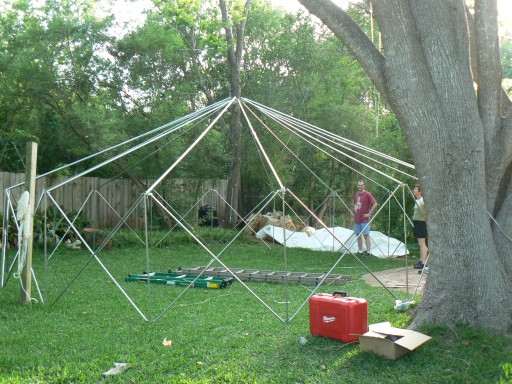
view of the mostly completed big bjurt

Having taken the bjurts out to Flipside, I have updated these notes to reflect my additional experiences

I am a theme-camp lead for Burning Flipside and one point of dissatisfaction with my camp has always been our shade structures. For the past few years, we have made do with a few cheaply made carport canopies lashed together. These drip water in between when it rains, don’t cut the heat effectively when it is very hot, and are interspersed with poles, breaking up what should be a communal gathering place into cramped zones. I had been casting about looking for something better. Domes are an obvious candidate, but they are a pain in the ass to make, and a pain in the ass to assemble on-site. After a while, I ran across bjurts, a plan for a shade structure designed by a burner to stand up to the harsh conditions at Burning Man. These seemed perfect, except for one drawback—they’re kind of small. Sizes can be varied somewhat, but the biggest calculated plan is 17′ in diameter. Not big enough to replace three 10’x20′ carports.

I corresponded with Bender (the designer of the bjurt) about ideas for making bigger bjurts, and other possible modifications, and he wound up providing me with a standard set of connectors for an 8-sided bjurt, and also a connector kit to build a giant 16-sided bjurt. This 16-sider is unknown territory for Bender and me.

We wound up dimensioning the small bjurt with a 12′ diameter, the big one 24′. This allows both of them to use some tube sizes in common, which simplified ordering and fabrication.

After much cutting, drilling, grinding, improvising, and a little bit of intemperate hammering, Gwen, some friends, and I have gotten both the big and small assembled. In case anyone else is considering doing this, I am writing up some construction notes. I have also posted some photos of the construction process to flickr.

Austin Broadband Information Center

I recently wrote about the impending volume caps that Time Warner Cable will be imposing on its Austin customers, a move which has earned an angry reaction from many Austinites. I’ve seen an online petition in opposition to these caps. I’m not a customer of TWC, and frankly, I’d be just as happy for them to continue pissing off their customers, convincing more and more customers to leave, until TWC doesn’t have any customers left to worry about pissing off.

It is telling that TWC approvingly cites Canada as an example of bandwidth caps in action. Cory Doctorow, a Canadian citizen, has stated that he cannot live in Canada because Internet access there is so dismal. It is equally telling that TWC does not cite South Korea or Japan—where bandwidth that Americans can only dream of is common—as an example of the kind of Internet service they aspire to provide.

Anyhow, the tirelessly public-spirited Chip Rosenthal is actually doing something to help: he’s put together a website to serve as a clearinghouse on information on the subject: the Austin Broadband Information Center. Check it out.

Scroll to Top