Politics on the Net

I don’t know where to begin when it comes to this ridiculous war. Everything about it is wrong. So I won’t even start.

Already ramping up for the 2004 elections, it is interesting to note that the Howard Dean campaign has a blog and is using Meetup to organize people. I don’t know much about Dean, but I like what I’ve seen (apart from these factors, which I like too).

Emergent democracy and money politics

Adina writes about emergent democracy and political fundraising.

It’s important to remember that fundraising is a means to an end for politicians. The end is buying votes.

What happens when people organize in opposition to a politician, either through modern means or traditional ones?

My first response was “each vote gets more expensive.” That is, the politician needs to work harder to get enough votes to win. Strong opposition to money-grubbing politicians could simply result in more money-grubbing. This nicely accords with the wisdom that, in a crisis, creatures do what they’re accustomed to doing, only moreso.

On further reflection, though, I’m not sure if that’s how it would work. If the opposition can be neatly compartmentalized and seems to be monolithic within that pigeonhole, the politician might logically reason “well, I’m not going to bother trying to reach group X. I’ll save my energies for groups Y and Z.” In which case, the opposition could be doing the politician a favor, by allowing him to target his message more accurately. He’d get more bang for his buck.

If the opposition appears to be very broad-based or the race is very tight, only then would a politician respond “Damn those Xists, I need their votes, I’m going to have to throw them a bone.” I wonder how often this would actually happen. If a politician came out against pie, the “pie is good” coalition would certainly be broad-based. Anything short of that, and I expect opinions would be more fragmentary.

Of course, a politician’s strategy team could make mistakes: it could read the opposition as being broader or narrower than it really is, in which case it would pick the wrong strategy. The trick here for any opposition would be to appear as broad as possible (which is generally true anyhow).

That’s how things look from the politician’s perspective. How do they look from the public’s perspective? Organizing can have a polarizing effect: it can help people crystallize their opinions and causes opposition groups to accrete. But this works both ways: can also cause the other side to organize and work harder.
Liberty vs security

“They who would give up an essential liberty for temporary security, deserve neither liberty or security.” The quote by Ben Franklin has gained an unfortunate currency of late.

An article in today’s New York Times discusses an effort by the OMB to quantify this tradeoff in terms of time or money. Which is…interesting, and might actually rein in some of the more abusive measures being taken in the name of security. And while measuring these tradeoffs is the OMB’s job, and I’m glad they’re addressing this issue, on a broader level I find the bean-counting approach to be disturbing. There are some tradeoffs you just shouldn’t make. Looking at the way things are headed right now, I’d rather live with the slim possibility that I’d get blown up than the certainty that my country has become a police state.

Patriot Act, the sequel

Read this now. This is a fairly brief and clear writeup on a bill being crafted by Ashcroft that will make the original USA Patriot act look benign by comparison. This abomination hasn’t been brought before Congress yet, but we must act so that when it does, it is shot down in flames.

The past and the south

“The past isn’t dead. The past isn’t even past.”

I’m not sure who said it–seems like something that Faulkner might have said–but there’s some truth to it. Certainly it’s silly to imagine the south is still the old south…but still, sometimes a story reminds you just how weird things can be in the south. The Economist is running an article about a bruhaha in Richmond over installing a statue of Lincoln. This isn’t new–Plastic had a lively discussion on the matter a while ago–but the Economist article quotes one of the opponents of the statue, Brag Bolling (how perfect is that?), who says that the statue is an “unnecessary slight to our state with a not-so-subtle reminder of who won the war and who will dictate our monuments, history, heroes, education and culture.”

In other words, he’s saying “Please let us live in our little fantasyland where the south never lost.”

A spendthrift of goodwill

This page points out how many people around the world came out to show sympathy with the USA 16 months ago, and how many came out over the past weekend to show opposition to the Bush regime’s administration’s current bellicosity.

Amazing how quickly George II managed to spend all that goodwill.

Thanks to Gwen for the link.

fire connections

A little while back, I posted some test results of different kinds of fuels in firedancing. I included a link to the vendor of biodiesel (fuel made from soy). Apparently, that created some business for him, because he offered to send me a gallon of a new biodiesel formulation, and mentioned “Thanks for all of the referrals – I feel like I am getting to know the ‘fire’ groups pretty well.” Funny how these things work out.

I also found a trailer for an underground movie directed by a friend from back in high school. It has firedancers. I wonder if I know any of them.

Warbucks

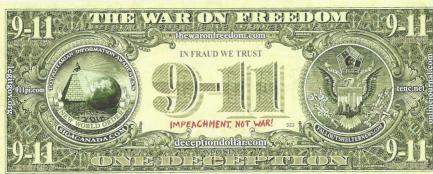
war dollar back

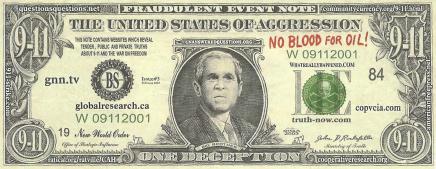
war dollar front

Thanks to Bryan for these. Clicking on the small images above will pop up very large images that may take a while to load.

Seven Lives

On any given day, about 6,600 people die in the USA. Mostly of disease, though about 270 of those deaths will be caused by accidents.

On a typical day in Texas, two or thee people fall to their deaths.

February first was not a typical day. Another seven people lost their lives that day.

Those 6,600 dead have friends and loved ones who mourn their passing. Communities that are diminished by their loss. So what’s so special about the seven? Admittedly they are the best and the brightest. Reading the resume of an astronaut always makes me wonder “how many lifetimes did this person have to accomplish all this?” But there’s obviously much more than that. Despite occasional sniping that manned space flight is risky, inefficient, showy, and that it doesn’t produce better science than unmanned missions, the fact remains that astronauts are invested with the highest of all our aspirations. When they fail, we feel it viscerally as a setback — not for NASA, not for some experiment, but for being something more than we are.

The next big thing to worry about

The New York Times Sunday Magazine carries an excellent article today on Hindu fanaticism in India. Read it now. It discusses, among other things, the violence against Muslims in Gujarat a little while back. Two thousand dead and 100,000 displaced: this is the kind of violence that led the U.S. to bomb Belgrade for Serb treatment of Kosovars.

Anil Dash, super-blogger and Indo-American, has been beating a drum of alarm on this subject for some time. And I’ve been aware that the BJP — the party in power in India — is Hindu-chauvanist ever since college. But I wasn’t aware of the systematic, organized quality of the problem until I read this article. And the scale of the problem is potentially so vast that the whole Israeli-Palestinian conflict — so prominent in American news and such a focal point of international affairs — will look like the Hatfields and McCoys by comparison.

After I read the article, Gwen pointed out that our friend Ish, an Indian Muslim, has family in Gujarat.

Scroll to Top