Mastodon & moderation

I’m on the board of a regional burn, Burning Flipside. We have to deal with banning people and it’s the hardest, most time-consuming thing we do. There are some analogies to Mastodon bans and defederations that might be useful.

One illuminating difference is that our ban list is private: we treat it as very secret. But there are frequent suggestions that we should share our ban list with other regionals and accept ban lists from other regionals. And in fact, there’s at least one regional that proactively shares its banning decisions.

There’s a certain logic to this, because the populations of regional burns overlap a lot. People from one regional often go to others, including bad actors, and sometimes when a bad actor gets “run out of town,” he (it’s usually a he) moves on to another. So I understand why people would want shared ban lists.

But being notified of another org’s banning decision puts us in an awkward place: it creates pressure on us to respond to it somehow. But our own policies require firsthand reports, which one of these outside-org reports would not be, unless a member of that board is a firsthand reporter. And we might come to a different conclusion than the other org, which could be difficult to explain.

Why do we keep our ban decisions secret? Partly it’s out of liability concerns. We don’t want to be accused of libeling/slandering someone. Also, our decisions don’t always make sense out of context: we once had to “ban” a toddler who was at the center of a custody fight between two parents. Sometimes knowing who has been banned would convey information about who made the report to us in the first place, which we would want to avoid at all costs. Every decision is made in a unique context, and it would be impossible to apply standardized actions consistently.

There’s a difference in the kinds of problems Flipside needs to deal with vs a social-media content moderator. The interactions being reported often happen in private, and even if not, they don’t generally leave an objective record on the Internet. This is tough for me to think through. Speech acts are acts, and the Internet is part of real life. But still, there’s a big difference between being threatened online and being threatened in person, never mind being physically assaulted. The Flipside organization does have a policy not to tolerate “any form of expression that serves to demean, intimidate, or ostracize,” and we have seen some problematic forms of expression in the past, but we haven’t received reports about them since that policy has been in effect. The problems we’re dealing with are more immediate. In any case, I’m not sure how the differences in problems should inform differences in the ways they’re handled. It deserves some thought.

On Flipside’s board, we like to say “we don’t have a lot of options for dealing with problematic participants, and most of them look like hammers.” The Mastodon software offers a number of moderation features, some of which are more subtle than a hammer. As far as I can tell, Mastodon instances don’t publish lists of users under moderation, but in some cases, those users themselves will use another forum to announce that they’re under some kind of moderation.

Then there’s defederation, a way of one instance’s mods saying to another’s “if you won’t moderate your users, we will.” Best as I can tell, defederation is public. Perhaps necessarily so. The instance my first account is on shows which servers it has filtered/silenced/suspended—which is equivalent to applying that moderation to everyone on that instance, remotely.

Right now, it seems like a lot of defederation—or at least chatter about defederation—is happening either because an instance’s moderators have been too hasty or too relaxed about applying moderation. If an instance really has devolved into a hive of scum and villainy, then that’s fair. It’s the healthy thing for the fediverse to do. If it’s a few bad actors on a large instance, it strikes me as procrustean.

This is another way in which the difference between regional burns and Mastodon instances is illuminating. It would be impossible and undesirable for one regional burn to ban everyone from another regional burn.

I’ve got some ideas.

  • Fediverse mods need to have a running group chat, so that mods for Instance A can say to the mods at Instance B “I’ve noticed a pattern of problematic posts staying up/unproblematic posts being removed,” and they can talk it out before anyone needs to make a defederation decision. Maybe this already exists.
  • It seems likely that Mastodon admins are going to subscribe to external services that make moderation decisions for them. Keeping the lights on is hard enough, dealing with moderation decisions as well is a whole ‘nother ballgame. If this happens, then knowing what moderation service a Mastodon instance subscribes to will tell you something about what kind of place it is.
  • Sharing ban lists of individuals between instances, as an alternative to external moderation services, might remove some pressure to defederate, although this might be opening up a bigger can of worms.

Identity is going to be an important aspect of this, because it is possible to change instances, or use multiple instances at the same time. Mastodon provides an easy method to verify your identity, although it requires a bit of nerdiness. This can solve the problem of a public figure who wants to be identifiable but is an asshole. It doesn’t solve the problem of a committed troll, who can easily spool up multiple identities with multiple verifications.

Note: I’ve referred to Mastodon throughout this, but the same idea applies to any service in the fediverse.
Page One

Gwen and I recently saw Page One, the documentary about the New York Times.

It was a sort of mile-high survey of the problems that most American newspapers are facing today. It was interesting watching it while the scandal surrounding Rupert Murdoch’s British tabloids is at its peak—Murdoch had nothing to do with the movie except extolling the iPad as the potential savior of the newspaper industry. The issues that the movie touched on—and there were so many that it didn’t really have much time to do more than touch on them—are all familiar to anyone paying attention to the news about newspapers—declining ad revenue, competition from online sources, the chummy, codependent relationship with power that leads to horrors like Judy Miller—but it was still very interesting seeing these discussed by the people directly affected by them.

Just as the movie hopscotched from issue to issue, it never quite developed a central thesis. But if a documentary can have a hero, this one definitely did in the person of David Carr. And if it can have one defining moment, this one’s came when he was on a panel talking about the future of journalism or something like that, clearly representing the old guard. At one point, Michael Wolff stands up and talks about how the world would manage without the New York Times. Then Carr gets up, shows a printout of the Newser.com (Michael Wolff’s project) front page; then shows the printout with all the stories sourced from old media ripped out, leaving nothing but a rough paper sieve.

There was talk about the role of the professional journalist vs citizen-journalists, of whether the civic function of newspapers actually makes business sense. There was a lot of talk about Twitter. Interestingly, not a lot about Facebook. The talk about blogs was mostly in the context of tabloid-grade professional blogs like Nick Denton’s properties—at one point, Denton is interviewed, and we see his “leaderboard”—the most popular current stories—on a big TV. None of the stories are news. They’re gossip.

For a brief moment, when blogs were new to most people, some people suggested that in the future everyone would have a blog and we’d get our news through legions of citizen-journalists, with some editorial control or artificial intelligence or something to make sure we as readers got the stuff that was of highest quality and greatest relevance to our interests. Technically, that’s possible. My friend Chip long ago set up the website Austin Bloggers, where anyone with a blog can post a link to their Austin-related postings. There’s definitely some good stuff there that’s too finely focused for traditional media.

But the idea that citizen journalists could replace professional journalists entirely was naive from the start, and since then, we’ve learned that most people, even if they are interested in sharing stuff online (and lots of people are), are not very interested in blogging per se.

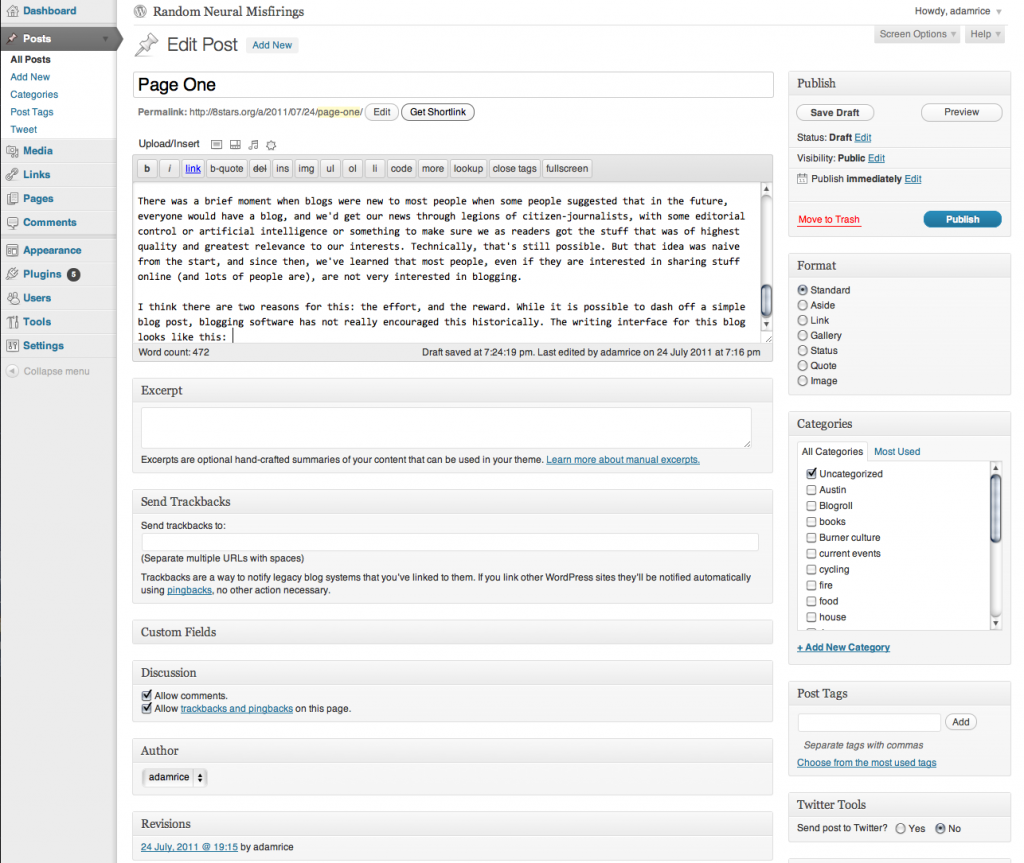
I think there are two reasons for this: the effort and the reward. While it is possible to dash off a simple blog post, blogging software has not really encouraged this. The writing interface for this blog looks like this:

Admittedly, there are blogging systems that are simpler than this, but this is the system I’m using, and it’s a mainstream one. Contrast that with the posting interface for Twitter:

Even once you’ve got a blog set up, there’s just a lot more cognitive load in getting a post up.

And then there’s the payoff. With Twitter or Facebook, your friends are probably going to see what you write and can easily comment on it; if you’re writing something personal, it’s relatively easy to make it so that only your friends see it. There’s more of a message-in-a-bottle quality to a blog post. Friends are less likely to comment (partly because even the commenting interface is more complicated, thanks in part to comment spam in blogs), and making a blog post visible only to friends involves considerably more administrative overhead for the writer and readers. Live Journal, as easy as it is to ridicule as the repository for bad poetry by teenagers, got this right by providing a blogging platform with social-networking features built in.

And unfortunately, while Facebook and Twitter have displaced what might have otherwise been a lot of blogging, they have not adequately replaced blogging. They’re fine for ephemeral, off-the-cuff communication—better than a blog, I’d say. A friend’s Twitter or Facebook postings are like a running stream that I can dip into when I feel like it, but they don’t work as a repository for sustained writing—one the writing side, because Twitter and Facebook are designed for off-the-cuff and short writing, and on the reading side, because it’s relatively difficult to backtrack and look at previous postings. As a medium for citizen journalism, this means that Twitter can be useful as a channel for minute-by-minute breaking news (Facebook less so, because posts are more often hidden from those you don’t know even if they are on Facebook, and Facebook in general is walled off from the rest of the Internet), but worthless for anything longer than that—especially with Facebook, where it seems almost impossible to dig up an old post. The same is true for discussions on posts, so while Facebook is great for getting people talking, it’s lousy for looking back at what people were talking about. For superficial gossip-grade conversations, this is fine. For more substantial discussions that one might want to look back on, it’s a problem.

Google Plus is too new to have been discussed in the movie. It allows for longer-form writing than Twitter or Facebook. The fact that Google is behind it suggests that maybe old posts would be searchable (though right now, they aren’t). And Google already owns a blogging platform, Blogger. I’ll be interested in seeing how they play out.

The comment gardener

With facebook and twitter and tumblr and flickr and blogs and instagram and forms of online communication I haven’t even heard of, people wind up cultivating their social networks like gardens. Or, perhaps more aptly, their Farmville plots.

This suggests a new sort of online game, where instead of tending a farm, you’re tending a virtual social network. Not your own—one that only exists in the context of the game. We can call it Friendville.

Theme updated

I’ve updated the theme for my blog, Harder Better Faster Stronger. If things look funny, please reload.

I do not have this update available for download just yet—I want to shake it down in my regular blog for a few days before making it publicly available.

There are only a few visible changes. I’m using Helvetica instead of Lucida Grande for the typeface. I’ve added gravatar support. I hope I’ve made things a little more consistent and harmonious.

A lot has changed under the hood. I’m now using Blueprint CSS (with customized metrics courtesy of this generator). Getting this to work right without hideous kludges required a fair amount of tinkering, and resulted in me learning a bit about WordPress’ inner working and a bit more PHP.

Please let me know if you run across any obvious design bugs.

Blog theme updated

I’ve finally finished the new theme for my blog. The name of the theme is “Harder Better Faster Stronger.” If you want to download it, here’s the official page for the theme.

I’ve been noodling around with themes in WordPress for a while, and it’s been a learning experience. Much of the inspiration for this came from Khoi Vinh’s Grids are Good presentation, though I don’t pretend this theme has anywhere near the level of polish found at Subtraction. There’s also a lot to like in Derek Powazek’s DePo Clean theme, though his is a little too austere for my purposes.

The name of the theme comes from the song by Daft Punk, a favorite of mine.

Wooly WordPress

I’ve been working on developing my own theme for WordPress, and the more I work on it, the more I learn how WordPress examplifies both the good and bad of open-source software projects.

The good is that a lot of people use it and develop for it. Problems seem to be patched quickly. There seems to be more innovation surrounding it than Movable Type.

The bad is that it feels as if there’s nobody in charge. This becomes acutely obvious once you start looking at the tag system. Even the tag nomenclature is not close to consistent, with some tags prefixed by “wp_”, some by “the_”, some by “get_”, some by “list_” and some with no prefix. There are some swiss-army-knife tags that can do many different things, with their output controlled by arguments, and there are some that are extremely specific, such as the tag that returns the blog author’s first name. Tag arguments are another area of inconsistency, with two completely different ways of expressing arguments, with some tags using one, some the other. There’s a lot of duplication of effort between tags, with one tag that returns a permalink formatted as a link and another that returns only the raw URL. And there’s inconsistency between the behaviors of tags, for example, the “wp_dropdown_categories” tag generates a dropdown menu of categories as a monolithic block of HTML; wp_get_archives, which generates date-based archives in a variety of formats can be used to produce a dropdown menu of monthly archive pages, but this is more atomic and makes it easier to tweak its output.

Perhaps some of these differences make sense to the programmers behind the project, but even so, they do not make sense to someone trying to write a template. I suspect some of the inconsistencies result from either lack of standards in the project, or lack of attention to standards if they exist. WordPress really should have someone stand up, acknowledge the mess, and lay down the law. I suspect if I delved deeper into the code, I’d discover more evidence of inconsistency.

Sneak Preview

Yes, I know the current hash of a theme is ugly. I’m working on a completely different theme. Here’s a [sneak preview](http://8stars.org/misc/concon) of what the front page will look like (just an inactive wireframe, still needs work).

pardon the mess

Upgrading WP to version 2.1.2. I’d made some hacks to the core code in the old version I was running in order to get my theme to work. I’ve got to use an orthodox theme until I get all that stuff working right again.

Scroll to Top