Central Texas Showdown 2025

Central Texas Showdown 2025

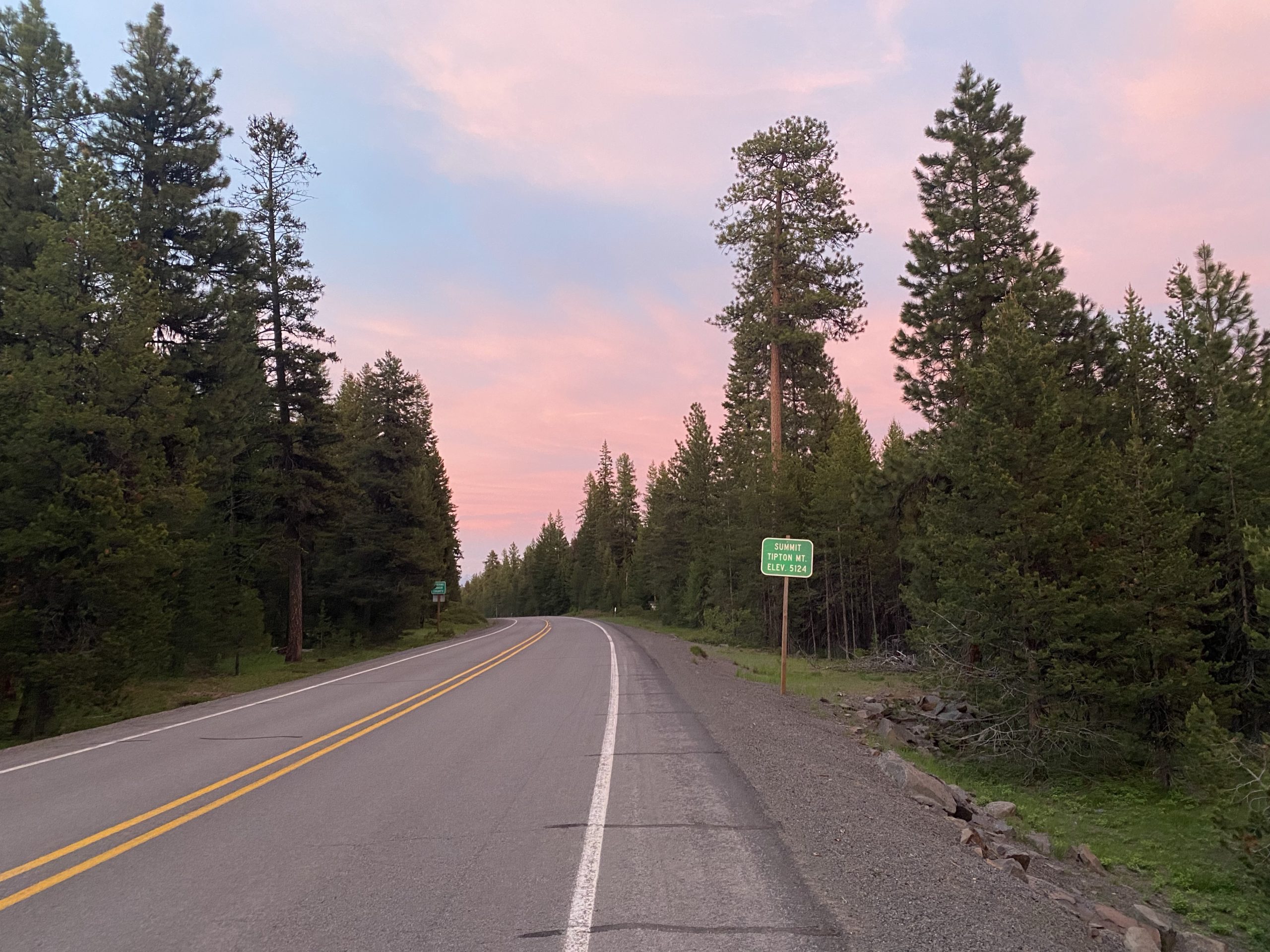
I had been looking for an ultracycling event that wouldn’t involve a lot of travel, and this popped up. It was billed as 25% gravel, which wasn’t what I’d prefer, but I figured I could make it work. So I signed up. My training leading up to it I felt was OK. Could be better, but I didn’t feel underprepared. I had put 35-mm tires on my bike—1 mm larger than the frame is supposed to accept—so that was as much as I could do to make it gravel-ready. I played around with a couple of bag configurations. I was packing pretty lightly, but wound up using my Tailfin rackbag, which was overkill for the load I put in it. Plus a toptube bag for snacks, and a small frame bag for tools and gadgets.

The start/end point is the town of Castell, population 13, midway between Llano and Mason. I had ridden some of the roads around there in the distant past.

Come race day, most of us arrived in Castell the night before. I missed the pre-race meeting, but I don’t think I missed anything important. Eventually I found out where everyone was camping (it wasn’t immediately obvious), and I laid out my air mattress under the stars. It was a clear night and being way out in the country, I could see all of them. I didn’t sleep well due to jitters, something other people mentioned too. In hindsight, I could have rented a hotel room about 20 miles away and slept (or not) in a more comfortable bed.
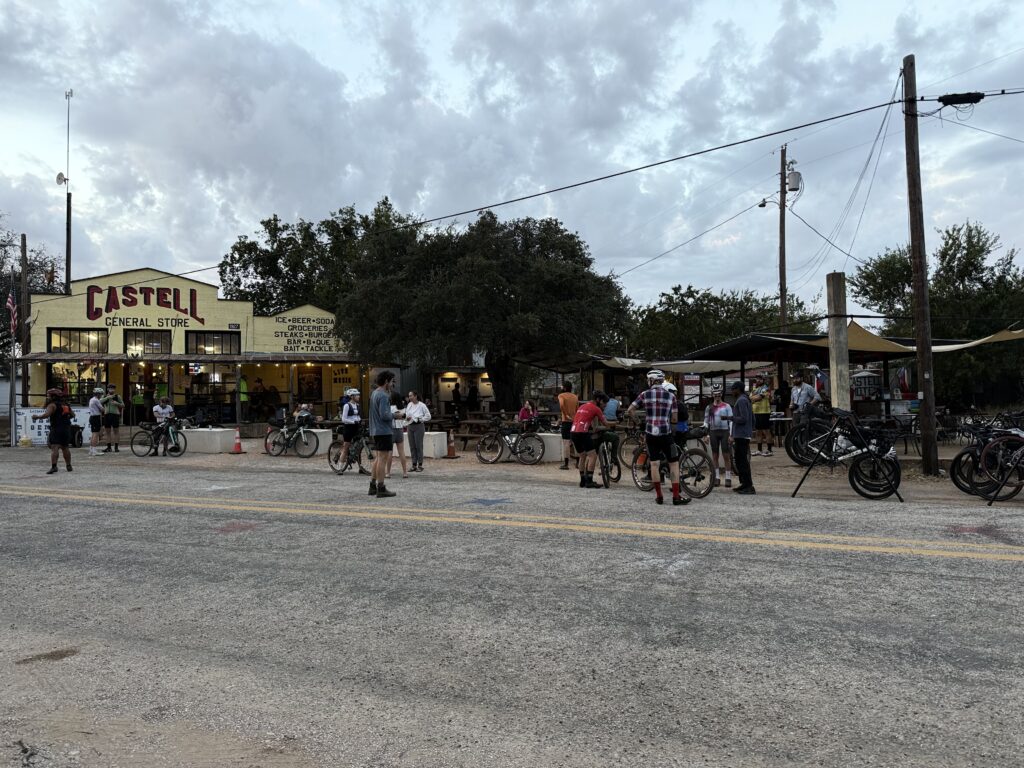
There were four events being run simultaneously: the 500-mile race (mine), a 300-miler, a 173-miler, and an 88-miler. At the start, they had us line up in that order. Only 16 of us in the 500-miler, I think (and only one woman). There was a two-mile neutralized start rollout. After that, at the head of the front pack, there were three people setting a strong pace—no one wanted to get ahead of them, but no one wanted to fall off the back of the train, either. Events like this are supposed to be no drafting, but I decided to enjoy the ride while it lasted. I knew if would break apart before long, and at the first gravel sector, about 20 miles in, it did. This and the next gravel sector both had sand traps that forced everyone off their bikes. At one point I tried walking in the grass along the edge, but that was filled with sticker burrs, which got all over my socks. I carry a tiny plier-type multitool, and it came in handy for removing them.

Even though the pack had broken up, inevitably there are people who ride at about the same speed, so you keep seeing some of the same faces on the route.

There were no resupply points on the route for the first 110 miles, so the organizers let us send bags ahead to a drop site around mile 60, and I took advantage of this. Everyone treated it like a lunch break, and I got to chat with a few of the other riders.
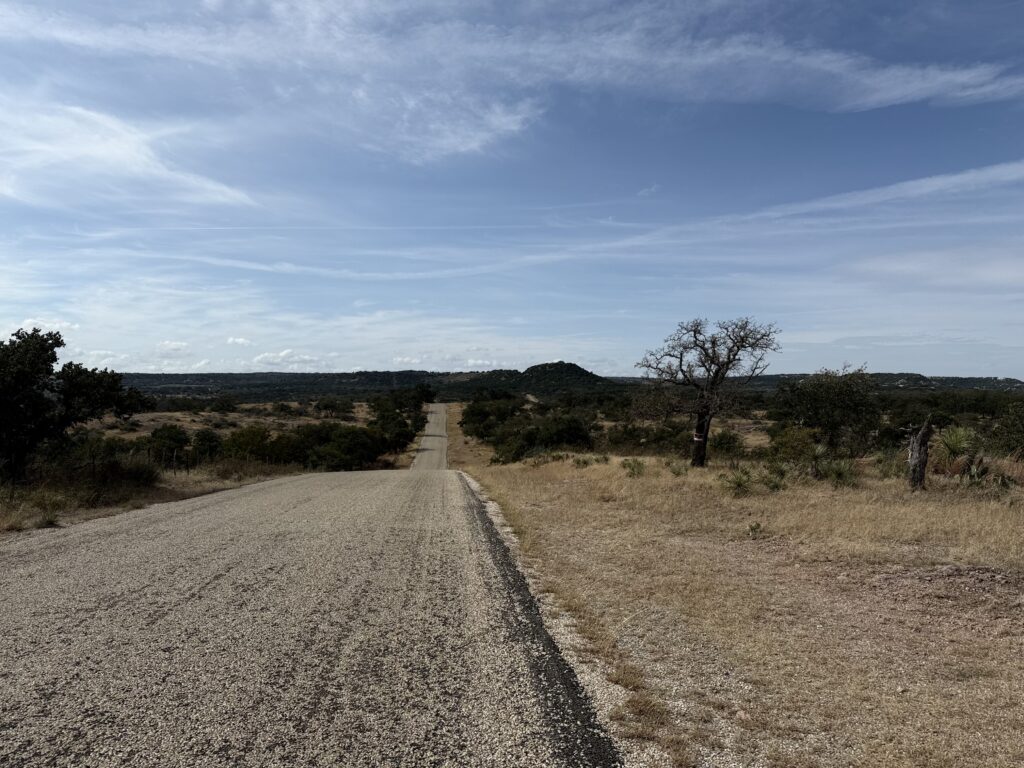
The road

I had been maintaining a pace I was happy with to this point, but starting to get leg cramps. It wasn’t terribly hot, my hydration was OK, I took a salt cap just in case. Didn’t help. In hindsight, I think it might be because of the climbing. The route is covered with short, steep hills that keep coming at you, and I think it was getting to me. Some other riders were complaining about leg cramps too. I read something recently about how different bike positions favor your quads vs your glutes, and I must be in a quad-oriented position, because my quads were killing me, but my glutes seem to have been underused.

Just before reaching Luckenbach at mile 110, I could feel a bad cramp coming on—I saw a slight rise up ahead and thought “if you try to pedal up that, you’ll cramp hard.” So I stopped, and the moment I got both feet on the ground, both legs locked up so hard I couldn’t bend my knees at all. I’ve never had leg cramps like that. I couldn’t even get off the bike. Eventually I did manage to get off the bike and just sat in the grass by the road for a while. Got back on and rode the very short distance to Luckenbach, where a few other riders were already taking a break. So I did too. We talked about the weather, because a big storm was supposed to blow in that night, and people were strategizing where they’d post up. I had checked the weather forecast beforehand and had booked a cabin at the 210-mile point, so I was motivated to get there. I moved my rain jacket out of my saddlebag and into my jersey pocket so I’d be able to get at it at a moment’s notice.

I’d never been to Luckenbach before, and I didn’t realize that it’s nothing but a tourist trap. There’s a bar, a stage, a couple of souvenir shops, and a burger stand. That’s it. No one lives there.
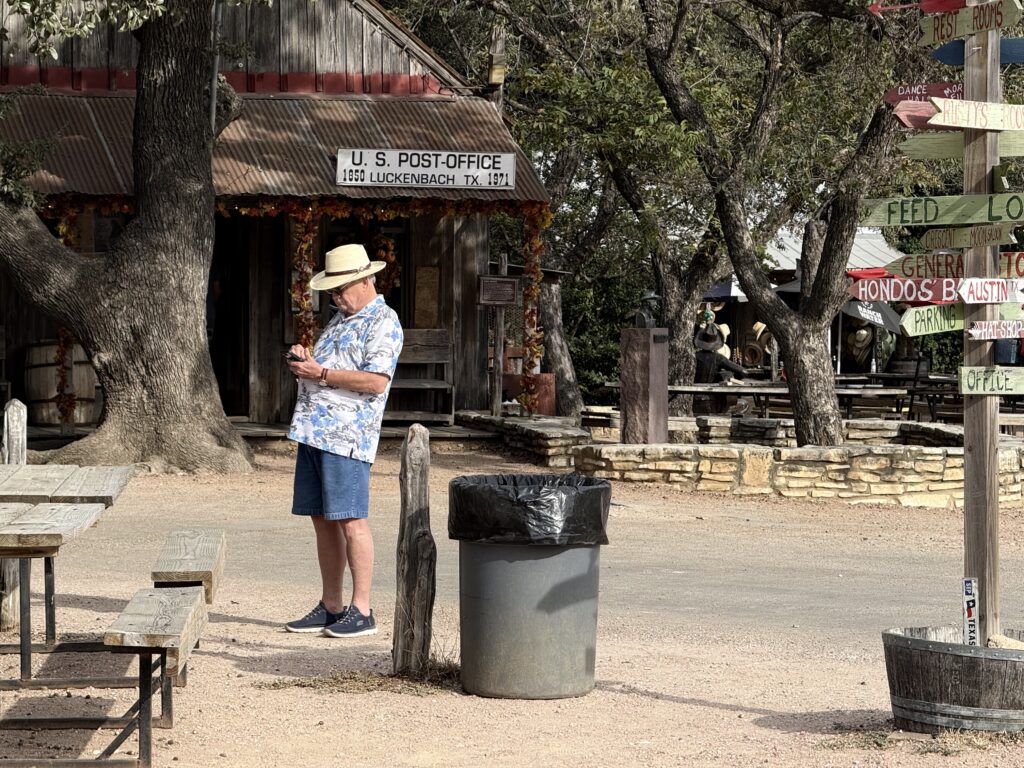
I feel like this photo sums up Luckenbach: an old guy in his standard-issue tourist uniform standing in front of the purely decorative post office

I rode on to Comfort, where I stopped and had some real food. When I rolled out from Comfort, it was getting dark, the weather had cooled off a bit, and I was feeling stronger. My leg cramps stopped. But my poor sleep the night before was catching up with me.

Comfort is where the route for the 300-mile event diverged from the 500-mile event, so suddenly I had a lot less company on the road. Riding these utterly desolate roads in the dark was messing with my brain a little bit, so I put on some music. I hadn’t been listening to music to preserve the battery life in my headset, but at this point it felt like a worthwhile tradeoff.

At mile 170, I hit another gravel sector. Riding gravel in the dark, on a road bike, without experience riding gravel, is not a recipe for success, but I took it easy and stayed upright. I could see a massive lightning storm off to the north.

Around mile 180, the wind whipped up and the temperature dropped 20°F in a heartbeat. On went the rain jacket. A minute later the rain was coming down in sheets. A few miles later, I was on gravel again. Riding gravel in the dark, in heavy rain, on a road bike, without experience riding gravel, is also not a recipe for success, but I took it slow and stayed upright.

The rain jacket did a good job of keeping me dry, but it did nothing to keep me warm. And although it was not objectively very cold, I was freezing: when I’m exhausted, my body can’t regulate its temperature. As soon as I was back on a sealed road, I pushed it as hard as I could (which was not very hard at that point) just to generate some body heat. I had a warm jersey in my saddlebag, but it didn’t make any sense to open that bag up until I was under cover. The town of Utopia was about 15 miles away, and I’d find a gas station or some kind of awning there. I just had to make it there.

The lightning storm was now directly on top of me, with lightnight strikes less than a mile away. I felt exposed.

Made it to Utopia, found a business with a covered front porch, and spent a few minutes assessing and questioning my life choices. During this time, the rain abated somewhat, and I got rolling again. Another 14 miles to the cabin where I’d spend the night. I got there at about 2:00 AM. Although I didn’t check the tracker, apparently I was in 3rd place at this point.

The cabin was rudimentary. I had arranged with the owner ahead of time for my late arrival—he had put the room key in a drop box, along with a laminated printout of house rules in ransom-note style that basically told me not to have any fun whatsoever. I had to pay extra to have sheets. Perhaps if I had paid a little more than that, they would have supplied shampoo, and soap that didn’t leave a waxy coating on everything it touched. They advertised that they had wifi, but it only worked—momentarily—if I was standing in exactly the right spot. My cellular signal, weak as it was, was actually better.

I washed my kit, washed my socks, showered, took care of some minor upkeep, and fell asleep hard. I was awake at 6:05 even without an alarm. I would have preferred to sleep later. I packed up and got rolling quickly.

I was riding much, much slower now. Yesterday had obviously take a lot out of me, especially that final “sprint” through the rain. My goal had been to finish in 60 hours, and there was no way that would be possible at this point. I was feeling discouraged.

I had a breakfast of snacks from my toptube bag and discovered that it wasn’t quite waterproof. I really wanted a hot meal, and looking at the map, I wouldn’t find one for another 70 miles or so. Which added to my discouragement.

The rain had stopped, but there was still a lot of water on the roads, and wet roads lead to punctures: road debris adheres better to wet tires, and has more of a chance to penetrate. And this is exactly what happened, over and over again. I have tubeless tire with latex sealant in them, so minor punctures seal up in a few seconds, but I was getting a puncture every few miles, and I think at some point, I just ran out of sealant, because I had one that wouldn’t seal. It is quite likely I should have had more sealant in there to start with, but it was too late to do anything about that.

This happened on RR 337, a notoriously twisty,turny, and hilly road popular with driving enthusiasts, and I had to walk for a while before I got to a spot wide enough for me to set my bike down and work on it. I was carrying a couple of emergency innertubes, and got one mounted quickly. But I realized that if I was going to keep puncturing—and there was no reason to think that I wouldn’t—my race was over. To be honest, given the mood I was in at that point, I felt completely fine about scratching.

The organizer had some volunteers driving rescue vehicles, so I could call for help, but I’d need to ride somewhere with cellular service before I could do that. There was a crossroads with a store about five miles ahead, and I reasoned that it might have a signal and food, so I made that my destination. It did have a signal, it didn’t have much in the way of food I’d want to eat (it had plenty of cheap beer). I managed to get a message through to the organizer, and one of the rescue volunteers, texted me that he’d pick me up.

One thing about this event that I didn’t fully appreciate beforehand was just how remote it was. I’ve ridden on a lot of remote roads in Texas before, but this sustained disconnection from the rest of the world was different. Riding for an hour and maybe seeing one other person. Cellular coverage being the rare exception, not the norm. Resupply points being so infrequent.

Photos of the event by a real photographer here.
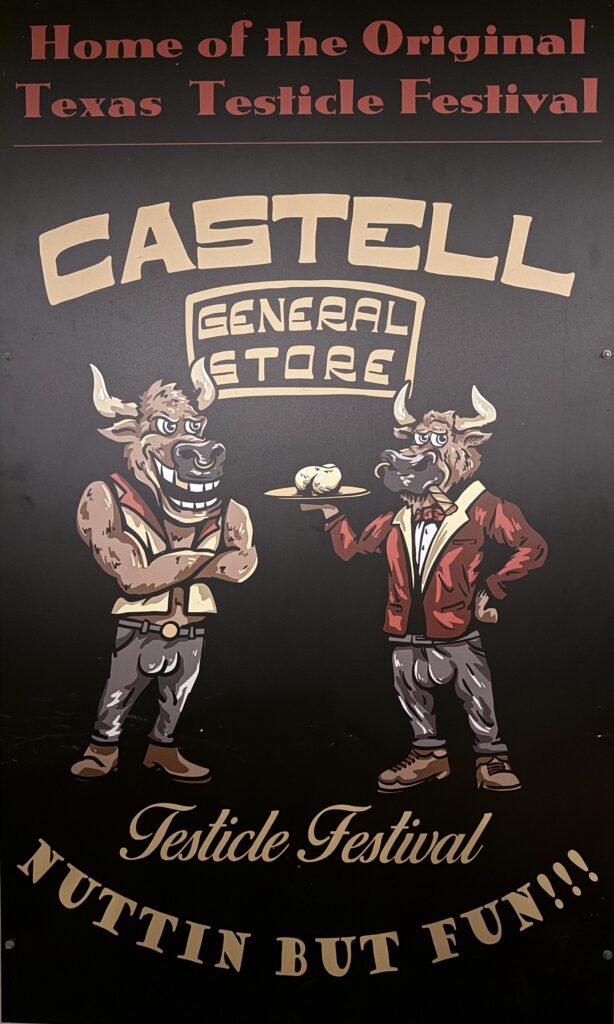
I guess they’re hard up for entertainment in Castell

Old Dime Box Revisited 600K

Randonneuring is a cycling discipline—is sport the right word?—that’s somewhere between racing and touring. You complete a planned route before a certain cutoff time, but finishing order doesn’t matter. Rando events have a few standardized distances: 200K, 300K, 400K, 600K, and 1000K. There are longer events as well, including the big show for randonneuring, Paris-Brest-Paris at 1200K. Each of these has a standard cutoff time; for a 600K, it’s 40 hours, and that includes whatever sleep and other off-bike activities you need to squeeze in.

Our local chapter posts a series of events every year, and I was interested in completing a 600K, so I signed up. It turns out I was the only person who signed up.

I’ve ridden nearly the same distance over a two-day period in my failed attempt at the TABR in 2023, although the circumstances were different then—I was in better shape, but I was carrying a lot of cargo. There was much more climbing, but Day 1 also had a massive tailwind. So it’s hard to compare the efforts.

I went into this knowing that I was pretty under-trained for this attempt, and would be getting through it on the basis of good pacing and orneriness.

Day 1

Day 1 was a 357-km (222-mile) loop heading northwest > northeast > southeast > southwest. I had probably been on half the roads at some point before. In general, the area west of Austin is hilly and dry; to the east it’s flat and wetter, with a lot of farmland. I generally prefer the former to the latter both in terms of aesthetics and riding quality. Hills are interesting and have knowable end-points. But in the flat farmland to the east, there is nothing to slow down the wind, which just grinds you down. Very few trees for shade.

Around Krause Springs, I noticed that the Hill Country Ride for AIDS was underway, and passed some of the participants. Gwen and I did that ride back in 2005. I noticed this time around a lot of the riders were on ebikes. This is a good place for it, because it is one of the prettiest places in Texas, especially when the wildflowers are in bloom.

I stopped for a sandwich in Marble Falls, about a quarter of the way through. This was the last real food I’d have until I got home. Mostly I was fueling myself with fruit-based energy blocks and the occasional Snickers bar. Appropriate fueling is a problem for me because in a Zone-1/2 ride like this, I can go for a really long way without bonking—I’ve finished 200Ks on no more than a few energy bars. But certainly this ride would put me deep in the red, and bonking would be really ugly.

I had been feeling a little off up to this point—nothing specific I can point to. I was nervous about this ride, and perhaps I was burning off that anxiety. After Marble Falls, I got into the zone better—and zoned out. I turn inward on rides like this, just focusing on what I’m doing, not so much on my surroundings, except for traffic.

Burnet had what seemed like it had once been a grand downtown, but was almost completely vacant now.

Florence was weird—there was a sharp rich/poor divide, only made more apparent by the fact that there’s basically one downtown street where the two sides are forced together. Some guy who was very impressed with his car (and its modified exhaust system) was making passes up and down the main drag rattling the windows.

When I reached Milam County, I was still about 60 miles from home, but I felt like I was on home turf—I know the roads, and I know the area. I had been riding conservatively to that point—and had mostly been riding into headwinds—and at this point, I knew I could turn up the heat a little bit. My knees were bothering me a little bit. Not the kind of trouble you get from bad positioning, just the cumulative effect of a lot of miles. I’d had some brief and minor episodes of hotfoot, but nothing bad (and never in the same place twice). At this point, my ass was really starting to bother me.

I rode the last 30 or so miles in the dark. And for the last 15 or so, my speed dropped off. This was not so much because I was tired (though obviously yes I was). I was losing the mental discipline to keep my speed up; I was on increasingly urban roads with more twists and turns. And I was keeping in mind the advice “don’t ride faster than your guardian angel can fly” (that is, don’t outrun your headlights).

I got home at about 11 PM, showered (I smelled like something a vulture would refuse to eat), ate, plugged in stuff that needed recharging, put some drip-wax on my chain, and crashed.

My ass was hamburger meat and my knees were kind of bothering me.

I slept amazingly well, and woke up before the alarm I had set.

I was a little dilatory getting out the door to begin Day 2, and probably could have saved half an hour there. I had about 8.5 hours of downtime from the time I got home until I left. A lot of people riding a 600K would opt for less sleep than I did.

My ass was still on fire, and my knees were still not great. I knew Day 2 would be a slog.

Day 2

Day 2 was an out-and-back route to the east, so, flat farmlands with no shelter from the wind. And like Day 1, it was all headwind for the first half. I knew that my performance would drop on the second day, but I wasn’t sure how much. It turns out the answer was “a lot.” I use the Ride with GPS app to read my cues and record my ride, and it reads out my stats at 15-minute intervals. Under normal conditions, I’d want to keep my heart rate between 120 and 130. On Day 2, my heart rate for a 15-minute interval didn’t go above 110 until the last hour of the ride. I couldn’t push it harder.

Similarly to the day before, I stopped at around the 60-mile mark for a sandwich, and again, that was the last real food I had until I got home. If fueling is a problem for me, hydrating is probably a bigger problem. I keep reminding myself to drink more, and I keep not drinking as much as I should. I’m sure I started Day 2 dehydrated, and I was really beginning to feel it. I know that when we eat, our digestive tract takes water from our bodies to process the food, and I kept asking myself “am I drinking enough to get any benefit from the food I’m eating?” The answer was probably “No.”

At the start I was taking it easy on my knees, but at around the halfway point, they started to feel a little better. My ass did not start feeling better, but I eventually kind of came to terms with it. I spent as much time as possible on the aerobars because that took some weight off my butt, and rotated my position so a less-sensitive part of my butt was on the saddle. What I realized when I was getting toward the finish of Day 2 was that I had been using my aerobar grips and armrests to slightly cantilever my butt out of the saddle, and the pressure on my forearm was tweaking those muscles and my pinkies and ring fingers, probably due to pressure on the ulnar nerves. Also, with just a few miles to go, I developed intense hotfoot on the balls of both feet, probably again from trying to keep weight off the saddle.

I finished with exactly 90 minutes remaining before the cutoff time.

Day 2 was not fun. I did not much like the area I was riding through, and my pain made it difficult to enjoy the ride regardless.

The bike I was riding is set up for comfort. It’s got a position I can hold all day. It’s got a suspension seatpost and stem (I can barely imagine what condition I’d be in if I’d been riding on a rigid seatpost). My tires could be fatter, but they were at a low enough pressure to absorb some bumps. And I’ve ridden similar distances before without being so badly pulverized. So I’m not sure why I feel so beat up now. I think there are two factors:

  1. My previous long-distance efforts were on better roads.
  2. I haven’t been doing a lot of long-distance riding lately to toughen myself up.

Like I said before, I got through this on orneriness. I wanted to prove to myself that I could do it. If I do it again, I’ll go into it with better preparation.

Ride report: Ontario, OR

I got off to a reasonably early start after sleeping like the dead. The weather was cloudy and cool, which was a nice change from the day before.

The first part of the day was riding along a dam reservoir on the Snake River. That was flat at least. Kind to my knees and easy for me to manage with my reduced power, although just the climb out of the river valley, starting at the Idaho border, was a challenge. This was followed immediately by a more serious climb that was just a slog. At the summit, traffic was stopped. There was a vehicle fire about a quarter of a mile down the road. I chatted with a couple of old-timers while we waited for emergency services to make the scene safe, which took the better part of an hour. No one was hurt, as far as I know.

Descended into the small town of Cambridge, ID. Rode around it a little to see what my dining options were–weirdly, the only restaurant on the map was a Chinese restaurant, but I found a coffee-and-sandwich place and stopped there to eat and assess.

Looking at my planning spreadsheet, I would be hitting one of the toughest climbs of the race, Lolo Pass, in a day or two. I didn’t think my knees could take it, and even if my knees weren’t a problem, my power output was so diminished I was worried about getting up it. I was already using my lowest gear on climbs that were hard but not that hard. I didn’t know how I’d get up Lolo Pass. Cambridge also looked like my best bailout option for a very long time, since I was pretty close to Boise.

I talked to Gwen about it for a while, but in the back of my mind, I knew it was over. One piece of advice I read for prospective racers was that you need to be really clear with yourself about why you’re doing this, because you will need that focus to sustain you through some very hard parts. I think that’s true, and I think my own reasons were nebulous. I’ll add to that: you need to really believe that what you’ll get out of it is worth what you put into it. Because you will put a lot into it. The juice needs to be worth the squeeze, and I realized right then that for me, it wasn’t. So I didn’t get what I wanted out of the race, but I did get something: knowledge of self.

Janie Hayes, who finished the TABR twice with fast times, wrote about scratching in the Tour Divide. I read that when I was preparing for TABR 2021, and was a bit mystified by it at the time, but it makes more sense to me now.

When I reentered cellular coverage in Cambridge, I also learned that a racer I had spent a fair amount of time around had since been diagnosed with Covid. I had no obvious symptoms, but it was concerning. I wondered if I had a mild case that was just bad enough to blunt my performance.

I did some checking and found a town with an Enterprise rent-a-car agency in Ontario, OR, roughly halfway to Boise, and without further ado, decided to ride there, rent a car from them, and road-trip home. Fortunately, that leg of the ride was mostly downhill–I was going fast enough to fool myself into thinking I was riding strongly, all of a sudden, and regretted my decision to scratch, but as soon as I hit even a bit of a climb, my regret went away. I incidentally saw the truck that had caught fire on the summit before Cambridge, being hauled on a flatbed. I stopped in the town of Weiser to get a snack and e-mail Nathan, the race director, word that I was scratching.

My first stop in Ontario was at a drugstore to get a home Covid test. I rented a hotel room and took the test: negative–I have to admit it would be nice to be able to blame scratching on it.

Next, arranging a car rental. Turned out not to be as simple as I thought. Enterprise seems to be the only car-rental agency with locations away from airports, but what I was quickly learning is that only the airport locations (for any rental agency) offer one-way rentals, which I needed. What I also learned is that even many of those airport locations would not offer a one-way rental, but Avis would. I booked the reservation online. I resolved to get an early start the next day, ride to Boise’s airport, and pick up a car. I had a plan. I was looking forward to taking a little road trip at this point, and made arrangements to see a couple friends along the way.

While this is going on, dot-watchers on the TABR facebook group have noticed I’m off course. From my hotel room, I checked in on the group and let them know I had scratched. Cody, a dot-watcher in Boise, offered to help me out, and we arranged for him to meet me partway between Ontario and Boise–I really didn’t relish riding my bike into the airport, which are generally not bike-friendly places.

So the next day I start riding toward his house and he texts me the location of an intercept point where we meet. He also took me to buy street clothes, let me shower, and then delivered me and my stuff to the airport. A real mensch.

At the Avis desk, I learned that I could not rent a car on a one-way rental from them without a physical credit card in hand that they could swipe. I was not carrying a credit card. I had the info for a credit card saved on my phone, and I had a debit card, but that wasn’t good enough. There was nothing I could say that would change their mind. They told me that all the other rental agencies had the same policy.

Time for a new plan. I need to fly home.

I get in touch with Cody again and we strategize. I book a flight departing that evening. He meets me at the airport, takes me and my bike to a bike shop (Bauer Haus, a real candy-store of a bike shop) that will pack and ship it. I took Cody and his daughter to lunch (meager compensation for their trouble), then they delivered me back to the airport. I had a connection in Denver and walked in my front door at 1:30 AM.

Ride report: Halfway, OR

The big push into Baker City took a lot out of me.

I was staying at the Churchill School bike hostel, and rolled out late because I did laundry there. I stopped in town for breakfast and discovered how weird my appetite has gotten. I was beyond hungry. I was at a nice restaurant having food I liked. And I still had to force myself to finish it. I don’t understand.

I planned on making the day’s ride shorter, but between the late departure and my low speed, it wound up being really short. It’s known that your peak heart rate and power go down when you’re exhausted. Two days ago, I couldn’t get my HR over 120 bpm. In the ride into Halfway, I could barely get it over 100.

Much of the day’s riding was through Hell’s Canyon, and the name is apt. It was hot and humid, and no trees, no shade. Nowhere to stop and take a break until the town of Richland, about 40 miles in, and the only shade there was the awning in front of the grocery store.

When I got to Halfway, I had an early dinner and went to bed. I slept long and hard, and I’m hoping I’ve pushed a reset button.

I will admit that I am feeling discouraged about this undertaking. Part of the reason I wanted to do this was to find out how I would be changed by the experience at the end. But I also have to admit that I romanticized the suffering. I am at the point where the suffering has lost whatever romance it may have had, and I am asking myself whether what I will get out of this will be worth what I put in. I didn’t enjoy being on the bike yesterday–it was just a slog.

My goal for today is to see if I can at least enjoy being on the bike, and forget my mileage targets.

Ride report: Baker City, OR

I am writing this post the day after the ride–technically, my ride ended after midnight, so arguably it is the same day.

I reached Mitchell–home of the Spoke’n Hostel–pretty early and had their spaghetti for breakfast, although the 30-mile climb out of Prineville meant I wasn’t too early. Mitchell is in a valley, so after that long climb, you give up all that altitude, and then climb it again to get out. By the time I left, the day has heated up.

Most of the rest of the day is a blur. The three big climbs after Mitchell were all late in the ride, well after the halfway point. By the time I finished the second of them, it was chilly enough that I needed my jacket for the descent. After the third, it was cold enough that I needed to add more warm clothes, and my sweat-soaked jersey was chilling me, so I needed to take that off. Finding a place I could even lean my bike took a while, and then I was working in complete darkness. I was exhausted enough that I knew to be concerned about dumb mistakes, and tried to be very methodical. Even so, I rode off without my bone-conduction headset on, but it was hooked around my handlebars, so no loss there.

One minute after I passed the Baker City City limit sign, the sky opened up. I was only in the rain for about 10 minutes but got soaked.

I had set the goal of reaching Baker City because there’s a bike hostel there. I knew it would be a big push.

It was too long. 195 miles with 5 major climbs. My appetite has been hit-or-miss, and my last solid food of the day wasn’t sufficient.

Ride report: Prineville, OR

Slept well and woke up at 5:30. Got rolling about 45 minutes later. Not great efficiency. Rode to Lewisburg and stopped at a greasy spoon for breakfast.

At some point while riding along the McKenzie River, I pulled over to strip off my warm clothes, and was passed by another racer, Richard. We rode together for a bit and stopped at a convenience store shortly before the turnoff for McKenzie Pass, the day’s main event. As we pulled in, another racer was pulling out and yelled his recommendation for the chicken tenders.

I rolled out a little before Richard and reached the turnoff. A couple of guys from Portland were getting their bikes ready; we chatted for a bit about whether the road was really closed due to a recent rockslide that needed to be cleaned up. We all agreed it was worth chancing it. I rode in ahead, knowing they’d pass me quickly.

The pass is at an altitude of about 5200 feet; the base is at about 1000 feet. As you ascend, you pass altitude markers every 1000 feet. At about 3500 feet, I had to take a break–I was whipped, my back hurts, and I ran across a rail I could use as a bench and prop for my bike. Before reaching 4000 feet, I came upon the Portland guys. I assumed they had already reached the top and were coming down. Nope. They were taking their time, I guess. There were a lot of cyclists on the climb–it’s a well known destination, especially right now when it is closed to motor traffic. There are gates at the east and west sides partway up that cyclists and peds can bypass.

I ran across a couple more racers, Mike and another guy whose name I didn’t catch. Mike and I rode together for a bit; I learned he’d read my blog entries about the 2021 race.

The top of the mountain is like Mount Doom–no life, just broken lava rock everywhere.

On the way down, I chatted with a rider going the other way, and later, at the eastern gate, there was another rider coming the other way. We chatted for a bit too. Something seemed familiar about him, and after he asked my name, I told him and said “and you’re Evan Deutsch, aren’t you?” He was. He’s won the TABR and has some very high placements when he didn’t. Nice guy, very down-to-earth.

I made it to the next town of Sisters, a very cute town blessed with two bike shops, which is pretty rare. Only one was open, so I went there. Blazin Saddles. My shifting has been off, and I hadn’t been able to fix it myself, so I suspected the derailleur hanger was out of alignment. It was. They dropped everything and got me fixed right up. Another racer was in there buying spares.

As long as I was making a stop in Sisters, I decided to eat. I found a food truck serving Mexican food and ordered a taco plate. Weirdly enough, I had to force myself to eat it–i just don’t have much of an appetite. This is a problem. There’s only so far I can go on stored fat.

My original goal for today has been Mitchell OR. What I realized was that I’d be arriving after nightfall, and the descent into town is scary enough in the daylight. I wound up stopping 40 miles short, in Prineville.

Ride report: Springfield, OR

A big day on the bike. We had a strong tailwind almost all day, and it’s clear many of the racers are making hay while the sun shines. The guys at the pointy end are all around 300 miles for the day, and probably not stopping.

A lot of climbing too, including a couple of very long, steep grades. I saw one racers going up the first of these on foot. Somehow, much later, I saw he had beat me to a road–but was on the wrong side of it. There was another racers I kept swapping positions with. I rode faster than him, but stopped more often.

My goal has been to average 180 miles/day, and it’s nice to start off with some extra miles in the bank.

I stopped in Tillamook for an early lunch at the Safeway, where I encountered my first dot-watcher, had a few snacks along the way, and stopped in Corvallis for dinner at a semi-fancy pasta place called Pastini. It was nice pretending to be civilized. I pushed on another 40 or so miles to Coburg, and am actually a little off course at a Motel 6 in Eugene. The place reeks of despair.

I’m going to sleep until I’m done sleeping.

Packed and ready

Take to the Sky, ready to go

Apart from a handful of small items I’ll need between now and tomorrow morning, my bike is ready for the Trans Am Bike Race.

My self, that’s another matter.

TABR gear list

Here’s my packing list for the Trans Am Bike Race 2023.

Tools, gadgets, and spares

Left to right, top to bottom (more or less)

  • Short length of gorilla tape
  • Zip tipes
  • Paracord
  • Derailleur cable
  • Fiberfix spoke
  • Disc brake pads
  • Extra length of chain
  • Chain tool
  • Extra spokes
  • Extra master links
  • Sugru
  • Thread locker
  • Extra SPD cleat
  • Random small screws
  • Derailleur hanger
  • CR2032 battery (for heart-rate monitor)
  • Spare dynaplug plugs
  • 2 innertubes
  • Tire boots
  • Pump
  • Tyre key
  • Shokz headset
  • Multi-head USB cable
  • Wolf Tooth 8-bit tool
  • USB converter for dynamo
  • Gerber Dime multitool
  • Dynaplug
  • Power bank
  • Wall charger
  • Patch kit
  • Extra valve cores
  • Taillights: Lezyne Strip × 2 plus Cygolite Hypershot 350
  • Secondary headlight: Magicshine ZX Pro (main headlight is on bikes).

This stuff will be stored in my Camelbak pocket, top-tube bag, and Tailfin bag, based on how likely I am to need it. It all packs down pretty small, and I will depackage the stuff that needs it. I’ll probably cut that paracord shorter. Everything in this picture weighs 1325 g.

My wheels are set up tubeless, but I do need to be able to fall back to tubes if necessary. I am debating bringing a spare tire.

Not shown:

  • Chain lube: I will be bringing 2 oz of Silca liquid wax lube.
  • Garmin InReach Messenger satellite tracker

Clothing

  • Smartwool undershirt
  • Spatzwear undershirt
  • Gore leg warmers
  • Running shorts (in case I can wash all my stuff and need to stay decent)
  • Galibier jacket (doesn’t seem to be currently listed on their website)
  • Stolen goat jerseys × 2
  • Castelli shorts × 2
  • Galibier shoe covers
  • Gore Wear cool-weather cloves
  • Specialized cold-weather gloves
  • Reflectoes socks × 2
  • Specialized Grail gloves
  • Beanie

All this weighs 2103 g. Some of it will be on my body at any given time.

Not shown:

  • Lake cycling shoes
  • Wool cold-weather socks

Personal care

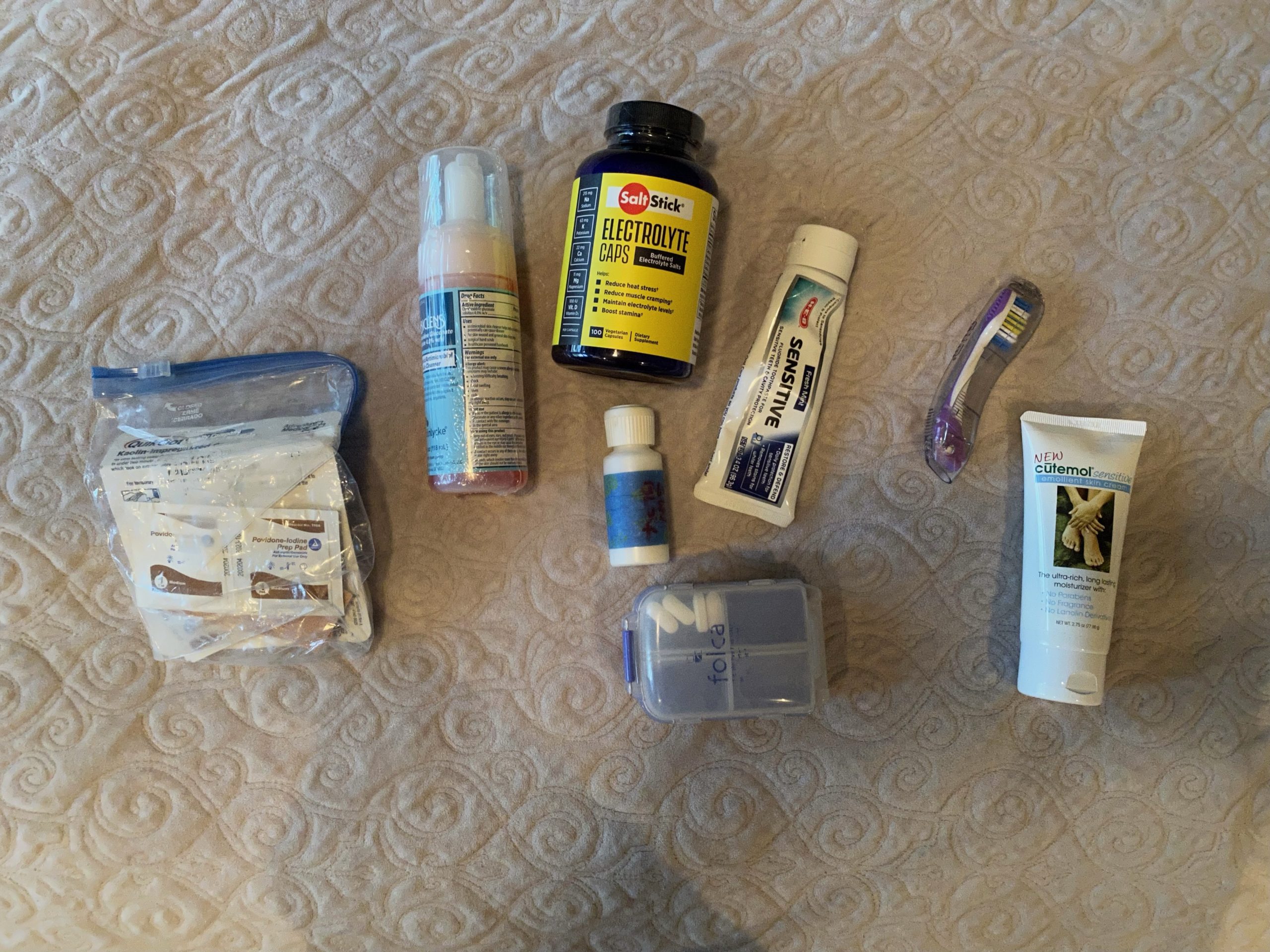
  • Minimal first-aid kit
  • Hibiclens
  • Electrolyte caps
  • Toothpaste
  • Toothbrush
  • Cutemol
  • Pill case for prescriptions
  • Sunblock

I had trouble with saddle sores in 2021, and am packing the Hibiclens and Cutemol in the hopes of preventing that. All this weighs 690 g.

Not shown:

  • Lip balm

Sleep setup

  • Sea to Summit Spark SP1 sleeping bag
  • Klymit Inertia 0 sleeping pad
  • SOL Escape Light emergency bivvy

I will probably sleep in hotels mostly, but don’t feel right not having something to sleep outdoors in. Weight of all this stuff: 870 g.

Total weight: 4,988 g. Plus the bags I’ll be carrying this stuff in.

The bags I’ll be using are:

Pace Bend Ultra 2022

On February 5–6, I competed in the Pace Bend Ultra. There were a number of divisions: 6-hour, 12-hour, 24-hour, solo and teams, men, women, and mixed (for teams). The idea is you ride around a loop as many times as you can until you reach your time limit. I competed in the 24-hour solo division. This was my first attempt at anything like this.

This would have been difficult under ideal conditions, and the conditions were not ideal. The overnight low was forecast to be 25°F; I had the temperature displayed on my bike-computer app, and when it was showing 31°F, I heard that the actual temperature measured on the course was 27°F. That’s really cold. I’ve commuted at roughly that temperature, but my bike commute takes 22 minutes each way. I was very anxious about the cold in the days before the race, and I wasn’t sure if my preparations would be adequate.

The course is a 6.2-mile loop inside Pace Bend Park, about an hour’s drive outside of Austin. Apparently the course used to be notorious for it’s “meteor impact” pavement, but a couple of years ago it was resurfaced, and is currently pretty nice.

The race started at noon on Saturday, with all the 12-hour and 24-hour riders departing together. This being a time trial, drafting is not allowed, but because of the relatively crowded mass start, we had a pass for the first lap.

My first two laps I was running hot—the trick with distance riding is to keep your level of exertion in a limited range—not too high, so you don’t burn all your matches prematurely. I was a little worried about that, but by the third lap, I was able to get it under control. I later heard from another racer who felt the same.

I had looked at the course elevation profile beforehand, and was not too concerned about the hills: 312 feet of climbing per lap, or about 50 feet per mile. No big deal. What I didn’t realize until I was a few laps into it is that while none of the hills are particularly difficult, you’re never not on a hill. You never have a chance to hunker down and motor. I was constantly finding I was in the wrong gear.

My fueling strategy worked pretty well. I spent a fair amount of time researching that, and while I learned a lot, I ultimately went with my gut (sorry). I made up a batch of big oatmeal-raisin cookies, and a bunch of small chicken-salad tacos. Every 2nd and 4th lap, I would eat a cookie, and every 6th lap I would eat a taco. I would need to pull into my pit station to eat the taco, which was fine—on the advice of a more experienced ultra rider, I planned on taking a pit stop every six laps anyhow; I’d refill the cookies I was carrying when I did that. Eating the cookies while riding was a little more difficult to manage than I anticipated, but I’m sure I could solve that problem. My hunger went up and down—there were points when I was really hungry, and then later, not too hungry. I was able to stick to this eating schedule pretty closely for all my time on the bike, but once it got dark, I decided it would be better to stop to eat my cookies than to eat them on the fly. I thought about using liquid fuel, and ultimately decided against. During training, I experimented with some liquid options, and they didn’t sit well in my stomach. I also tend to under-hydrate, so even on a hot ride, I wouldn’t get a lot of calories that way. According to the Training Peaks estimate (I don’t have a power meter on my bike), I burned 10,500 calories, which sounds about right. About half of that probably came from stored fat (which would be less than 2 lb).

At 6 hours, I felt like there was a turning point in the event. It was getting dark and cold, everyone had burned off the last shred of nervous energy, and we were all settling into the pace that we’d maintain for the rest of the race. It was at about this point that I started adding layers for warmth. I started out wearing a high-tech base layer, a jacket, cold-weather shorts, leg warmers, cool-weather gloves, insulating wool socks, and lightweight booties. At around this point, I added a beanie under my helmet and a wool base layer. Later I would add a fleece neck buff, my rain jacket, and a pair of running tights; I also swapped my gloves for warmer ones.

At 11 hours, I discovered the warming tent. It was not especially warm—I could see my breath in there—but it was warmer. It wasn’t provided by the event organizers, but by a team: there were some people helping their teammates providing de-facto neutral support, and they gave me soup and hot chocolate in addition to a warm place to sit and socialize with other racers taking breaks.

At 12 hours, I had all my extra layers on and still couldn’t get warm—I was shivering uncontrollably in my core. One of the guys in the warming tent who was there in a support capacity lent me his jacket (which was big enough to fit over the 4 layers I was already wearing) and it made a huge difference.

At 13 hours, I was riding a little erratically on the road, and I was really worried about my ability to ride through the coldest part of the night. When I stopped in the warming tent, I realized I could take a nap and just sleep through that part, and I gave myself permission to do that. My attitude and riding improved immediately.

At 15 hours, I decided to take that nap in the warming tent, where there was a cot. I had a sleeping bag with me, but I never really got comfortable enough to sleep. It was miserable. At some point I moved from the cot to a reclining folding chair, and while I didn’t sleep there either, I found it more restful.

At 20 hours, just before 8 AM, I ended my pretend-nap, at which point the sun was out and the temperature had risen to the freezing point. I was not very refreshed, but I was riding a lot better than when I had stopped for my so-called nap.

At 21 hours, the 6-hour division started. While there were obviously some hardcore time-trialists in the 12- and 24-hour divisions, the 6-hour division had a higher percentage—I think that was the only division where people were using disk wheels. They would rocket past me on their TT bikes like I was standing still. There was also one hapless guy in the 6-hour division who must have seen an ad for the event and thought “that sounds like fun.” He was riding a hybrid, wearing basketball shorts and knee socks. It was clear he was not an experienced rider. I think he rode two or three laps and packed it in. I can only imagine how he felt lining up at the start with guys who looked like they were riding spaceships.

Gwen also showed up around this time with food. She crammed a homemade biscuit with gravy in my mouth. I was glad to see her.

At 23 hours and 15 minutes, I packed it in. At that point, my lap time was about 30 minutes (partial laps are not counted), so I could have squeezed in one more lap, but I was starting to ride erratically, and decided it wasn’t worth it.

At the end of the race, I learned that I was one of only two competitors who didn’t have a car to warm up in. I think that made a difference. There’s no telling how I would have fared if I had been able to warm up every few laps, or if I had been better insulated, but if I had ridden through that five-hour pretend nap at my last-lap pace, my distance would have been right around 300 miles, which I had predicted to be my “realistic-optimistic” distance.

I knew, but kind of forgot, that my body cannot regulate its temperature when I’m exhausted: if it’s the slightest bit cold, it’s hard for me to warm up. I definitely experienced that in the race. Part of the problem is that as I get worn out, I can’t push myself as hard and can’t raise my heart rate, so I’m generating less heat, but there’s something else at work too. I’ll need to be careful to be better insulated if I do anything like this again.

Final results: 241.8 miles, 39 laps. 2nd place in the men’s solo 24-hour upright-bike division (out of five), first in my age group. My actual time in motion was 15:34.

Scroll to Top