Kabbalah is the new Scientology

Davey was having a party to break the fast last night, so Gwen and I went. Not that either of us fasted, but if someone wants to have a party, we won’t get fussy about the reasons. I had some of Davey’s fancy homemade gefilte fish (three layers!), the first I’ve had in a long time and very tasty.

Some of us were chatting and we somehow got onto the subject of pop-Kabbalah (which should be distinguished from old-shul Kabbalah), and I asserted that pop-Kabbalah is the new Scientology: a pseudo-religion scam designed to suck money out of people, especially famous ones. Gwen argued that pop-Kabbalah wasn’t as bad because it was at least rooted in a legitimate religious tradition. “Oh yeah?” I countered, “then what about Jews for Jesus? That’s rooted in two legitimate religious traditions!”

I made that assertion mostly based on my gut feelings, knowing almost nothing about pop-Kabbalah. Having read the wikipedia entry on it, though, I feel all the more convinced of my point.

Still the same boy I used to be

This blurb appeared on my bank statement:

Are your finances keeping up with the changes in your life? Look to Women & Co, a financial program from Citigroup…

What kind of changes do they think are going on in my life?

No place like home

Gwen and I did the AIA Austin Homes tour over the weekend. It was a mixed bag.

There were eleven homes on the tour, of which we saw eight, I think. Of these, there were two houses that we could imagine, at some point, aspiring to live in. The rest were straight out of lifestyles of the rich and famous; I’m pretty sure one of them had been featured in Met Home.

Gwen and I are closing on a new house soon. It’s not a big place–in fact, at 1100 sqft, it’s about as small as we could comfortably go. Before we even move in, we’re going to have a contractor move some walls around to optimize the use of space. We’ve gotten down to the nitty-gritty, measuring how many linear feet of bookshelf space we need and figuring out how to allocate it. Things like that. We’ve got some money to spend, but not a fortune. In short, we’re dealing with a lot of constraints, and trying to be creative and efficient within those constraints. We were hoping to get some good ideas for our own project.

Most of the houses we looked at on the tour were not designed around constraints. We looked at two that happened to be next door to each other (at 2406 Woodmont and 1710 Forest Trail) where the client’s brief to the architect seemed to be “make it as big as possible, and spend as much money as possible doing it.” There’s no question that the workmanship was excellent, and the houses lacked nothing. But they simply to piled on one feature after another, as if the architect never had to make any hard decisions about how to fit something in. The Woodmont house was nice but uninspiring, and seemed more designed to look good in a catalog than to be lived in. A professional decorator had done the kids’ rooms, which showed no sign of their occupants’ personalities. The Forest Trail house we positively disliked–all dark wood and raw stone, as if to resemble a castle with central air and heat.

We looked at another place (1400 Hardouin Ave) that was a remodel of a really excellent early-modernist structure, where the architect had knocked some walls down, redone the kitchen, that sort of thing–the same kinds of things that Gwen and I are contemplating, only on a grander scale. We chatted with the homeowner and architect for a few minutes about the house, and the architect mentioned not being able to do certain things because of the budget. After we walked out, Gwen and I looked at each other and both started saying “what budget?”. The remodel budget for this place was clearly a lot more than our entire house + remodel budget.

We really did like one of these fantasy houses–the one I think was in Met Home (2806 Robbs Run). It was about three times larger than anything we could imagine wanting, but there were some good and interesting ideas. The shape of the place was like two tall, narrow barns running parallel with a glass box in between. The glass box was the staircase; at one end there was a massive screened-in porch with a fireplace (which, I must say, seems like the only logical place for a fireplace in a town like Austin). Everything about this place was obviously thought through and built to withstand a nuclear attack–the open-tread stairs felt like poured concrete. And–bonus–they showed excellent taste by displaying a painting by our friend Stella Alessi by the front door.

One wacky fantasy house (101 Vale) we looked at was designed by its occupant, a man appropriately named Duke. This was an enormous, rambling house detailed all over the interior with rough-hewn cedar (bark still on), which served for door frames, table legs, countertops, etc. There was a lot about this house that we wouldn’t choose for ourselves, but it definitely did have personality. It also had a secret passageway, which I commend.

There was a pair of townhouses (4905 Woodrow) by our not-so-favorite design-build shop, metrohouse. These are the guys who don’t believe in closets, and sadly, these were the only houses that were really built on something approximating a middle-class budget. These guys had constraints. Unfortunately, they don’t do a very good job working within them. They put in one or two marquee features on each house, and cheap out on everything else. The nicer of the two houses had an ipe (say ee-pay) deck and a beautiful tiled soaking pool, a screened-in porch that opened to the interior through a glass garage door. But all the windows were of the same grade you’d find in a shitty apartment building. Floors were painted concrete or plywood, walls were cinderblock or corrugated sheetmetal. No thanks. Their floor plans are confusing, if not downright hostile. One of the two houses had an industrial staircase athwart the front entry, positioned such that a tall person will nearly bean himself upon walking in. That same house had countertops made of galvanized sheetmetal that had been nipped, folded, and riveted down at all the corners, resulting in sharp edges guaranteed to draw blood whenever you accidentally walk into one; one of these is in the bathroom, and just slightly overhangs the doorway, practically inviting you to do so.

The houses we liked best were both remodels/additions. These were both outside our budget, but were what marketers call “aspirational”–that is, the sort of thing we could reasonably aspire to someday.

One (1113 Mission Ridge) was apparently designed by its occupant, and had a beautiful, low-key atmosphere. There was a huge glassed-in entry area that looked straight through to a small pool in back, but conducts to the common room to the right, which has an office off to one corner, and a hallway to (apparently) the original part of the house, which now has the bedrooms for the parents upstairs and the kids downstairs. There was nothing precious about this place, nothing staged, but it had all kinds of details that showed thought–the parent’s bedroom created a symmetric layout with a semi-open closet under the eaves on one side, and a semi-open bathroom on the opposite side; the bathroom itself was symmetric, with a sunken tub in the middle, shower to the left, and commode to the right (each in enclosures). That kind of logical thinking carried through the house, with details you might not even notice, intelligent connections between spaces, and so on.

The other of the two add-ons (1315 Cullen) preserved more of the function of the original structure (a bungalow from the 40s or 50s) as the main part of the house, with a small addition on the back, a deck, and a new guest cottage. Walking in from the back yard, we entered what might be called a mud room if it weren’t so pleasant, which led through a galley kitchen that had been jazzed up with weirdly angled counters that somehow worked well, and then onto the living room. This connected to a private suite of rooms (bathroom, office, and craft room–?) that had no doors except a big sliding door isolating the suite. The interior had probably been gutted down to the sticks, and the quality of the finish-out was beautiful. The interior was pretty conventional, but the exterior had some interesting materials choices, including a fence and a gate made out of hardipanels, giant exposed OSB beams in the construction of an awning over the yard, etc.

The homes tour cost $50, or you could do it a la carte for $5/house. Gwen and I were comped tickets because her office designed the brochures. It wasn’t worth anything near the asking price, but we’re glad we saw it. It was useful for us to see how certain kinds of lighting or furniture work in actual homes, and we saw lots of stuff we wished we could do, but not a lot in terms of design that we could emulate.
Makes no difference if it’s sweet or hot

We’re having one of those whacky music weekends.

I don’t mean the ACL festival. What with the extreme heat and the crowds, that’s for masochists. A friend was forced to empty out her camelbak at the gate, and was told she could refill it from the fountain inside. Technically, there is a fountain inside, but she tells me there’s also a half-hour line to reach it, and the flow is so puny it would take another half-hour to fill her camelbak. This is nothing but evil moneygrubbing on the part of the organizers. It’s not a TABC requirement.

No, on Friday night Gwen and I rode down to Guero’s to catch our friend Gregory playing in his band, Bonneville County Pine Box. Not really our thing, but it was a fun outing.

After that, we rode over the Long Branch Inn to catch Sonic Uke and the White Ghost Shivers. Sonic Uke, which seems to be populated entirely by Cafe Mundi baristas, played their very strange interpretation of sweet music from the 20s. Always fun. White Ghost Shivers, on the other hand, is your quintessential hot-music outfit. They had seven (?? hard to tell) people crammed onto the Long Branch’s tiny stage, and they just tore it up non-stop with their rowdy, bawdy stuff until closing. Very high-energy, and a very packed room. We had to get there an hour before anything got started to find any kind of seat.

Saturday we veered in a completely different direction and heard the Vespers of the Blessed Virgin by Claudio Monteverdi, with instruments by the Whole Noyse and vocals by the St Mary’s Cathedral Schola Cantorum (phew). The program notes say that this piece marks the end of renaissance music and the start of baroque. I’ll take their word for it. The show was at St Mary’s, and I gotta say, the Catholics do not want you to get comfortable in church. The music was not my usual thing, but was excellent nonetheless.

The Constant Gardener

Saw The Constant Gardener yesterday. Excellent movie. This was a thriller, and felt like the movie that The Interpreter was trying to be, only moreso. Much more sinister, topical, and frighteningly believable plot.

Ralph Fiennes played his usual forlorn, understated character; in this movie his character seemed a little bit disconnected. I’m not sure if that was intentional or not. Excellent cast for the secondary characters, including Bill Nighy (from Sean of the Dead!) as a lubricious foreign-service aristocrat and Pete Postlethwaite as a Big Pharma stooge / relief-worker missionary.

40 year-old virgin

Saw The 40 Year Old Virgin recently. Hilarious. The title gives away the premise, which sounds suspiciously thin, but the story and Steve Carell pull it off. The movie manages to make fun of and sympathize with the eponymous dweeb all at the same time (much the way Galaxy Quest did).

One nitpick (as a friend pointed out) is that Andy Sitzer, Steve Carell’s character, rides a bike, the implication being that bike riding (like everything else Andy does) is juvenile. Feh. Catherine Keener was great as always. The first few movies I saw her in had her protraying a cast-iron bitch of one variety or another; she’s good at that, but I like her as a sympathetic character just as well.

The Soup Peddler’s Slow and Difficult Soups

Recently finished reading The Soup Peddler’s Slow and Difficult Soups, by David Ansel.

David is a friend (he was also the officiant when Gwen and I got married), and it’s not every day that friends have books published (unless you’re a friend of John Grisham’s), so this is pretty neat. Bad part first: I thought his writing was a little gimmicky–I know half the people in the book and they aren’t all quite that jaunty. He invents a character to give the story tension and conflict, which I don’t think it really needs.

But it was a fun read. I guess that’s inevitable when you know have the people in the book, and most of the locations. It’s a real love-letter to south Austin, something that will be cited as a source of Lost Austin someday (perhaps October) when Austinites are waxing nostalgic about how much better things used to be here. It also contains a number of soup recipes (imagine!), some of which I may try once the weather cools off a bit.

David’s story, in case any of you don’t know it and can’t wait for the book to arrive, is that he quit a programming job suddenly, wasn’t quite sure what to do for work, and started preparing soup for friends and delivering it by bike. It caught on, and he now has an intergalactic soup-deliver empire. Well, it’s not intergalactic, but he has like a proper place of business and employees, and I hear he even delivers to the north side now.

Revenge of the Sith

Yes, I finally saw Star Wars Episode III: Revenge of the Sith. I wasn’t in a hurry, because I knew A) it would be around for a long time in theaters, and B) it would be bad.

It was bad. Good points: A) Lots of excellent eye-candy–enough to justify sitting through the movie many times over just to catch it, if you’re into that sort of thing; B) No speaking role for Jar-jar Binks.

But the dialogue was so awful that I was rewriting it in my head as the movie went. Darth Vader is made out to be nothing more than a punk-ass whiny kid who gets all Columbine on the galaxy. The whiny schtick actually worked for Hayden Christensen in the only other movie I’ve seen him in, Shattered Glass. Here, no.

It would have been easy to add nuance to the story, to make Anakin Skywalker less annoying, and to make the movie as a whole less disappointing. In fact, it seems as if it would have taken a positive effort to make it as bad as it is. I see that George Lucas has the writing credits. He’s fine with the scissors. Not so good with the pen.

The circle of life

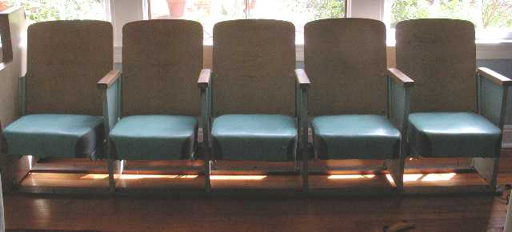
I had this row of five theater seats–actually taken from a church, with slots for prayer books in the back–sitting around since 1998 or thereabouts. Never got much use out of them.

When Gwen and I moved, they were an albatross around our neck. Big, heavy, and hard to move–no room in our current, temporary digs for them. Tried to sell them, to no avail. Wound up moving them and storing them in the garage.

I tried listing them again on Craigslist just last night. By noon today, they were sold. And the really cool thing is, I sold them to Lovejoy’s, meaning that I can go and visit them whenever I want.

Although I really like Lovejoy’s, I’ve always been discouraged from visiting because of the cigarette smoke–it seems like an especially intense smoking environment. I I told the guy who bought them from me “I don’t want to get political, but I’ve got to tell you, I’ll be visiting you guys a lot more come September”–when the smoking ban goes into effect. It’s interesting that, rather than hunkering down, he’s spending money to update the place, although he also said he’d be counting on people like me. We chatted about the issue in general–he told me about the prodigious amount of cleanup that dealing with cigarette smoking involves, which is one thing I never thought of.

So if you ever find yourself in Lovejoy’s and park yourself on the seats shown here, you’ll know where they came from.
row of five theater seats

March of Progress

I recently got a new 20“ iMac G5. It’s very nice. I had been plugging along with my old Sawtooth since 2000, and felt I was past due for an upgrade.

While it is great having a faster machine, I’m more impressed by the industrial design of this thing. It’s like an abstraction of a computer, with the messy parts that make it work almost completely invisible (the outsized bezel and optical-disc slot are the only clues that there’s more here than a screen). When I show it to people who haven’t seen one before and point out ”that’s all there is“, they are dumbstruck. But pop the back off and the parts are laid out before you as if at a buffet table.

One grave annoyance with the new machine–the updated operating system, more likely–was printing. My old printer, which I’d had since 1995, had always been somewhat fussy, but now there were some documents that I simply could not print, even after trying many workarounds. I came very close to reenacting a scene from Office Space with it.

So after doing a little research (and getting a job I couldn’t print) I drove up to Fry’s yesterday and replaced it with an HP 1320. Now I can print. With my old printer, it was a bad sign when it started ejecting pages quickly–that meant that it was spewing postscript gibberish. The new one prints just as fast, but it is actually printing what I want it to print.

It’s also interesting to look at how the industrial design of printers has changed.

The Lexmark was a real workhorse. It weighed a ton. The whole top flipped up like the hood of a car, with a complex hinge and spring mechanism. The left side swung open to reveal the logic board. In short, it was designed for serviceability. It had a LCD screen with some buttons that allowed the user to control many of its output options (redundant, considering this can be done through the computer).

Since then, the big change in the exciting world of printers has probably been with inkjets, which have gotten very good, and are cheap enough to hand out as party favors. This has no doubt forced the laser-printer segment of the market to compete harder on price, and it shows in my new printer, which is much lighter. No LCD screen, almost no buttons, no easy access for service. It’s also much smaller and sleeker, and somehow manages to fit in a duplexer. And, of course, cost about a quarter what the old one did.

Scroll to Top