Changes

My house went on the market yesterday. The sign went up in the yard today.

I’ve been in this house since 1997, a long time for some people. But I spent the first 18 years of my life at the same address, and I think this has shaped my attitude towards moving (in a word: don’t). There are a few reasons for this move, but economic ones are probably foremost: Gwen and I have some debt, and the property taxes on this place are just not affordable. And there’s a huge amount of equity tied up in the house, because it has roughly doubled in value since I bought it. We expect to sell the house for a pretty good chunk of change, pay off most of our debt, move into something cheaper and still have a lot of money in the bank. I like this house, and I love this neighborhood–wherever we move next, it’s almost certain to hurt our quality of life in terms of neighbors, ready access to places we like to go, etc. So I feel a bit cornered into making this move, and I have a diffuse resentment at the circumstances that have me cornered.

But I’m not all negative about this. The move is also an opportunity to start fresh, which is good. The part of town we’re looking at most closely (78702) is on the leading edge of an intense revitalization, so it may turn out pretty nice in a few years, and will probably prove to have been a good investment. Gwen and I do not know what our next home will be–we’re considering a few options, including buying an empty lot and building a new home on it. This, obviously, would be a big step into the unknown, and if any members of my adoring public have specific advice, I’d appreciate it.

Gwen and I have talked about the whole issue of gentrification. We’re being gentrified out of our current house–not that this neighborhood was remotely undesirable before, but our incomes have hardly kept pace with the increasing property values and property taxes. We may well be the gentrifiers rather than the gentrifiees at our next place. Is that ethical?

Debate reaction

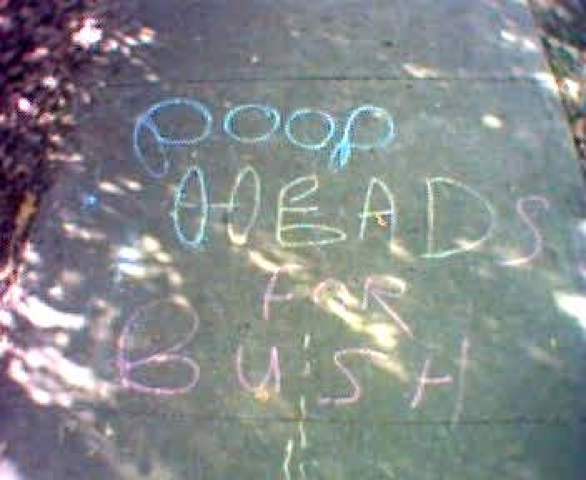
I wasn’t thrilled with Kerry’s performance, but he did a better job than Bush. Bush was frequently agitated and occasionally at a loss for words. Kerry, who is usually at a loss for brevity, was cool and reasonably concise. Since the value of these debates is as much in the visceral reactions that people have as in the policy points scored, Bush lost ground.

In terms of policy points, commands of facts, etc, one’s analysis almost gets reduced to a question of “who do you want to believe?”. This is, of course, ridiculous–as if there is no objective reality–but partisans will believe who they want to believe, and undecideds will make up their mind based on gut reactions. Both sides exaggerated or mis-stated numbers. The post-mortems have not taken the president to task for the bigger problems in his points–his continued insistence on the Iraq/Al Quaeda links, though Kerry did. Kerry missed an obvious scoring opportunity when discussing the run-up to war: Bush repeatedly insisted we needed to go into Iraq to remove the WMDs. Kerry never asked “what WMDs?? (in The Daily Show’s wrapup, Jon Stewart did ask). Bush has to run on his record–talking about what he will do invites the question “why aren’t you doing it now?”. Kerry has the luxury of talking about what he will do without really being held to account. The tack that he took, of engaging more closely with allies, doesn’t seem likely to gain traction with most people.

The post-debate wrapup (we watched the debate on NBC) struck me as absurd: the network invited each side to give its own spin. This is not acting as a news organization: this is acting as a clearinghouse for press releases.

No soup for you!

Last night I saw an ad placed by the Center for Consumer Freedom, an astroturfing, misleading bunch of asshats. The premise behind the ad is that someone, somewhere, is trying to take away your right to stuff your face with Heart-Attack Specials, McCrispeties, and Munchee-os. The ad actually features the Soup Nazi (from Seinfeld) doing his schtick. The website actually uses phrases like “food fascists.” Both the ad and the website are trying to whip up hysteria surrounding problems that do not exist.

While there have been a couple cases of people suing McDonald’s for their obesity, these have been thrown out of court. This organization is clearly a sort of pre-emptive strike against any further actions to hold major food manufacturers accountable for the content of their products. It’s hard to imagine that bad food will be regulated the way tobacco and alcohol are, the terrifying future that fast-food fearmongers foretell. Restaurant food (like tobacco and alcohol) does not even carry labeling disclosing its contents, and the fast-food lobby is a hell of a lot better organized and funded than the, uh, lobby for people who don’t like fast food.

Apparently these industry tools have set up a sort of link farm, with websites to bash the Center for Science in the Public Interest, another to tell the inside story behind such radical groups as the Sierra Club.

On their “about us” page, they say they are “supported by restaurants, food companies and more than 1,000 concerned individuals.” What concerns me (among other things) is that food companies may include industrial ranching operations, which receive government subsidies. Meaning that, in some way, my tax dollars are funding these clowns.

Code 46

Released with no fanfare that I know of, Code 46 is one of the best SF movies I’ve seen in a long time.

The movie tells of a bustling, gleaming future where everyone in the world speaks perfect English, liberally sprinkled with Spanish, French, Arabic, and Chinese (five of the six official UN languages–I didn’t notice any Russian). It’s a world that looks very much like our world today–the same cars and clothes, though the cities are perhaps shinier.

I don’t want to spoil it for anyone who doesn’t want it spoiled, so I’ll discuss the rest of it inside. Go watch it and then read the rest of this post.
…

Allegro non Troppo

Continuing its fine tradition of showing movies with live sound, the Alamo had a showing of the animated feature Allegro non Troppo, accompanied by Peter Stopchinski and another three musicians, who played variations on the music in original score. These were quite good–they fit with the action on the screen, and nodded in the direction of the originals without being retreads. But I have to say, you can’t do justice to Bolero (or anything like it) with a quartet.

I’d seen Allegro non Toppo back in high school. It was great seeing it again, and the live accompaniment was a real treat.

Stonehenge

Out in Hunt, Texas, not far from Kerrville, there is a reproduction of Stonehenge.

I first encountered it in 1999, when Jenny and I were working on a book about bike touring (never completed). She and I were out on a very long, difficult, and inadequately hydrated (but beautiful) ride that we referred to as the “Mountain Home butt-grinder.” We were well into the ride, and feeling very discouraged in general when we rounded a bend, I looked up, and exclaimed “Holy shit, it’s Stonehenge!” Watched over by a pair of Easter Island heads, no less.

A couple weekends ago, Gwen and I went to a wedding out in Hunt, right near Stonehenge. This time, I had my camera.

stonehenge in Hunt, Texas

More photos inside
…

Date authentication

In the slow-motion controversy over the gaps in the record of GW’s Texas Air National Guard Duty, the latest wrinkle has been the emergence of some damning documents that some people are concerned might be forgeries. While I’d be delighted to see Bush publicly embarrassed for shirking his military duty, I have to admit that the documents do look suspicious, and if they are forgeries, whoever is responsible is really fucking stupid.

But enough about all that. This got me thinking: today in the electronic world, there are ways to prove that you are the author of a document. But is there a way to prove that you authored the document on a certain date?

Currently, I don’t think there is a verifiable way to do this. But I can imagine a system that would make it possible.

First, we need to review the general ideas behind public-key cryptography (often abbreviated PKI, for “public-key infrastructure”). Traditional cryptography encoded a text using a single key, and both sender and recipient had to have copies of this key. Moving the keys securely was obviously a very serious problem.

PKI solves this. Everybody has two keys: a public key and a private key. The operations of these keys are complementary: a document encrypted with one’s public key can only be decrypted with the private key. So anybody can look up your public key, and secure the document so that only you can read it. Conversely, a document encrypted with one’s private key can only be decrypted with one’s public key. This allows you to “sign” a document electronically: your public key can be considered well-known, and can only be paired to your private key, so if a document can be decrypted by your public key, that’s evidence that it was encrypted with your private key, and either you wrote it or you left your private key lying around for someone to abuse.

Another important concept is the “secure hash.” A secure hash is a relatively short string of gibberish that is generated based on a source text. Each hash is supposed to be unique for each source text. It is trivial to generate the hash from the source text, but effectively impossible to work out what the source text might be based on the hash. Hashes can be used as fingerprints for documents. (Recently, a “collision” was discovered in a hashing algorithm, meaning two source texts resulted in the same hash, but it would still be effectively impossible to work out the source text or texts from any given hash.)

Now, PKI is fine for authenticating authorship, but doesn’t authenticate date of authorship. Not without some help.

PKI relies on key-servers that allow you to look up the public key of other crypto users. Imagine if we set up trusted date-servers to authenticate that a document was actually written when we claim it was written. It might work something like this: An author wishing to attach a verifiable date of authorship to a document sends a hash of that document to a trusted date-server. The date-server appends the current time and date to the hash, encrypts it under its own private key, and sends it back as a “dateprint. The author can then append the dateprint to the original document. If anyone ever doubts that the document was authored on the claimed date, they can decrypt the dateprint using the date-server’s public key; this will give them the claimed date and the document hash. The skeptic then takes a hash of the current document and compares it to the hash contained in the dateprint: if they match, then the current document is identical to the one submitted for dateprinting.

Scroll to Top