Stonehenge

Out in Hunt, Texas, not far from Kerrville, there is a reproduction of Stonehenge.

I first encountered it in 1999, when Jenny and I were working on a book about bike touring (never completed). She and I were out on a very long, difficult, and inadequately hydrated (but beautiful) ride that we referred to as the “Mountain Home butt-grinder.” We were well into the ride, and feeling very discouraged in general when we rounded a bend, I looked up, and exclaimed “Holy shit, it’s Stonehenge!” Watched over by a pair of Easter Island heads, no less.

A couple weekends ago, Gwen and I went to a wedding out in Hunt, right near Stonehenge. This time, I had my camera.

stonehenge in Hunt, Texas

More photos inside

Ten years

Looking through some old e-mail, I just discovered that I’ve had the “crossroads.net” domain name, and this e-mail address, for exactly ten years as of a few days ago.

Not dead yet

I’m still here.

Shortly after departing for Japan, my site was hacked. I’ve gone around and around with my web host, which has been unwilling to reactivate a compromised site–which I can understand, but they also haven’t exactly been johnny-on-the-spot about helping me to secure it. For the moment, at least, it’s live again.

Gwen and I returned from Japan last night. We had a ball over there. More on this later.

The paperless office

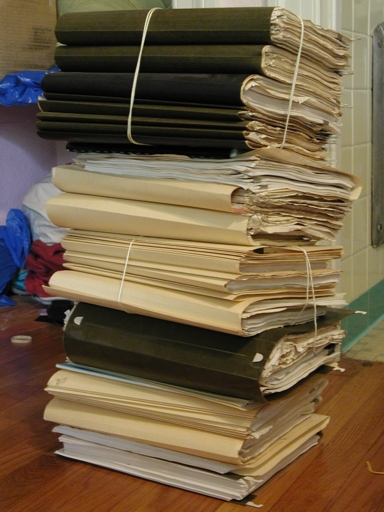
pile of work manuscriptsI’m doing a little housecleaning and found this stack of old jobs shoved into an inaccessible shelf in a closet. These are all Japanese source documents, mostly faxes on flimsy thermal paper, with text now faded to pale gray. The stack is 24″ tall.

I didn’t make a careful survey, but it’s likely that very few of these papers are any newer than 1992; that’s the year I got a fax-modem. Since then, I’ve had a digital copy of almost every job that’s come to me. The paper copy (I always print out my jobs, regardless) is a temporary convenience–it’s not what I think of as the archival version. I kept around these old papers out of some completeness fetish, but really, the odds that I’ll ever want to refer to any of these (or that I could find what I wanted) are vanishingly slim. So away they go.

In the book In the Age of the Smart Machine, Shoshana Zuboff observed that when the back-office operations at an insurance company were first computerized, the operators still preferred to consult paper files: they considered the online information to be ephemeral and suspect, and felt that the information’s “real” form was on paper. Not me.

Interestingly, I’ve acquired a new client that has a completely paper-based workflow. But so far, I’ve been able to scare of PDFs of most of the documents they send me anyhow.

People are not parameters

I saw an ad on TV for this online dating service, eHarmony. They claim to match people on 29 different parameters.

This is bullshit.

Let’s look at the math involved in this claim. For simplicity’s sake, let’s assume that each trait is binary: either you’re compatible or you’re not with a certain person. Let’s also assume that none of these are dependent on other traits, and that people have a 50% chance of being compatible on any given trait. Let’s also assume, for the sake of argument, that these guys can accurately assess each of these traits in people. Finally, let’s note that none of the traits they consider here are “has the right genitalia,” so let’s add that as a 30th (though this doesn’t account for bisexuals). That gives you roughly one in a billion odds of finding a perfect match.

Obviously no match will be perfect, and, perhaps more perniciously, eHarmony could in theory precisely quantify just how incompatible a person is for you (I have no idea if they actually do this).

But the bigger problem is that this assumes that people can be reduced to a set of psychological parameters; even if there is some kind of unquantifiable chemistry between people that it is secondary in importance to these.

I used a different dating service and it worked out pretty well. In fact, after looking at (and in one case using) other dating services that try to boil people down to a long laundry-list of multiple-choice questions, I signed up with the one that used the fewest parameters and tried to extract the most personality (within the narrow limits of the medium). Well, except for this one maybe.

But perhaps I’m full of it. Perhaps eHarmony is a good service for people who like the idea that people can be easily quantified. In that sense, they’d have a self-selecting population to work with: its users would have already answered the “what kind of dating service do you like and how do you assess people” questions and narrowed their odds of finding a good match. Perhaps this means there needs to be a matchmaking service for dating services.

I’m married

The really important things are hard to put into words.

I’ve been married before, and one might expect that my attitude towards marriage would be less awed, less wondering, and more cynical. And at some level, that’s true: I have firsthand experience of a marriage that didn’t last, so I can’t discount the possibility that it will happen again. On another level, it’s not true at all: there’s still a very immediate sense of stepping into the unknown, of electricity, of possibility, of change, and of permanence, or at least the prospect of it.

Later: Our friends Frank and Mary Pat, professional photographers, volunteered to take photos at the wedding, and they have posted pictures online.

Letter from my bank

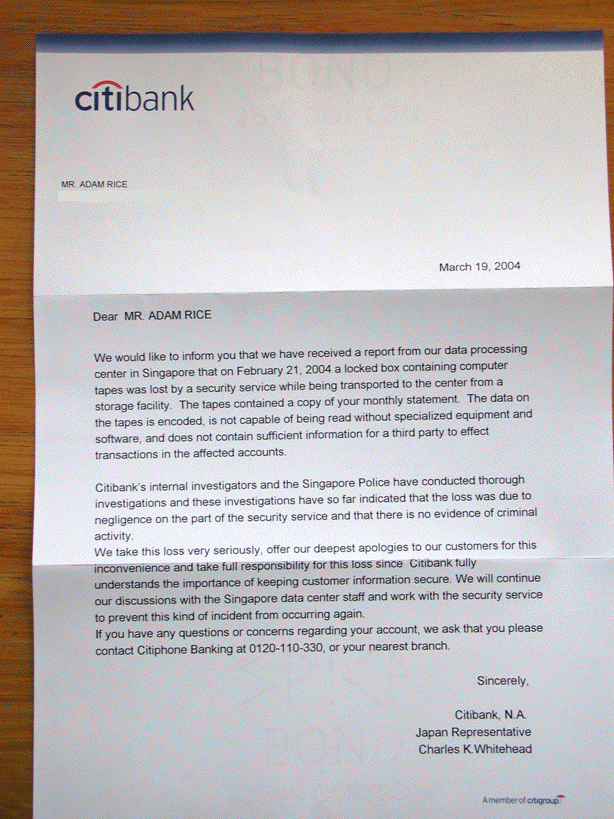
I’ve got a bank account in Japan to make business with my Japan-based clients easier. I just got a letter from them advising me that backup tapes with my information were lost. They tell me the data was encrypted and I’m not at any risk of identity theft. For the sake of argument, I’ll take them at their word.

What’s interesting to me about this is that I got a letter at all: if this were happening with an American bank, I don’t think I would have. Frankly, I’d rather know about the mistakes–and know that I will know when there is a mistake–than put up with the “trust us” routine.

Three elephants

This guy, very wealthy, wants to give his son a big bar-mitzvah party, something that’ll impress all the people he does business with, so he decides to have a bar-mitzvah safari. He flies the whole party over to Africa and hires guides, a bunch of bearers, two elephants, the whole works. The party is making its way through the jungle when it comes to an unexpected halt. The father calls to the head of the procession to ask what’s going on, and the guide shouts back that they have to give way to the three-elephant bar mitzvah that is crossing their path.

This joke was a touchstone in my family–any big social event was referred to as a “three-elephant” whatever. I went to a three-elephant wedding this weekend that was, well, odd in lots of ways.

The bride and groom, Jennifer and Mark, are friends of mine, through Gwen. Both real hippies, living on some land outside Bastrop. Mark’s glasses are mostly made out of duct tape; Jennifer is an acupuncturist. But it turns out that their families are both part of San Antonio old-money society; Mark was all but disowned by his parents for his anti-establishment lifestyle. You can practically hear a sitcom premise winding up in the background. I knew we were in for something when I saw the ornate invitations done in hand calligraphy.

The event was at the Don Strange Ranch about 110 miles from Austin. This is no more a ranch than the Queen Elizabeth II is, but this does have the ranch schtick as its theme. Chuckwagons, old milk jugs, saddles, and other rustic paraphernalia picturesquely dot the landscape. Half a dozen longhorn cattle were corralled into an uncomfortably small pen that kept them up close to the guests as they walked in.

When an old barn is meticulously updated to become a setting for fabulously wealthy and elegantly attired people to hobnob and drink champagne, the place ceases to be a ranch and becomes an exercise in unwitting kitsch.

That said, the grounds were really beautiful.

The ceremony was an even more bizarre juxtaposition. It was an ill omen that the sound crew couldn’t get the wireless lavaliere mics to work correctly (this was the first wedding I’ve been to that was mic’d), and one of the speakers emitted a constant buzz. Shoeless women carrying cones of flower petals walked around the seats, sprinkling petals and waving sage-sticks. Then a procession of grandparents, cousins, parents, etc came down the aisle. A woman bearing a floral cross came down and hung it from a giant flowered bower. Then the groom, then the bride. There were four officiants: a Catholic priest, an Episcopal priest, and two Pagan priestesses (named Rivers and Spirit). They conducted the whole thing tag-team style; the Episcopal priest visibly rolling his eyes at the pagan sections (and me rolling my eyes at every section). Unsurprisingly, the Pagan parts were gag-inducingly sweet, airy-fairy hoohah, and the Christian parts were intimidating, stern, and didactic–the priests were clearly trying to wrestle the proceedings back to something they considered respectable. Needless to say, with that much going on, the ceremony was long-ish and never seemed to reach a clearly defined end. I can only imagine the wrangling between the kids and the parents that resulted in that camel of a ceremony. I was amused, later, to discover that Rivers’ dog has the pedestrian name Mickey–but Mickey receives 14 different naturopathic treatments every day.

The reception was a lavish spread. Five open bars. Appetizers laid out on derelict horse-drawn carts. A full (and very good) dinner for 425 guests. A cover band that went through three costume changes and, as is required by the International Brotherhood of Cover Bands, played Proud Mary along with other chestnuts like Mustang Sally, Celebrate, a Donna Summer medley, etc. Gwen and I, along with our friends, were in the cheap seats off to the side; it was the important friends of the family who sat at the more central tables and who left first.

A new job

I’ve been a freelancer since 1989, and in that sense, I get a new job every time a new document comes down the pipe. I am still a freelancer, still doing the same thing, but I still feel like I’ve got a new job.

When I started translating as a freelancer, things were kind of thin. Gradually, my client base and workload picked up, and by 2000, I was making a pretty nice income.

Then came 2001: my income was less than half what it had been in 2000: the Japanese economy–already bad–seemed to get worse, and we all know what happened in the U.S. economy. 2002 was slightly worse; 2003 about the same.

December 2003 and January 2004 were alarmingly quiet, and I could no longer pretend that I was riding out a lean spell and things would pick up in their own time. Either I needed to get more translation work, or I had to get a “real” job (though the idea gave me hives). In the past, I had occasionally made efforts to get new work by cold-calling, but I found the process uniformly unproductive and had given up. Time to try again. I contacted a lot of translation agencies. Most of them thanked me for my resume (if that much) and that was the end of it. Some had me do translation tests. This turned into a more labor-intensive way for me to wind up buried in a rolodex somewhere. But I contacted one company that was different. They sent me a very demanding translation test–a long passage (as trials go) of very challenging material. I slacked a little on finishing it, but eventually did so. And eventually heard back that they like my work and want to add me to their stable. And that they can, it seems, completely saturate my pipeline. And they pay pretty well (especially for Americans). In short, if I choose to, I can pretty much work full-time and exclusively for them. I feel both relieved that a long and difficult period seems to be ending, and anxious that I might screw up.

Jenny and I have discussed before the danger as freelancers of turning one’s client ecology into a monoculture, but right now, it beats the hell out of a xericulture.

Nastygram to T-Mobile

Following is the text of a letter I’m sending to T-Mobile

I recently signed up as a customer of T-Mobile, and was annoyed to discover that every time I receive voicemail, I also receive a text message from the network notifying me that I have voicemail (that is, I was annoyed after I overcame my initial confusion). A customer-service rep told me this is just the way it works, and there’s no way to turn it off. This isn’t a feature, it’s a bug. You should turn it off.

I was doubly annoyed when I received my first bill and learned that I am being billed 5¢ for each of those messages—which I don’t want in the first place.

My annoyance all the more acute because a neighborhood I visit regularly is so poorly covered by T-Mobile that phone calls often roll over to voice mail automatically. So we have a situation where I’m often out of reach because of shortcomings in your network, and I am paying extra for poor coverage.

You guys have me on the hook for one year, but so far, I’ve been less than impressed and will eagerly explore my options when my contract is ended.

Scroll to Top