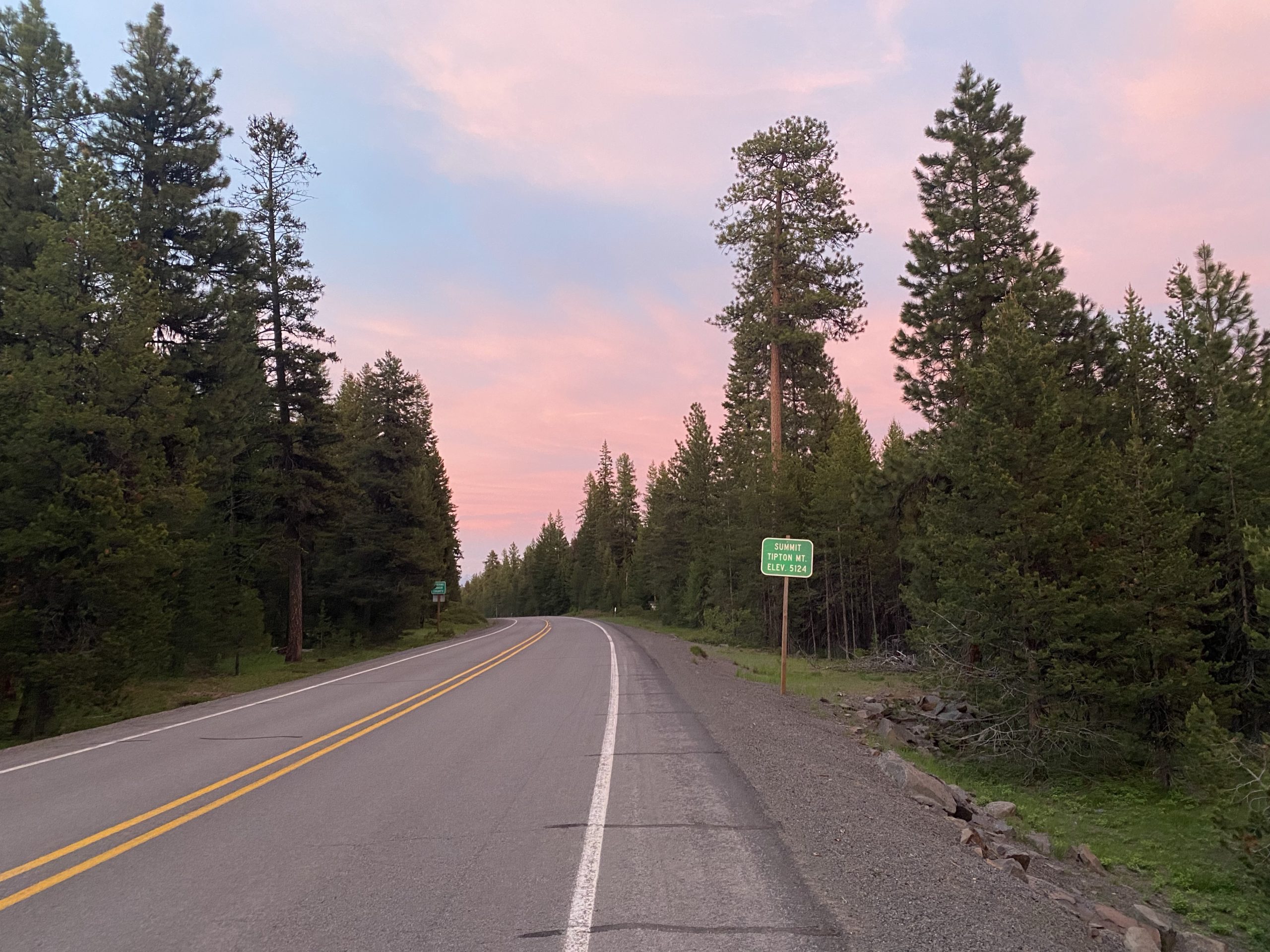
Ride report: Halfway, OR

The big push into Baker City took a lot out of me.

I was staying at the Churchill School bike hostel, and rolled out late because I did laundry there. I stopped in town for breakfast and discovered how weird my appetite has gotten. I was beyond hungry. I was at a nice restaurant having food I liked. And I still had to force myself to finish it. I don’t understand.

I planned on making the day’s ride shorter, but between the late departure and my low speed, it wound up being really short. It’s known that your peak heart rate and power go down when you’re exhausted. Two days ago, I couldn’t get my HR over 120 bpm. In the ride into Halfway, I could barely get it over 100.

Much of the day’s riding was through Hell’s Canyon, and the name is apt. It was hot and humid, and no trees, no shade. Nowhere to stop and take a break until the town of Richland, about 40 miles in, and the only shade there was the awning in front of the grocery store.

When I got to Halfway, I had an early dinner and went to bed. I slept long and hard, and I’m hoping I’ve pushed a reset button.

I will admit that I am feeling discouraged about this undertaking. Part of the reason I wanted to do this was to find out how I would be changed by the experience at the end. But I also have to admit that I romanticized the suffering. I am at the point where the suffering has lost whatever romance it may have had, and I am asking myself whether what I will get out of this will be worth what I put in. I didn’t enjoy being on the bike yesterday–it was just a slog.

My goal for today is to see if I can at least enjoy being on the bike, and forget my mileage targets.

Ride report: Baker City, OR

I am writing this post the day after the ride–technically, my ride ended after midnight, so arguably it is the same day.

I reached Mitchell–home of the Spoke’n Hostel–pretty early and had their spaghetti for breakfast, although the 30-mile climb out of Prineville meant I wasn’t too early. Mitchell is in a valley, so after that long climb, you give up all that altitude, and then climb it again to get out. By the time I left, the day has heated up.

Most of the rest of the day is a blur. The three big climbs after Mitchell were all late in the ride, well after the halfway point. By the time I finished the second of them, it was chilly enough that I needed my jacket for the descent. After the third, it was cold enough that I needed to add more warm clothes, and my sweat-soaked jersey was chilling me, so I needed to take that off. Finding a place I could even lean my bike took a while, and then I was working in complete darkness. I was exhausted enough that I knew to be concerned about dumb mistakes, and tried to be very methodical. Even so, I rode off without my bone-conduction headset on, but it was hooked around my handlebars, so no loss there.

One minute after I passed the Baker City City limit sign, the sky opened up. I was only in the rain for about 10 minutes but got soaked.

I had set the goal of reaching Baker City because there’s a bike hostel there. I knew it would be a big push.

It was too long. 195 miles with 5 major climbs. My appetite has been hit-or-miss, and my last solid food of the day wasn’t sufficient.

Ride report: Prineville, OR

Slept well and woke up at 5:30. Got rolling about 45 minutes later. Not great efficiency. Rode to Lewisburg and stopped at a greasy spoon for breakfast.

At some point while riding along the McKenzie River, I pulled over to strip off my warm clothes, and was passed by another racer, Richard. We rode together for a bit and stopped at a convenience store shortly before the turnoff for McKenzie Pass, the day’s main event. As we pulled in, another racer was pulling out and yelled his recommendation for the chicken tenders.

I rolled out a little before Richard and reached the turnoff. A couple of guys from Portland were getting their bikes ready; we chatted for a bit about whether the road was really closed due to a recent rockslide that needed to be cleaned up. We all agreed it was worth chancing it. I rode in ahead, knowing they’d pass me quickly.

The pass is at an altitude of about 5200 feet; the base is at about 1000 feet. As you ascend, you pass altitude markers every 1000 feet. At about 3500 feet, I had to take a break–I was whipped, my back hurts, and I ran across a rail I could use as a bench and prop for my bike. Before reaching 4000 feet, I came upon the Portland guys. I assumed they had already reached the top and were coming down. Nope. They were taking their time, I guess. There were a lot of cyclists on the climb–it’s a well known destination, especially right now when it is closed to motor traffic. There are gates at the east and west sides partway up that cyclists and peds can bypass.

I ran across a couple more racers, Mike and another guy whose name I didn’t catch. Mike and I rode together for a bit; I learned he’d read my blog entries about the 2021 race.

The top of the mountain is like Mount Doom–no life, just broken lava rock everywhere.

On the way down, I chatted with a rider going the other way, and later, at the eastern gate, there was another rider coming the other way. We chatted for a bit too. Something seemed familiar about him, and after he asked my name, I told him and said “and you’re Evan Deutsch, aren’t you?” He was. He’s won the TABR and has some very high placements when he didn’t. Nice guy, very down-to-earth.

I made it to the next town of Sisters, a very cute town blessed with two bike shops, which is pretty rare. Only one was open, so I went there. Blazin Saddles. My shifting has been off, and I hadn’t been able to fix it myself, so I suspected the derailleur hanger was out of alignment. It was. They dropped everything and got me fixed right up. Another racer was in there buying spares.

As long as I was making a stop in Sisters, I decided to eat. I found a food truck serving Mexican food and ordered a taco plate. Weirdly enough, I had to force myself to eat it–i just don’t have much of an appetite. This is a problem. There’s only so far I can go on stored fat.

My original goal for today has been Mitchell OR. What I realized was that I’d be arriving after nightfall, and the descent into town is scary enough in the daylight. I wound up stopping 40 miles short, in Prineville.

Ride report: Springfield, OR

A big day on the bike. We had a strong tailwind almost all day, and it’s clear many of the racers are making hay while the sun shines. The guys at the pointy end are all around 300 miles for the day, and probably not stopping.

A lot of climbing too, including a couple of very long, steep grades. I saw one racers going up the first of these on foot. Somehow, much later, I saw he had beat me to a road–but was on the wrong side of it. There was another racers I kept swapping positions with. I rode faster than him, but stopped more often.

My goal has been to average 180 miles/day, and it’s nice to start off with some extra miles in the bank.

I stopped in Tillamook for an early lunch at the Safeway, where I encountered my first dot-watcher, had a few snacks along the way, and stopped in Corvallis for dinner at a semi-fancy pasta place called Pastini. It was nice pretending to be civilized. I pushed on another 40 or so miles to Coburg, and am actually a little off course at a Motel 6 in Eugene. The place reeks of despair.

I’m going to sleep until I’m done sleeping.

Packed and ready

Take to the Sky, ready to go

Apart from a handful of small items I’ll need between now and tomorrow morning, my bike is ready for the Trans Am Bike Race.

My self, that’s another matter.

TABR gear list

Here’s my packing list for the Trans Am Bike Race 2023.

Tools, gadgets, and spares

Left to right, top to bottom (more or less)

  • Short length of gorilla tape
  • Zip tipes
  • Paracord
  • Derailleur cable
  • Fiberfix spoke
  • Disc brake pads
  • Extra length of chain
  • Chain tool
  • Extra spokes
  • Extra master links
  • Sugru
  • Thread locker
  • Extra SPD cleat
  • Random small screws
  • Derailleur hanger
  • CR2032 battery (for heart-rate monitor)
  • Spare dynaplug plugs
  • 2 innertubes
  • Tire boots
  • Pump
  • Tyre key
  • Shokz headset
  • Multi-head USB cable
  • Wolf Tooth 8-bit tool
  • USB converter for dynamo
  • Gerber Dime multitool
  • Dynaplug
  • Power bank
  • Wall charger
  • Patch kit
  • Extra valve cores
  • Taillights: Lezyne Strip × 2 plus Cygolite Hypershot 350
  • Secondary headlight: Magicshine ZX Pro (main headlight is on bikes).

This stuff will be stored in my Camelbak pocket, top-tube bag, and Tailfin bag, based on how likely I am to need it. It all packs down pretty small, and I will depackage the stuff that needs it. I’ll probably cut that paracord shorter. Everything in this picture weighs 1325 g.

My wheels are set up tubeless, but I do need to be able to fall back to tubes if necessary. I am debating bringing a spare tire.

Not shown:

  • Chain lube: I will be bringing 2 oz of Silca liquid wax lube.
  • Garmin InReach Messenger satellite tracker

Clothing

  • Smartwool undershirt
  • Spatzwear undershirt
  • Gore leg warmers
  • Running shorts (in case I can wash all my stuff and need to stay decent)
  • Galibier jacket (doesn’t seem to be currently listed on their website)
  • Stolen goat jerseys × 2
  • Castelli shorts × 2
  • Galibier shoe covers
  • Gore Wear cool-weather cloves
  • Specialized cold-weather gloves
  • Reflectoes socks × 2
  • Specialized Grail gloves
  • Beanie

All this weighs 2103 g. Some of it will be on my body at any given time.

Not shown:

  • Lake cycling shoes
  • Wool cold-weather socks

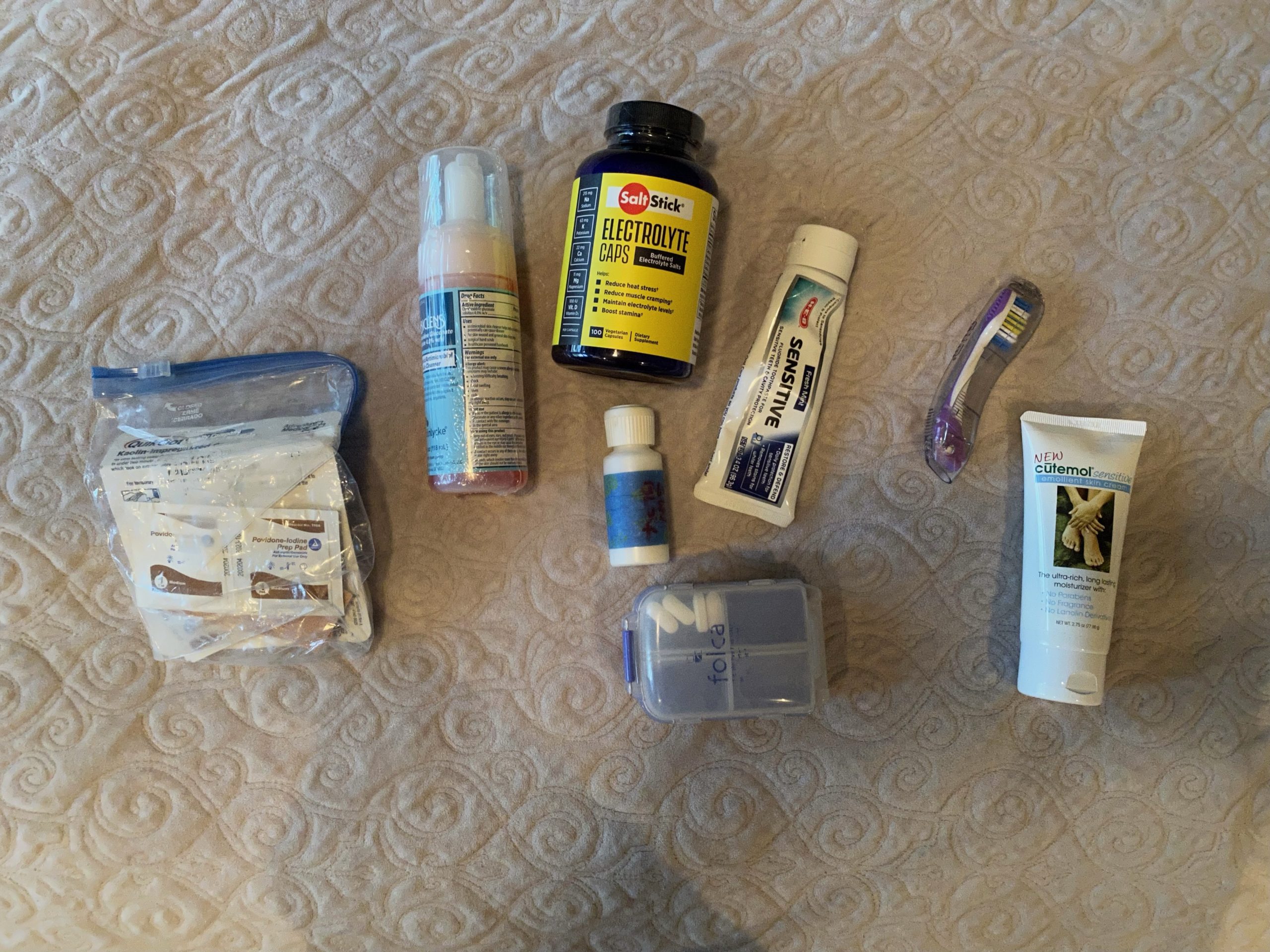
Personal care

  • Minimal first-aid kit
  • Hibiclens
  • Electrolyte caps
  • Toothpaste
  • Toothbrush
  • Cutemol
  • Pill case for prescriptions
  • Sunblock

I had trouble with saddle sores in 2021, and am packing the Hibiclens and Cutemol in the hopes of preventing that. All this weighs 690 g.

Not shown:

  • Lip balm

Sleep setup

  • Sea to Summit Spark SP1 sleeping bag
  • Klymit Inertia 0 sleeping pad
  • SOL Escape Light emergency bivvy

I will probably sleep in hotels mostly, but don’t feel right not having something to sleep outdoors in. Weight of all this stuff: 870 g.

Total weight: 4,988 g. Plus the bags I’ll be carrying this stuff in.

The bags I’ll be using are:

Blister clear

I got involved in Burning Flipside and burns in general through firedancing. At the time I got started in firedancing there was a weekly firedancing get-together at Pato’s Tacos (RIP), and most of the people I met there were involved in Flipside.

My first Flipside was in 2004. Even before that, I got roped into coordinating the fire conclave. I overthought it and ran myself ragged during the event finding fire performers to take part. It turned out pretty good.

I skipped Flipside 2005, but returned to coordinating the conclave after that and continued doing it. One year some hoopers who were not using fire asked if they could be in it. I asked Pat, then a board member, and he left the decision to me. This was a small thing, but it taught me an important lesson about how Flipside works.

Over the years I continued to improve the way that I ran the conclave, and I took on other related responsibilities. I took over as a theme-camp lead. I helped run the informal secondary market for tickets. I joined Flipside’s advisory body. I helped organize a major art project.

It was in April 2012, during a work day for that art project, The Hive Project, that I got a call from Sparky, a then-serving board member, inviting me to go on a ride-along with a board member during the event, and to consider joining the board. I crumpled up on the floor but said OK. My reaction was both “why me?” and “if not me, who?”. I couldn’t expect other people to do it if I wasn’t willing to. I still argued that I felt I was contributing to Flipside without being a member of the board. I forget exactly what psychological aikido move Thomas used on me to counter that argument, but it worked. In the tradition of the microscopic culture that is Flipside’s board, two other invitees, Princes and Izzi, and I sat down with the board for beers at Scholz Beer Garden, to discuss joining them as provisional members. We all said yes.

The ride-along shift itself, with Beth, was uneventful and did not scare me off.

I had a severe case of imposter syndrome about the whole thing, but I also made a conscious decision that I was going to dedicate a big chunk of my life, my time, and my thoughts to my new role.

I continued serving as a provisional member until September or October 2012, when I signed the paperwork to become a full member.

Flipside 2013 would be my first event as a board member, which kicked my imposter syndrome up to a new level. I lost a huge amount of sleep in the month or so before the event, lying in bed and mentally working through scenarios. During the event, on the afternoon before burn night (when we’re all busy with burn-night prep), a massive pecan tree fell, while I was on shift. It didn’t hurt anyone, amazingly, and luckily there were experienced safety volunteers to manage that incident because I was not ready to (a tree collapse was not a scenario I had mentally rehearsed).

Over time my imposter syndrome ebbed, and I saw possibilities for improving the event that my role made possible. I focused in particular on improving documentation for the event. Old board members retired, new ones joined. Eventually no one who had been on the board when I joined, or who joined when I did, was left on the board.

Right at the beginning of 2020, I resolved to compete in the Trans Am Bike Race, and to focus on that, I would need to resign from Flipside’s board. We all know how that went. The TABR was cancelled in 2020. Flipside was cancelled in both 2020 and ’21. Because of those cancellations, I did not feel that the board could do an adequate job bringing new people on (no ride-alongs), and if I quit with no successors lined up, that would leave four on the board, which is not enough. So I stayed on. I did start TABR ’21, but had to abandon. But with Flipside 2022 in the books, we had four people lined up who were interested in joining the board. I wanted to take another stab at the TABR. And it was time to give other people a turn at the wheel. I gave plenty of notice and documented the things I did as a board member to smooth the transition. I set today as my last possible day.

On the Slack workspace that the organization uses for board members and senior managers, I announced that today was my last day as a board member. I had some powerful and complicated feelings after I sent that message. I’ve been doing this thing for over ten years, and it has taken over a big chunk of my life. I am glad I have something else to focus on, but it will be a strange feeling with nothing planned for Monday nights. Joining Flipside’s board has turned out to be one of the best things I’ve done with my life.

Later

I thought about when I moved back to the U.S. from Japan. I had somewhat similar feelings then. For one thing, I had put a lot of work into figuring out how to live in Tokyo, and I felt like I was throwing that investment away. I’m not feeling that way now. But being an American living abroad, being a Japan hand, had become part of my identity, and I felt like I was giving that up too, and I am feeling some of that this time. Being a board member for Flipside has become a significant part of my identity.

I also thought about something I’ve observed in some other volunteers that I call the Death Grip. You hold on to a role, not because you enjoy it, but because you’ve convinced yourself the role needs you–no one else can do it. I’ll admit I felt a pang of that, but I am letting go.

And of course, there’s the camaraderie that develops among board members. We spend a lot of time with each other. We have bonding through shared hardship.


PS: What’s up with cryptic title? My callsign on comms is “Blister”; “clear” is what you say when you’re ending a communication on comms.

Reflections on my anniversary

Gwen and I celebrated our 19th wedding anniversary with a weekend trip to Dallas. Nerd that I am, I reflected on an episode of Star Trek: The Next Generation that featured a character, Kamala, who became whatever the man around her wanted her to be. If she spent enough time in the presence of one man, she’d imprint on him, and would permanently be what that man wanted in a woman. One of the ideas suggested–but never spelled out–by this episode is that the way she expressed her own individuality is in the man she chose to imprint on.

And I thought about how, in marriage or any long-term relationship, we are changed by the person we are with. One partner will bring out one side of us, a different partner would bring out a different side. We consciously choose who we want to be with, but what I never thought about before is the fact that in doing so, we are also choosing who we want to be.

I did well on both counts.

Accessory mounting plates for aerobars

Updated–see end of post

I’ve written before about different options for mounting gadgets on aerobars. None of them really address the needs of bikepacking cyclists, who may want to have two sets of lights, two computers, and possibly other stuff out front, so I’m taking matters into my own hands and having a couple of designs fabbed up by SendCutSend.

Both designs use four lateral slots with P-clamps to attach to the aerobars with some positioning flexibility. I’ve found a source for high-quality, dimensionally precise P-clamps with silicone coating for a little vibration damping. Both designs require straight sections of aerobars to clamp to, and will work better on “J-bend” bars than “S-bend.”

Each design has its pros and cons.

The first one (“New York Style”) is being produced out of thin 6061 aluminum, but could be made of carbon fiber. It gives a little more room for different attachments, and might be a better basis for a single do-it-all mounting base.

The second (“Chicago Style”) is being produced out of .25″ 6061 aluminum (could get it as thick as 0.5″). This is thick enough to tap the holes, which obviates the need for separate nuts (or other fixtures). There are some limits on what SendCutSend can do–for instance, it can’t tap an M3 hole in a thicker plate than this. Because of the material’s inherent rigidity, the fore and aft slots can be closer together. This lets it fit on bars where there’s a relatively short straight section, which might make it feasible on S-bend bars.

Both designs provide a bunch of mounting holes for specific purposes. I’ve got one set of AMPS holes for installing a Quadlock mount. The New York Style plate has a few Garmin/Wahoo combo hole patterns, holes for mounting a bottle cage, and holes for GoPro bases–these serve as a sort of universal adapter for lots of gadgets. Many kinds of headlights can be used with a GoPro adapter; there are also Garmin/GoPro adapters, which give you control over the viewing angle. This particular iteration of the Chicago Style plate has fewer mounting options.

Update

I’ve received my first “New York style” prototype, mounted it, and taken it for a good test ride. The plate is 0.125″ 6061 aluminum and it feels much more solid in the hand than I expected. The plate by itself is 89 grams; with bar clamps, a Garmin mounting “biscuit” and a couple of GoPro mounts, 195 g. On a “grams per gadget” basis, this works out heavier than most out-front mounts, but not by a big factor. I’ve also received but not used my “Chicago style” prototype, and despite being twice as thick, the smaller footprint means it’s about 10 g lighter. A slightly longer center section would make it more functional.

The plate itself is a little rough around the edges, literally. The fabrication service I used doesn’t offer edge-chamfering. If they did, I’d use it. That said, unless you plan to spend a lot of time stroking its perimeter, this won’t be a problem.

It was absolutely solid and silent on my ride. Having received it and used it, I can see some ways to optimize it. It’s definitely overbuilt.

Interested in getting one of these? I am soliciting input for a small production batch..

A prototype of a plate for mounting accessories between aerobars

Shown with 2 headlights, a Quadlock phone mount, and a Garmin mount,

Shown with 2 headlights, a Quadlock phone mount, and a Garmin mount,

Shown with 2 headlights, a Quadlock phone mount, and a Garmin mount,

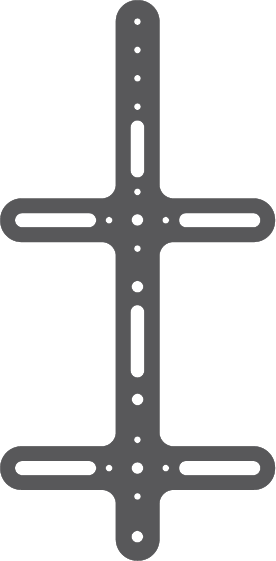
Finally, I’ve developed a variation on the “Chicago style” plate above that you might call “Chicago style with everything” — this has room for two Garmin 830s, a headlight, and a water bottle. Or skip the water bottle and add an undermount headlight. Or skip the Garmins and add a phone. This measures slightly less than 100 × 200 mm. This is realistically about as much will fit.

A design for an accessory mounting plate

Mastodon & moderation

I’m on the board of a regional burn, Burning Flipside. We have to deal with banning people and it’s the hardest, most time-consuming thing we do. There are some analogies to Mastodon bans and defederations that might be useful.

One illuminating difference is that our ban list is private: we treat it as very secret. But there are frequent suggestions that we should share our ban list with other regionals and accept ban lists from other regionals. And in fact, there’s at least one regional that proactively shares its banning decisions.

There’s a certain logic to this, because the populations of regional burns overlap a lot. People from one regional often go to others, including bad actors, and sometimes when a bad actor gets “run out of town,” he (it’s usually a he) moves on to another. So I understand why people would want shared ban lists.

But being notified of another org’s banning decision puts us in an awkward place: it creates pressure on us to respond to it somehow. But our own policies require firsthand reports, which one of these outside-org reports would not be, unless a member of that board is a firsthand reporter. And we might come to a different conclusion than the other org, which could be difficult to explain.

Why do we keep our ban decisions secret? Partly it’s out of liability concerns. We don’t want to be accused of libeling/slandering someone. Also, our decisions don’t always make sense out of context: we once had to “ban” a toddler who was at the center of a custody fight between two parents. Sometimes knowing who has been banned would convey information about who made the report to us in the first place, which we would want to avoid at all costs. Every decision is made in a unique context, and it would be impossible to apply standardized actions consistently.

There’s a difference in the kinds of problems Flipside needs to deal with vs a social-media content moderator. The interactions being reported often happen in private, and even if not, they don’t generally leave an objective record on the Internet. This is tough for me to think through. Speech acts are acts, and the Internet is part of real life. But still, there’s a big difference between being threatened online and being threatened in person, never mind being physically assaulted. The Flipside organization does have a policy not to tolerate “any form of expression that serves to demean, intimidate, or ostracize,” and we have seen some problematic forms of expression in the past, but we haven’t received reports about them since that policy has been in effect. The problems we’re dealing with are more immediate. In any case, I’m not sure how the differences in problems should inform differences in the ways they’re handled. It deserves some thought.

On Flipside’s board, we like to say “we don’t have a lot of options for dealing with problematic participants, and most of them look like hammers.” The Mastodon software offers a number of moderation features, some of which are more subtle than a hammer. As far as I can tell, Mastodon instances don’t publish lists of users under moderation, but in some cases, those users themselves will use another forum to announce that they’re under some kind of moderation.

Then there’s defederation, a way of one instance’s mods saying to another’s “if you won’t moderate your users, we will.” Best as I can tell, defederation is public. Perhaps necessarily so. The instance my first account is on shows which servers it has filtered/silenced/suspended—which is equivalent to applying that moderation to everyone on that instance, remotely.

Right now, it seems like a lot of defederation—or at least chatter about defederation—is happening either because an instance’s moderators have been too hasty or too relaxed about applying moderation. If an instance really has devolved into a hive of scum and villainy, then that’s fair. It’s the healthy thing for the fediverse to do. If it’s a few bad actors on a large instance, it strikes me as procrustean.

This is another way in which the difference between regional burns and Mastodon instances is illuminating. It would be impossible and undesirable for one regional burn to ban everyone from another regional burn.

I’ve got some ideas.

  • Fediverse mods need to have a running group chat, so that mods for Instance A can say to the mods at Instance B “I’ve noticed a pattern of problematic posts staying up/unproblematic posts being removed,” and they can talk it out before anyone needs to make a defederation decision. Maybe this already exists.
  • It seems likely that Mastodon admins are going to subscribe to external services that make moderation decisions for them. Keeping the lights on is hard enough, dealing with moderation decisions as well is a whole ‘nother ballgame. If this happens, then knowing what moderation service a Mastodon instance subscribes to will tell you something about what kind of place it is.
  • Sharing ban lists of individuals between instances, as an alternative to external moderation services, might remove some pressure to defederate, although this might be opening up a bigger can of worms.

Identity is going to be an important aspect of this, because it is possible to change instances, or use multiple instances at the same time. Mastodon provides an easy method to verify your identity, although it requires a bit of nerdiness. This can solve the problem of a public figure who wants to be identifiable but is an asshole. It doesn’t solve the problem of a committed troll, who can easily spool up multiple identities with multiple verifications.

Note: I’ve referred to Mastodon throughout this, but the same idea applies to any service in the fediverse.

Scroll to Top