How not to design a bike lane

bike lane diagram

A little while ago, I was riding to a downtown destination by way of San Jacinto Blvd, and noticed that they had striped it for bike lanes. Without wading into the controversy of whether bike lanes really are good for cyclists or not, I have to say, they really blew it here. The diagram above shows the lane striping at the 10th-Street intersection on San Jacinto.

If you’re on a bike and headed straight, what do you think you ought to do here?

If you stay in the bike lane, you’ve potentially got two lanes of traffic turning across your path. In order to avoid that problem, you need to swing across a lane and a half of traffic well before you reach the intersection. Neither is a good option. The latter is less bad, but will be counter-intuitive to a naïve cyclist. While I’ll be the first to admit there are a lot of people on bikes who do dumb stuff that understandably pisses off drivers, I wonder how often drivers are getting pissed off at cyclists who are just responding sensibly to poorly designed situations like this.

Coming home by way of Trinity Street, I discovered bike lanes there as well. Although I didn’t notice any intersections that were striped as egregiously badly as the one on San Jacinto, the oddity on Trinity is that the location of the bike lane relative to the curb changes from block to block. One block there’s a dive-in parking lane between the bike lane and curb. The next it’s immediately next to the curb. After that there’s a parallel parking lane between the bike lane and the curb. Unless you know in advance where you should be aiming, you will find yourself out of the bike lane after crossing almost every intersection. And the street is just hilly enough that in many cases, the bike lane on the far side of the intersection is invisible behind the crest of a hill.

It seems impossible to me that these bike facilities were designed by anyone who rides a bike.

East Side Pies

In the perpetual search for the best pizza in Austin, I am tentatively appointing a new leader: East Side Pies, 1401 Rosewood (next door to Sold Out 4 Christ ministries, near the Carver library and Long Branch Inn). Last night was our first order from there, so they haven’t established a track record, but damn, that was a good pizza. New York style thin crust. Excellent ingredients—Gwen, who doesn’t even eat meat, agreed “that’s some damn good sausage.”

The now-dethroned Parlor still has a damn good pizza with a slightly thicker crust, not to mention an ambience with a certain je ne sais quoi.

I’m still holding out for a good Chicago-style stuffed pizza (sadly, Mangia no longer counts as “good”), but I can be quite content with East Side Pies and the Parlor.

And now that I live on the east side, where many delivery places fear to tread, I can say “suck it” to the west side, because we’ve got better pizza here anyhow.

The trouble with Mail

I’ve recently started reading Hawk Wings, a blog focused mostly on Apple’s Mail.app and other personal-information programs like iCal and Address Book. I’m always keen on ways to tweak Mail, but I was moved to actually write about it by the recent post Mail’s most annoying bug. It got me thinking about all the ways Mail could be better.

When it was released with OS X 10.0, Mail was barely usable. I had used Eudora up to that point, but when I made the switch to X, I decided to leave the old OS behind completely. While Eudora was available, it did not handle Japanese; it only handled Japanese on OS 9 thanks to a plugin that had not been ported to X (I know nothing of the state of Eudora’s i18n today). I looked at some third-party alternatives, and gladly would have paid for one that I liked, but I found nothing that I liked better than Mail, so I stuck with that.

Today, Mail is a pretty good program, but it has obvious problems, and even if those were all fixed, would be solid but not innovative.

Bad/no keyboard equivalents: Mail lets you read messages one of two ways: by splitting the window into a message-list pane and a message-viewing pane, or by showing each message in its own window. My natural inclination (probably inherited from Eudora) is to open each message in its own window, but when you do this, it is impossible to use the keyboard to navigate between messages while viewing the message. You need to close the current message window, then arrow up/down, then open that message. It’s a small thing, but multiplied out hundreds of times a day it adds up. I am dumbfounded by the lack of this, as well as some of the strange keyboard commands that are there—the commands to send and check mail, two of the most common e-mail activities, are obscure and non-mnemonic.

Bad threading: Mail tries to group messages by thread, but also groups based on subject line. I have a client that uses the subject line “request” on every message he sends me, so every time he sends me work, I need to disclose an increasingly ungainly list of messages (I keep all the old ones around just because I am that way). Another weakness in this quasi-threading is that it is “flat”–it doesn’t show which message is replying to which. This is possible. Properly threaded e-mail been possible for decades. Apple should be able to figure it out.

Inclusion of .sig in body: As far as I can tell, most civilized mail clients segregate the signature line from the body of the message when you are editing. Not Mail. This means you needs to edit around the .sig, or add it back after you’ve deleted it.

Reply format oriented towards top-posters: I’m not going to say that top-posting is wicked and only evil, stupid people do it, but I don’t do it. [Update: Holy crap, look at the passions this topic arouses.] When replying to an e-mail, I try to interleave my points with the sender’s points. Mail is set up to encourage top-posting though: it places the cursor on a blank line above the quoted text, and prefaces the quoted text not with a salutation but with a more bureaucratic “on such-and-such a date, so-and-so wrote:”. So there’s that wasted blank line, and a first line that I almost invariably wind up editing (if you get e-mail from me that has that introductory line unedited, it means either that I’m really busy, that you are bugging me, or that I don’t know how to address you). Again, customized salutation lines have been around for a very long time. Mail should solve this and not assume that everyone is a top-poster. And when I want to interleave my response into the quoted text, Mail does a lazy job. The helpful thing would be to create three blank, unquoted lines with the cursor on the middle line. Mail creates one blank unquoted line. If I’m inserting a comment between two paragraphs of quoted text, there will be one blank quoted line just hanging there—it should clean that up. I think Eudora did.

Simple filtering: I use a lot of rules in Mail to direct my mail into the appropriate slots. I know that Boolean logic can get confusing, but Mail could offer an expert mode for creating rules like “If (A or B) not C” Yes, I know that Mailsmith can do this. I also know that Mailsmith has no support for Japanese. i18n is a real bright spot in Mail: before Mail, e-mail containing Japanese was a frequent PITA. I still have occasional problems with it, but the problem is mostly solved.

No queue for outgoing mail: This is another one of those Eudora features I miss. With Eudora, it was possible to write a message and queue it for delivery later (indeed, this was the default, though it was also possible to send immediately). Not with Mail: you send it, it’s gone. A five-minute grace period would save a lot of mistakes.

So far, these complaints are just of the “this is broken” variety. There are lots of ways Mail could actually be innovative.

Presentation of threads: This is one thing where gmail is out in front: it shows “conversations,” including both messages you received and sent as part of the conversation. Even if Mail would show all the messages in a mailing-list thread in one window—ideally with proper threading indicated—I’d be very happy. If it could go a step further and strip off all the detritus of footers and excess quoting, I’d be amazed.

Mailing-list handling: As long as we’re talking about mailing lists, Mail should be smart enough to recognize “hey, you’ve subscribed to a mailing list” and offer to set up special mailboxes and filters for it. Since almost all mailing lists run on a handful of platforms (Yahoo Groups, Google Groups, Mailman, and maybe one or two others), it should be possible to create special actions for quitting a list, etc, so that newbies who subscribe to a list they then decide to leave don’t post annoyed and annoying messages to the list asking “how do I leave this list?” (actually, this suggests a whole xmlrpc mechanism for managing lists, but that’s a topic for another day).

Ad-hoc mailing lists: this could be dangerous in the wrong hands, but sometimes it is useful to have a mailing list for a short period of time and a small number of people. With the right rules and actions, a mail client could emulate a mailing list well enough. There should be a quick way to set this up.

Alternate views: It could be useful (or at least interesting) to be able to view my mail database in calendrical form. Or by person. It would be interesting, for example, to see a histogram of all the mail exchanged between me and Gwen over time.

Old blog, new domain

I’m back to using Movable Type, although I’m intrigued enough with WordPress that I may continue fidding with it behind the scenes.

One thing that really is new is my domain name—it looks as if that deal is going through. My old e-mail address should continue working for a few months, and there should be redirects for this and a few other subdirectories that should also last for that period, but now would be a good time to update your address book and bookmarks. Wherever you see “crossroads.net”, change it to “8stars.org” (or “eightstars.org” if you prefer—they both work).

Why 8stars? It’s an obscure visual pun. The Chinese character for rice, ç±³, looks like an 8-pointed star (in fact, the Japanese nickname for the asterisk is “kome-jirushi,” or “rice-mark”). You can see a stylized version of this character in the header of this blog—I’ve actually been using that mark for some time. I would have registered 8star.org, but someone else already had. So I went with the plural. 8pointedstar.org is just too damn verbose.

It is with some regret that I part with the old domain name: I’ve had it since 1994, and really thought I’d have it permanently. As silly as it may be, that domain name had become part of my self-image. There’s also a practical reason to regret it: having a durable e-mail address has allowed some people to contact me at that address even after many years of silence. The flipside, of course, is that I get an ungodly amount of spam. So there’s a silver lining. Plus, well, there’s the money. Not enough to retire on, but enough to make a significant difference in my retirement fund, buy a few toys, and go on a trip.

Dizzy

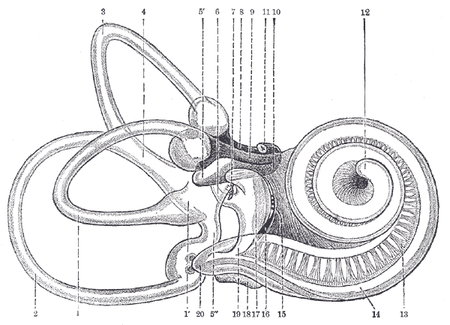
gray's anatomy picture of the inner ear

I’ve been laid up since Wednesday with labyrinthitis, an infection of the inner ear, which results in fluid-filled and inflamed ear passages. And dizziness. WoOOOooOOooo. It’s slowly coming under control with potent antibiotics; I was initially prescribed dramamine to deal with the immediate symptoms, but that turned out to be completely ineffective; I saw the doctor again yesterday and he prescribed a combination of valium and prednisone (cortisone) instead. The valium also seems to be ineffective (perhaps he prescribed it in part to counter the behavioral side-effects of the prednisone, which can put you on edge, from what I’m told), but I am on the mend.

For a couple days, I wasn’t able to keep food down. Since then, I’ve improved gradually. Today’s the first day I’ve been able to comfortably read more than a paragraph or so at a time, although it still requires more concentration than usual, and I’m unsteady when moving around. With any luck, I’ll be over all this by the end of the week. It’s been a strange experience: I think it’s the first time in my adult life that I’ve been so incapacitated by an illness that for days on end, I can’t do much more than lie in bed and watch TV. It’s also kind of strange that I would be laid low by just this one symptom–there’s been no pain or anything else that you’d normally associate with being laid up.

Ch-ch-ch-changes

I’ve been offered a big chunk of change for the crossroads.net domain name. There’s a good chance I’ll take it. If this happens, everything under this URL, as well as my e-mail (and Gwen’s) will change. More here soon.

Alfresco Whispers

Post-move, I’ve been cleaning out some old papers, and found this. I’ve decided to type it up and post it online for the benefit of future generations. This was originally typed up (and orchestrated) by Chris Poole. Although I’ve tried very hard to reproduce this in exactly the same form as Chris typed it up, it’s quite possible that I’ve introduced a few typos.

I don’t remember exactly which one of these I translated, but it was somewhere in the late 30s/early 40s.

At the closing luncheon of IJET-4 an exercise in consecutive translating was conducted, drawing on the expertise of the assembled translators and interpreters. A simple phrase in English was chosen as the starting point and a Japanese speaker was asked to translate it. This in turn was translated back into English, and then back into Japanese again and so on. People were asked to translate into their own language and were given sixty seconds to do so. No one saw anything but the previous version, and were therefore unaware of the subtle changes that were taking place.
It should be noted here that some difficulty was encountered due to people’s handwriting, but as the participants became aware of the overall objective, a guarantee of anonymity seemed to become more important. In deference to these numerous requests I therefore present the results typed up, with annotation where appropriate.

  1. Bridges between cultures are built on foundations of tolerance.
  2. 文化のかけ橋、忍耐を土台となる。
  3. Patience, indeed, is the foundation of bridges between cultures.
  4. 文化のかけ橋になるのは、忍耐しかありません。 “Foundation” component of metaphor disappears.
  5. The only cultural bridge is forbearance 忍耐 alternatively translated as “tolerance,” “patience” and “forbearance”. The latter perhaps confusing the translator, who finds refuge in an ambiguous use of the word 理解 which then of course becomes “understanding”. A very durable concept which lasts until 21.
  6. 文化は他を理解することで結ばれる。 “Bridge” metaphor disappears via 結び and “link”.
  7. Cultures are linked by understanding others.
  8. 他の人たちを理解することにより文化交流がなされる。 “People” are introduced through the ambiguity of 他.
  9. Cultural exchange is done by evaluating other people.
  10. 文化交流は、外国の人を理解することから始まる。
  11. International understanding begins with an understanding of foreign people.
  12. 国際理解は外国の人を理解するから始まる。
  13. International understanding begins with an understanding of foreign people.
  14. 国際理解は外国人を理解するから始まる。
  15. International understanding begins with the act of understading foreigners.
  16. 会得する、理解、始めに、その行動は外国人の行動を理解すること。
  17. Understand first that behavior is to understand the behavior of foreigners. Statement becomes rather incoherent imperative due to confusing layout of 16.
  18. 外国人の行動であるとまず理解すること。 Does not read 17 as imperative.
  19. To understand from the outset that this is the way foreigners behave. Seems to become conditional clause here.
  20. 外国の方はこういうふうに行動するものだと初めから理解すること。
  21. You must understand that this is how foreigners behave. Back to the imperative.
  22. 外国の方はこうなさいます。 Then back again to descriptive statement.
  23. This is the way foreigners would do it. “would do it” if what? Do what?
  24. これは外国人がよくするやり方です。 Solves above problem, but introduces question of frequency.
  25. This is what foreigners often do.
  26. 外国がどんあことをよく行いますか? Inexplicably becomes question. Also omits 人, leaving sentence to mean “what sort of things do foreign countries often do?”
  27. What kind of things do they like to do in foreign countries? In order to make sense of the above, invents identity/ies, not necessarily native to the countries, who now have a choice about “what they do”.
  28. その人たちは(かれらは)外国にいったときどんなことをしたいのでしょうか。 Good, if cumbersome, translation that makes it plain that “they” are visitors.
  29. What do you think they might want to do when they go overseas?
  30. 太りすぎたらどう対処すると思いますか。 Handwriting problem. Misreads “overseas” as “overeats”.
  31. If you are too fat, how do you handle the problem? Introduces value judgment on obesity.
  32. 太りすぎていたら、どうそれに対応しますか。 Female translator said she would rather not translate something like this. I emphasised that it was only a game so she obliged (but didn’t see obesity as a problem).
  33. If you were too fat, what would you do?
  34. ふとり過ぎていたら貴方はどうなさいますか。 Renders “you” as 貴方
  35. What will the lord do when he gets too fat? Mistakes 貴方 for 貴族 and renders it as “lord”.
  36. 神は肥りすぎたらどうするか? Reads “lord” as “God”.
  37. What do you do if God is too fat? 37, 39, 43, 47 all manage without a personal pronoun in Japanese. Personal pronounds cause problems on both occasions they appear in 34 and 40.
  38. 神様があまり太っていたらどうしますか。
  39. What would you do if god was too fat?
  40. 神が肥満過多だったら貴方は… Bases vague, open-ended questiion on condition that God were too fat.
  41. If God were too fat, what would you be? Good logical translation that deduces remainder of question.
  42. 肥りすぎの神様がいったらどう思いますか? Raises question of attitude rather than “being”.
  43. If there is an overweight God, what do you think?
  44. 太りすぎの神様がいるとすればどう思いますか。
  45. What would you think of a fat God.
  46. 太った神様をどう思もいますか。 Rumoured fat God lives!
  47. What do you think of the fat God.
  48. 神様太ったでしょう? Renders simple question as traditional Japanese greeting addressed to God.
  49. You look well God! Good translation.
  50. やあ、元気そうじゃないか! Supreme being departs as “God” is read simply as exclamatory component of greeting.
  51. Hello my lover. You’m be lookin’ fine today (Devonshire) Very ably translated into equivalent dialect.

We’ve moved

Giles house after move

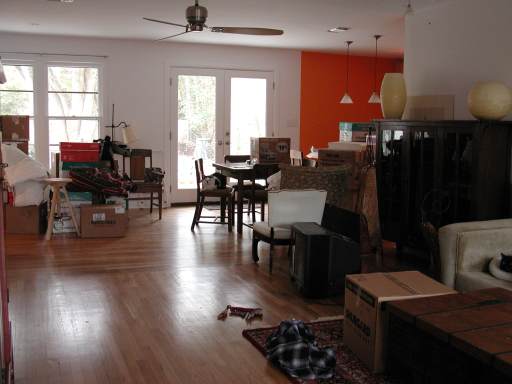
Our renovation is done. We’ve moved in to the new place. Now we just need to unpack and get rid of all the stuff that won’t fit. I’m exhausted.

Cathedral of Junk

Went to an event organized by the Museum of Ephemerata at the Cathedral of Junk this past weekend. I’ve been living in Austin for a while, and I’ve been a part of some of those things that “keep Austin weird,” so when I saw the cathedral, I was surprised that I had never even heard of it—much less seen it–before.

It’s extraordinary.

Every once in a while I encounter an artifact that rises above its humble materials and primitive construction, ennobled by the dedication of its creator to become something almost sacred. This is one of those things.

I saw it at night, and need to see it in daylight.

Scroll to Top