The Sidepad

I’ve been musing a bit lately about the problem of having too much information on our computer screens to deal with. I’ve also been thinking about the problems involved in using a computer as the hub of an entertainment center. What follows is a concept that might be able to address both problems, as well as a few others.

This is a gadget I call the “sidepad.” It has a few modes of operation.

1. Docked mode

In this mode, the sidepad is physically connected (via a docking station) to the host computer, and acts as a specialized secondary display.

I’ve written before that I like the idea of roping off a section of my display for to use as for status-monitoring displays and the like, or better yet, a separate display entirely. There wouldn’t be enough of this ancillary stuff to fill a normal display (even a small one), but a custom display such as I am proposing would be perfect.

Shown here is a very rough mockup of a 20“ iMac with an ancillary display showing how the two would relate.
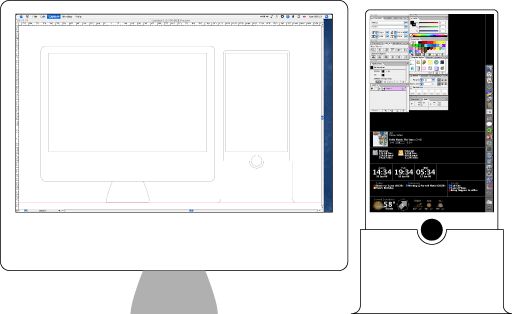
Image showing iMac with sidepad

Here is a detail of just the sidepad in docked mode
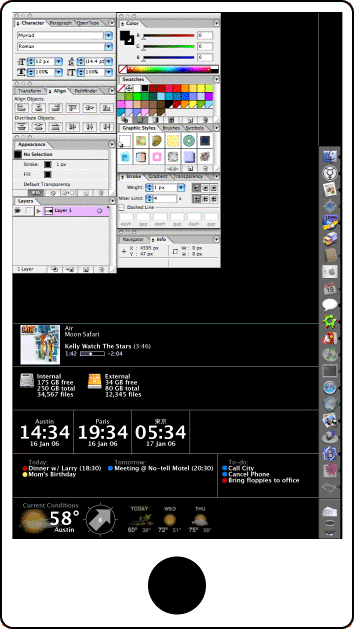
Detailed view of sidepad in docked mode

In this, the ancillary display shows the dock, application palettes, and ”dashboard“-style information, though in a much simpler and more disciplined format than Apple’s Dashboard. For lack of a better name, I’ll tentatively call this part of the display the ”dashpad“. Rather than having each widget being free-floating and self-contained, each dashpad widget fits into a ”slot“ and has no chrome (though actual widgets in this case could be somewhat dressier than I am showing them here). I have left the application palettes alone, although I envision a standard visual format for them, along with a special API to take advantage of the ancillary display.

How would something like this work technically? At the physical level, I imagine a dock that would connect to the host via Firewire. Although it would act in some respects as a second display, it would probably need to be treated more as a peripheral; it would have its own processor, which would need to collaborate with the host to fake acting like a second display in some respects.

At the software level, the OS would need a new API that let applications relegate palette display to the sidepad when present, along with support in the OS for the look and actions of those palettes. Likewise display of the dashpad.

2. Detached mode

In this mode, the sidepad is undocked from the host computer, but within wifi range, and acts as a remote terminal for that computer, as well as the command center for home entertainment.

We’re at a point where having a remote display for one’s home computer can be incredibly handy. Such as:

  • You see something while watching TV and want to check some background info on the web (IMDB entry on an actor, product website for something you see advertised).
  • You are piping music from your computer to your stereo. You want to be able to see track info, and to have more control over playback than next/previous track buttons on a normal remote offer.

Obviously these tasks can be accomplished with another computer networked into your primary computer, but this can require a fair amount of setup, and the expense and maintenance of an another computer. Apple likes to talk about its computers being ”digital hubs,“ and I love the idea, but I need to be able to use it out at the ends of the spokes.

Shown here is the sidepad removed from the dock. It would communicate with the host over wifi (probably setting up a VPN). Assuming the mac was also hooked up to, say, a TV and stereo, the sidepad would work as a remote control in this mode, directing media signals to the appropriate outputs.
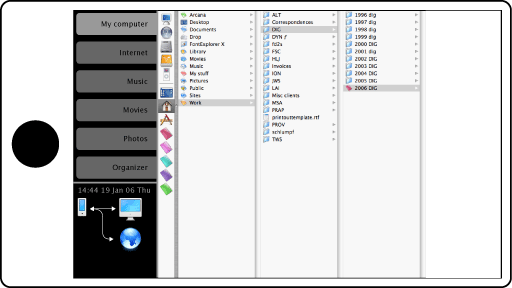
sidepad in detached mode

In this mode, the screen would show something completely different. A fixed source browser would appear on the top-left, with tabs for one’s computer, the Internet (which would show a browser in the remainder of the screen), music, movies, photos (which would hook into the appropriate sources on the host’s hard drive, and display suitable browsers), and an organizer (contacts and calendar that would sync with the appropriate iApps).

3. Outbound mode

In this mode, the sidepad is operating independently of the host computer, functioning as an Internet terminal, media player, and PDA.

A lot of people who mostly need a desktop computer could also use something lightweight for e-mail, web surfing, and entertainment when they are away from home. The proportions of the display are not an accident: it has a 16×10 aspect ratio, for widescreen video. A laptop (especially a used one) is not an unreasonable solution, but may be overkill, and requires more work (and if Apple has its way, a .Mac subscription) to keep in sync with one’s desktop. Low-powered, small, and lightweight web-surfing tablets such as the Nokia 770 and Pepperpad already exist, but these are not really designed to sync with larger computers, much less provide either of the other modes I’ve discussed.

In order to fulfill its other functions, the sidepad would need a powerful enough processor to act as a PDA, with utility applications like a word processor, spreadsheet, and e-book reader. So it would be a no-brainer to include these functions in this mode.

One aspect of this mode that is open to criticism is the fact that it would require a fair amount of storage to be useful, increasing its price and putting it dangerously close to iPod territory. This could be handled by making storage optional, by using a memory-card slot, or by actually designing in an iPod dock.

The display in this mode would be very similar to that in Detached mode. The functionality would be different, though. The ”my computer“ tab might be disabled if a VPN at a decent speed cannot be established. The media tabs would reveal locally stored content, not content on the host computer.

Objections

What are the odds of something like this being built? Slim. There are a lot of problems with this idea:

  • Price: it might wind up being expensive enough that most people would reasonably ask ”why not just get a laptop?“
  • Size: For one thing, the size is not one we’ve seen before in a portable product—bigger than a PDA, PMP, or portable game console, but smaller than a laptop. The fact that nobody’s selling a device this size (measuring roughly 12” x 6“, the size of a license plate in North America) may be because nobody would buy it. For another thing, in order to feel well-connected to the host machine in docked mode might require different models for different screen sizes.
  • Marketing: With several different modes, none of which are ones that most consumers will instantly grok, this would be a challenge to sell effectively.

Still, I’d buy one.
Renovation, week kajillion: colors, trim, and hardware

We’ve gotten to a point in the job we’re all the fussy stuff has to get tackled, and where it takes a lot of work to see a little progress. We’re also starting to see little fit-and-finish issues, consequences of bad planning, etc. Nothing too serious.

One mistake I made in our electrical plan was that the ceiling fans all have light-kits, but I didn’t reflect separate wiring for both fan and light in the plans. I just figured that out last night, and correcting that problem will be a little sticky. We’ll have to compromise in a couple spots. I can live with that. As much work as I put into trying to figure that out, I could have put in more.

Karl noticed that, now that the cabinets are installed in the bedroom, the ceiling fan looks poorly positioned. I didn’t think it was a problem, but he said “we’ve feng-shui’d the heck out of this room, and it would be a shame for it to be out of place.” Another problem with this room—one which we could only detect under the harsh glare of flashlights at night—is that there had been some sketchy taping and floating at some point in the past (I think), and so the new paint was forming bubbles over those spots. We’d caught a couple spots previously, but found more last night.

The brown color we had chosen for the bedroom just didn’t quite look like we expected. Karl pointed out that the color chip we had used is flat, but the paint we had selected is eggshell, which has a little sheen to it; he said the sheen changes the way you perceive the color. He went and recovered the room with flatter paint (and perhaps a tiny bit blacker) and it looks very close to what we were expecting. The paint in the other rooms looks great, though. Karl repainted the oven hood, and annoyingly, hairs got caught in the wet paint as it dried.

One of the two sets of double-doors for the office closets are up, and they don’t quite line up with each other. Not hard to fix, Karl tells me.

I’m thinking/hoping that by catching all these little things as we go along, our punchlist at the end will be very short.

Although the process has been moving along quickly, we’re getting impatient to move in, mostly because we’re fed up with the place we’re in now. It’s not a bad place (hey, we’re trying to get it rented out), but the new place will be a lot better.

Unexpected beauty

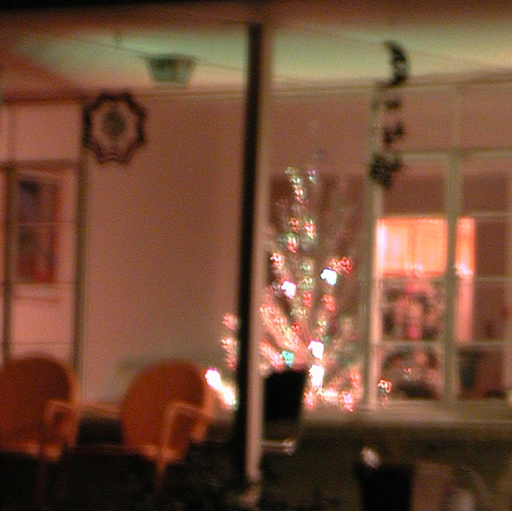
I was walking down a quiet street at night in my neighborhood, listening to Cat Power’s melancholy “Evolution.” I spotted an aluminum Christmas tree looking ghostly in a picture window, rotating with shifting colors, and in that moment, each was the perfect complement to the other, each elevating the other to a higher plane.

Aluminum Christmas tree

The Trouble with 37th Street

I lived on 37th Street during the Christmases of 92, 93, 94, and 95, and was an enthusiastic (if not always artistic) participant in the whole lights display. I have always thought the lights were wonderful, and that they helped create a sense of community on that street that I haven’t seen anywhere else. I’ve stayed closer to the folks I knew from 37th Street than any other neighborhood I’ve lived in.

In recent years, the light show has shrunk. I believe the Christmas just past will be the last.

The Chronicle just ran an article on the diminishing lights, fingering absentee landlords in California as the ultimate culprit. This is nonsense. Mike Dahmus used this as a jumping-off point to complain about low-density student housing.

The reason that 37th Street is going dark has to do with people and personalities. It has something to do with landlords as well, but a homegrown one.

People leave

Jamie and Bob were the original instigators of the whole show. Robert later joined in and, with his volcano and motorcycle, put up one of the three showcase displays on the street. Robert and Bob have both left; Jamie is leaving. Ray was also noteworthy for his car-hedge of lights. He’s gone. There’s just not that much holding the street together anymore.

The real-estate market

There are a lot of rent-houses on that block, but there were a lot when I lived there too—I was in one of them. Eight of those rent-houses are owned by a local guy, whose name seldom passes from my lips without being preceded by the word “slumlord.” In fact, he owns 308, which Jamie once occupied, and which under this guy’s stewardship has been home to a meth dealer; I believe it was more recent occupants of that house that Jamie got into a fight with (as mentioned in the article). When I was living on the street, I believe the same guy owned the same number of houses on the street. 308 was unoccupied—it was owned by this guy, who was undertaking an extremely desultory and dubious expansion and renovation of it. All of his houses are messes, only rentable to less-discriminating students.

Note the way this article changes gears in such a way that you’re not supposed to notice:

Neighbors partly blame changes in the neighborhood on irresponsible and absentee landlords. “We didn’t demand all we could get from the houses,” Pine said. Now, eager to reap the highest rents possible from the maximum number of tenants, greedy landlords are letting “kids get away with murder and won’t do anything about it,” he complained. [Emphasis mine]

The irony is that Ray himself once owned most of the houses in question, and sold them to people like this guy.

Barnes – who counted five homes that have changed hands this year on 37th Street, compared to what he said is usually one

If you want to place the blame somewhere, you could also blame the outrageously high property taxes in this state (and rates of increase in those taxes) that force people out of their own homes once their neighborhood becomes sufficiently desirable. This increasing churn rate is not unique to to 37th Street–it can be seen throughout the surrounding neighborhood.

Personalities

When I lived there, there was, shall we say, an institutional memory for the lights. There were enough people on the street to enforce certain social norms. Jeannie would lecture visitors who left trash behind, and there was a strong anti-commercial sentiment on the street. So there may have been a broken window effect in action: by dealing with minor infractions, major infractions never happened.

As this institutional memory left with the old-timers, street hawkers moved in and the scene became rowdier. Another less public aspect of this is Jamie himself. While Jamie has never openly appealed for money, he has always been the recipient of spontaneous largesse from visitors to his backyard. The amounts of money involved are considerable, and this created animosity between Jamie and some of the other old-timers, who felt that he should donate the money, share it out, or simply not make it so obviously easy for visitors to give money to him (he kept up clotheslines with clothespins where people can hang money). I have to believe that this friction within the street’s micro-community must have caused some old-timers to lose interest in maintaining the street’s Christmas zeitgeist.

. . .

It pains me to write all this, rather, it pains me that all this is so. Living on 37th Street was a great experience, and it is sad that the community that made the lights possible no longer exists.

Collaborative content and social awkwardness

I check in with Wikipedia every day, and try to be a good steward of the articles I’ve contributed to.

Wikipedia is a funny thing. It’s easy for two people of good intent to have very different ideas of what’s appropriate content, and to get into a fight over what belongs and what doesn’t. In situations like this, the “right” thing to do isn’t very clear-cut. In some situations though, there is a clear right and wrong. Commercial links and self-links are explicitly discouraged.

So it felt a little awkward for me today when I discovered someone I kinda-sorta know had inserted links to his own site in many articles. This is a little like cussing in church.

I reverted all his insertions.

Another snag

Looks like this was the week for miscommunication. First our cabinets came in slightly misconfigured (which we decided we could live with), now this.

The floor in the kitchen was kind of a mess. Originally pine planks, it had a layer of linoleum, then a layer of plywood, then another layer of linoleum on it. We wanted to strip everything down to the pine and have that refinished. The floor would have a lot of “character” (ie, flaws), but that was OK. If the old floor turned out to be excessively torn up, we were thinking of having oak laid to match the rest of the house as Plan B. We were clear with our contractor about our plans, and he thought he had clearly communicated it to his crew. The crew had previously ripped away the plywood, and had made a little headway on the lower layer of linoleum, but when we dropped by the house yesterday, all the pine planks were ripped up.

We called Karl to ask what was going on, and he was as surprised as we were. Apparently, someone on his crew had it in mind that we wanted everything stripped down to the subfloor. I know exactly how that is—you take an idea into your head and it refuses to be dislodged. Karl commented that some of the conversations he had with this guy indicated (in retrospect) that they really weren’t on the same page, but he didn’t realize it at the time.

So, Karl asked “what kind of floor do you want?”. Since he’s eating the expense, we didn’t want to stick it to him. We hadn’t been thinking in terms of putting tile down in the kitchen, but once we did, it started making a lot of sense. Plus (as a benefit to Karl), it’s something he can do with his crew, rather than job out (he’s not comfortable laying hardwood floors), so he’s only stuck with the costs for materials. Gwen and I headed straight over to Travis Tile and in a remarkably short time found a tile that we liked and that was pretty inexpensive—it’s a porcelain tile that looks remarkably similar to the countertop material we’ve chosen. Gwen commented that it was probably the fastest decision she’s ever made—no doubt an exaggeration.

This sets us back a day, and it’s a tough break for Karl (probably to the tune of $400 in materials), but it’s a happy accident that we’ll come out of it with a better floor than we had even contemplated before.

Week 5: cabinets and trim

Week 4 was pretty quiet, what with Xmas and all, but things are rolling along again.

Our kitchen cabinets arrived on the 27th, a day ahead of schedule. Karl called and told me “We’re having a little trouble fitting things in the way we planned.” Uh oh. “I’ll be right over” I tell him (even though I need to be at a practice for First Night in less than an hour). Fortunately, we’ve had very few moments like that.

One of our design constraints has been preserving this nifty old Vent-Rite hood that came with the place. It’s 40“ wide (to suit the original stove). We wanted our new 30” stove centered underneath it, or nearly so, but this resulted in an extremely narrow base cabinet (5“–6”) between the stove and the wall. We had approved plans that showed an open-fronted 6“ base cabinet there.

When the cabinets arrived, we discovered that the cabinet-maker had borrowed 3” from the left of the stove and put it on the right, to make that narrow cabinet 9“ wide. This meant that, without some modification, the left side of the stove would be almost flush with the left side of the hood—something we had explicitly been trying to avoid. Either we could live with this, have one of the wall-hung cabinets remade to be narrower (allowing the hood to slide over), or have all the base cabinets remade to the original specs (there is one monolithic base cabinet left of the stove, and the narrow one right of it). Had we insisted on that, the cabinet-maker would have taken a bath on this job, and it would have pushed our schedule way off. I called Gwen to advise her of the situation and say that I was willing to live with the cabinets as-is. She decided to come over and look for herself. She was annoyed at the situation, but decided she could live with it too after seeing it.

I’m not sure why the cabinet-maker made this change. He may have decided a 6” base cabinet was a dumb idea, and wasn’t aware of our reasoning behind it. More detailed communication might have helped. All that said, the craftsmanship on these cabinets is excellent. Better than we were likely to get from any of the big cabinetry suppliers, and tailored to our kitchen’s small dimensions.

Karl’s crew has made the massive boxes for the bedroom’s wall of storage. I think Karl is going to let the cabinet-maker handle the face-frames and doors, but he might be taking care of that himself.

The butcher-block surface for the kitchen island arrived yesterday, and we’re still getting an estimate on the quartz surface for the main counter. Most of the baseboard trim is in place. Karl has been measuring out the built-in bookcases—these are in the part of the house where the foundation and framing are most askew, so those will need a little fudging to look right.

First Night

Other cities have been doing this for some time, and now Austin is holding its first First Night, which will turn the downtown area into a big arts festival on new year’s eve.

I’m going to be a performer—there will be a total of five fire troupes (including Sangre del Sol, who are amazing, and our own troupe, which we are calling Pyrogenesis) performing at Auditorium Shores, in front of the skeleton of the old Palmer events center. The fire extravaganza will supposedly be running from 8:00 to 11:00 PM (add N minutes to allow for disorganization); our troupe is smack in the middle.

Every time I mention First Night to friends, they say “wha…?”. I’m sure this blog entry will make up for the paucity of publicity the event has been getting.

There’s nothing so pure as the kindness of an athiest

Gwen’s been a fan of Freakwater for some time—a couple of women belting out country music with warped lyrics. Last night they played at the Cactus Cafe, along with a drummer/clarinetist/keyboardist, pedal steel guitar/mandola player, and bass player ripped straight out of the Rockabilly Book of Stereotypes, with an ugly old turned-around Rickenbacker and a black cowboy shirt with pearl snaps and embroidering. It was a good show. Two encores. The Zincs (well, the Zinc, since there’s only one) opened, and he was good too.

As a side note, it is interesting that Freakwater posts fan transcriptions of their lyrics on their website. After the recent flap over lyrics posted online, this is refreshing.

And as an update to this side note, it’s doubly interesting that Google’s new music search takes you directly to a lyrics search link.

Scroll to Top