IJET-15, Day 1

Saturday and Sunday were the days of the conference. It was starting at 9:00 AM, so we had to be out the door and heading towards the 東横線 by about 8:00. Not that this was hard to manage: aside from our circadian rhythms being almost perfectly out of phase with the local time, Tokyo is in the wrong time zone: the sun was up at 4:30 AM, and Bryan’s office gets plenty of light. So we were awake pretty early.

Once at the station, I vaguely recalled that 桜木町 was the stop for the Pacifico, but to my consternation, the Toyoko-sen didn’t stop there anymore–instead it had a stop at みなとみらい. Which also sounded like the right area, based on my memory, but not what I expected. Off we went. Turns out that the Toyoko-sen’s route had in fact been diverted recently, and my guess was correct. As Tom explained over lunch (at a wacky little Chinese place), 東急 had built backwards from the new station, which is underground, up to the point where the new segment would intersect the old, and in one night after the trains stopped running, ripped up the section of old rail over the juncture, relaid it to connect to the new segment, made a couple of test runs, and continued with service as usual the next morning. Quite an audacious feat of engineering–something that was a recurring observation through this trip.

Gwen was not in on the conference, but would be attending the schmoozefest that night, so she came in to Yokohama with me and lit out on her own. She managed to find her way around well enough.

Sessions attended that day: the opening plenary “state of the industry” session, and on a new publishing venture launched by some of my fellow translators. I checked in on one about translation memory, but wound up leaving that to catch up with friends. Richard Sadowsky observed that when we had first gotten to know each other at a much earlier IJET–perhaps IJET-3 in 富士吉田(?), he had commented that he and I seemed to be the youngest translators there, but that was no longer true. He’s right: Richard has aged quite a bit since then.

Gwen made her way back to the conference site, and everyone shuffled downstairs to the dinner, a really lavish buffet with free beer and wine. Gwen and I were still kind of looped from jet lag, and made a relatively early departure.
Harajuku-Shinjuku meandering

Friday the weather had mercifully cleared (in fact, we didn’t really get rained on at all for the rest of the trip), and we relocated to Bryan’s office, which would be our base of operations for the rest of the trip.

There were some last-minute details about the conference that I had been meaning to check online–I wanted to refresh my memory of which train station to exit, for example. Though I had set up an account with a local ISP, GOL, I was unable to log on for some reason. Very infuriating.

I took Gwen to Harajuku. It’s my favorite part of town. We wandered around aimlessly. I was a bit disoriented by the changes in the neighborhood: where there had once been a couple of sidewalk cafes on 表参道 there were now gleaming retail showrooms. And the Aoyama Apartments, the first Western-style apartment building in Tokyo, were demolished. This wasn’t a surprise–the death knell had sounded on them a long time ago, but it was still a shame that a bit of Tokyo history was gone. For the most part, the backstreets (though they had no doubt seen many small businesses come and go) looked about the same. We walked past Jenny’s old apartment, and it still stood, though there was a little novelty shop wedged in front of it now. Nearby was an excellent stationery store that I remembered, with an incredible selection of postcards and desk-stuff on the ground floor, and a lot of art books downstairs.

We kind of wandered via a route that I’d never be able to reproduce through 千駄ヶ谷 up to 新宿. We wandered around there some more, taking in both the busy-but-civilized part and the sleazy 歌舞伎町 Quite a lot of walking that day.

Japan trip: depature

I hadn’t been to Japan since 2000; Gwen had never been. But this year’s IJET conference was going to be in Yokohama, it was coming shortly after our marriage, so the trip would serve as a honeymoon, and, well, Lost in Translation just made me really nostalgic for Tokyo. And although the trip would be expensive, I really felt that I needed to try to drum up some business in Japan, since that’s where most of the J-E translation demand is. So we decided quite some time ago that we’d go. Gwen negotiated a lengthy vacation from her job. We got tickets at a pretty good rate through JTB (though flying on AA instead of JAL–a bit of a letdown).

We left on Wednesday the 19th and arrived in the evening of the 20th after an uneventful flight. A typhoon was in the area, and Tokyo was getting heavy rain. After a bit of misdirection, getting very wet in the process, we made our way to the 多摩旅館, an inn in 高田馬場 run by a fellow translator who I vaguely knew from my days in Japan; although we would be crashing at a friend’s place for most of the trip, we needed a place where we could sleep in to get over the initial shock of jet lag. That was pleasant, and there was an Indian restaurant I had never tried, Malabar, just a few doors away. It has been my ongoing project to eat at all the Indian restaurants in Tokyo, so after we checked in and got settled a bit, we had dinner there and ate quite well. I learned that Takadanobaba has become a haven for Burmese refugees, and there are a lot of hole-in-the-wall Burmese restaurants there where the menus are available only in Burmese–no Japanese, no English.

How I use Movable Type

Since Mena asked so nicely, here’s my setup.

My MT database has seven blogs in it:

  1. This blog–this and the next two would probably count as a single blog under Six Apart’s current licensing;
  2. My “hit and run” blog;
  3. My “longer articles” blog;
  4. Instructions for making firedancing equipment. This isn’t very bloggy, but it was more convenient to do this in MT than all by hand;
  5. The Honyaku Home Page. This has five authors (though only two others, aside from me, are really active). Also not very bloggy, but MT is a good enough CMS for the purpose;
  6. Jenny’s personal blog;
  7. A test blog.

I’ve thrown up a few other demo blogs here and there under this install, but those have all been temporary.

The paperless office

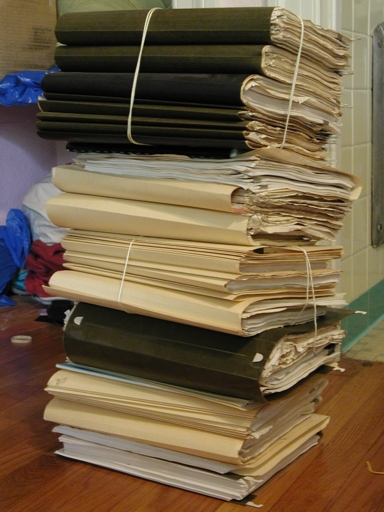
pile of work manuscriptsI’m doing a little housecleaning and found this stack of old jobs shoved into an inaccessible shelf in a closet. These are all Japanese source documents, mostly faxes on flimsy thermal paper, with text now faded to pale gray. The stack is 24″ tall.

I didn’t make a careful survey, but it’s likely that very few of these papers are any newer than 1992; that’s the year I got a fax-modem. Since then, I’ve had a digital copy of almost every job that’s come to me. The paper copy (I always print out my jobs, regardless) is a temporary convenience–it’s not what I think of as the archival version. I kept around these old papers out of some completeness fetish, but really, the odds that I’ll ever want to refer to any of these (or that I could find what I wanted) are vanishingly slim. So away they go.

In the book In the Age of the Smart Machine, Shoshana Zuboff observed that when the back-office operations at an insurance company were first computerized, the operators still preferred to consult paper files: they considered the online information to be ephemeral and suspect, and felt that the information’s “real” form was on paper. Not me.

Interestingly, I’ve acquired a new client that has a completely paper-based workflow. But so far, I’ve been able to scare of PDFs of most of the documents they send me anyhow.

Another pocket of slack stamped out

The end of free has come to Movable Type. If you want to upgrade and be honest, it’ll cost you. A lot. I am disappointed.

I am an enthusiastic user of MT2. It’s a good program. I’ve encouraged other people to use it, and via the MT support forum, tried to help the community a little. But based on my own current usage, I’d owe Six Apart $150 if I upgraded to MT3: their license is based on the number of authors and blogs you host, rather than a more direct metric, like the number of support requests you make. And my usage is entirely for vanity and community projects: it’s not like I make a dime off any of this. That’s a lot of money to spend on free expression.

Even that might not be too bad if I perceived much value in this upgrade. I don’t. As useful as MT2 is, it’s getting long in the tooth, and there are features that users have been clamoring for for years, few if any of which appear in the new version apart from comment management.

For the time being, I’ll sit pat. MT2 works, and it isn’t going to stop working. But there are features I was expecting in MT3 that aren’t there, and (as I understand it) will not be there unless developed by third parties. Switching to a different system–even an open-source one–would be expensive for me in terms of time: I’ve got a lot invested in tweaking MT and learning its ins and outs, and getting to a similar level of proficiency with a different system would take a long time. So in that sense, it would be reasonable for me to pay $150 to upgrade (if I had a reason to), but only because they have me over a barrel.

Later: After the barrage from the blogosphere, Six Apart has backed off a bit–giving you more for your money and allowing a more expansive definition of a “blog.” I congratulate them for being responsive. With a little creative counting, I could probably sneak in on the $100 license now. Still not exactly cheap.

Lowered standards

I’m accustomed to getting various paypal scam-spams that direct me to a paypal-like page in the hopes that I will naïvely give them my login info. I just got another. This one is noteworthy for the URL:
http://v093707.dd2336.kasserver.com/zero/scampage/
Come on, guys, if you’re going to run a scam, don’t call attention to it right in the URL! There used to be a time when grifters took pride in their work and put some craftsmanship into it. I’m very disappointed.

Kill Bill: Vol. 2

Yet another in my orgy of movie postings, I saw Kill Bill 2 last night. Very good. A somewhat different feel from Vol. 1: less campy, less bloody (though still, pretty damn bloody), more intense. Excellent cinematography. QT is the ultimate cult-film aficionado who was granted three wishes by a genie, and he has made the most of those wishes. He even appears to be using different kids of film stock to evoke different moods (or digital post-processing to create the same effects): black and white segments, which are memorable for the brilliantly lit tight shots of Uma Thurman and David Carradine showing the geological surface of his face and the subtler imperfections on hers; muddy-colored segments located in Barstow CA, that made me wonder whether he had unearthed some 1970s-era film stock, and super-grainy blown-out footage from Pai Mei’s temple, evoking cheap Hong Kong action flicks.

Some movies leave you with the sense that some establishing scenes, which would have helped make sense of the plot, were left on the cutting-room floor. Not with QT. This movie is all about how we got to where we are. So before The Bride can punch her way out of a coffin, we break to a flashback, a story that would stand on its own, to explain how she came to be able to do this. And this is tightly linked to another flashback story that answers another niggling question.

It was interesting to be made aware, with those pitiless close shots, of the tiny wrinkles now appearing on Uma Thurman’s face. Even teenage celebrities are getting obligatory plastic surgery these days, and some women a generation older than Thurman can no longer frown from all the botox paralyzing their faces. And it was interesting to consider that this increasingly inhuman standard of beauty must be influencing the way movies are made: a lot of actresses probably would refuse to put their features under the audience’s loupe, or would insist that the laugh lines be photoshopped away. Some actresses probably couldn’t be cast for a role like this at all, because they are physically incapable of the facial gestures required. It seems ridiculous to say that Thurman deserves respect for putting herself on display in this way, but the way things are headed, perhaps she does.

The Seagull’s Laugh

Saw The Seagull’s Laugh a little while ago. Noteworthy if for no other reason than being the first Icelandic movie I’ve ever seen, it’s interesting as a weird little slice into life in a postwar Icelandic village, and the study of a mythologically witchlike character (appropriately named Freyja) and her machinations. In fact, I suspect there are a lot of mythological references that I’m just not catching (there’s something about Freyja’s red hair pinned to the wall that seems especially freighted with symbolism).

Robot Stories

Robot Stories was a special AFS showing at the Arbor, and I’m glad I caught it. A tetralogy of related shorts that dealt with serious science-fiction questions, questions of the edges of what is humanity. These are rarely addressed in SF movies–in AI the last time I saw, though perhaps less successfully because of the Spielbergian cruft.

The second of the four in this film was out of place and the weakest of the lot; the others looked at how we relate to machines, and at what point machines become people. Or people become machines. And a host of related questions, many of which have been taken up many times in SF literature, but which a good movie shows in a new perspective. If your consciousness is downloaded to a computer shortly before you die–and continues to be aware, present, and involved in the world–are you dead? And if you had a spouse, are the two of you still married? And if you are, is that a good thing? This movie evoked these questions in me, in some cases with a single silent shot.

Scroll to Top