Thoughts on an iPhone app for bike touring

I’ve played around with a number of iPhone apps for cyclists. None of the ones I’ve looked at are really optimized for bike touring—instead, they’re mostly oriented towards fitness cycling, which has somewhat different goals.

An iPhone app for bike touring would need to overcome the problem of battery life and fulfill three main tasks. Battery life isn’t as big a problem as it is generally made out to be, but even in a best-case scenario, it would be difficult to get a solid 24 hours of use out on a single charge when using the iPhone as a bike computer for a big part of the day.

The not-Nueces not-Bike Boulevard

Dear City of Austin—

I think your heart actually is in the right place regarding bikes. You want to do right by bikes. But time and again, you’ve shown that when you apply bike facilities to existing infrastructure, the streetscape is such that the results are worse than no bike facilities at all. Beyond that, the fact that compromise apparently is valued not only as an end in itself, but as a higher goal than a good outcome (which is the nicest way I can say that you lack the courage of your convictions) means that good ideas get turned into bad ones. We saw this with Shoal Creek Boulevard, and now we’re seeing it with the Nueces Bike Boulevard.

The irony is that Nueces already feels like a de facto bike boulevard. It gets very little motor traffic and is a pleasant place to ride. When the project was first announced, I thought it was smart, a way to recognize and build on what already exists.

But the whole Shoal Creek Boulevard debacle taught us that the city prioritizes convenience for parked cars above bikes. I suppose the retreat from the original Nueces Bike Boulevard plan is slightly less appalling, in that it shows the city prioritizes convenience for moving cars above bikes. But it is still galling.

I don’t want to be that guy who complains without offering solutions. Here’s mine: Stop. Stop planning or announcing any bike facilities whatsoever. You just get our hopes up and then let us down.

Survey of iPhone bike-computer apps

I’ve written before about the iPhone’s potential and drawbacks as a bike computer. And there are a lot of bike-computer apps available for it right now. Let’s take a look at them.

I’ve gone on a bit of a kick lately and tried out four different ones. There are one or two others that I haven’t gotten around to yet. I hope to eventually, and will report on them in this space when I do.

Executive summary: Rubitrack for iPhone and Cyclemeter are clearly oriented towards performance cyclists; right now I’d give the nod to Cyclemeter. GPSies seems almost like a toy, but might be of use to hikers. Motion-X is for GPS otaku.

Moving forward and circling back

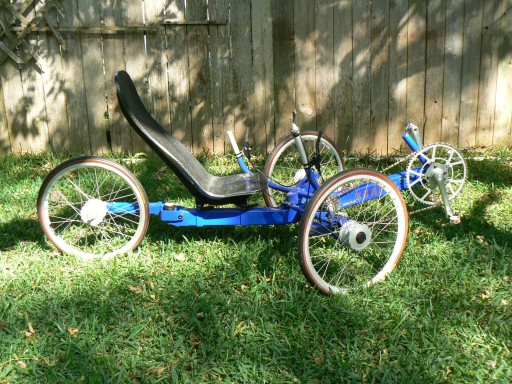
zenit-3

I recently resolved a nagging issue in my life that had been like an albatross around my neck for years.

Back in ’97, I visited the Netherlands, and became interested in recumbent trikes. I’ve always been drawn to the mechanically obscure, and if recumbent bikes are weird, recumbent trikes are way out there. As is my wont, I researched them obsessively when I got back home, and eventually homed in on a model that, even by the rarefied standards of recumbent trikes, was exotic. It was the AS Engineering Zenit. Made in Russia by former Illyushin Aircraft engineers, it had front-wheel drive, a box-section aluminum frame, hydraulic drum brakes, and other unusual features.

I ordered one. It took forever to arrive—the better part of a year. I may have been the last customer to have an order filled. I know that AS Engineering stiffed several customers. It didn’t come as a finished product, but it didn’t come as just a frame (the way many custom bikes do) either: because of its many custom parts, it was somewhere in between. I began putting it together with quality parts, but after a while, I got bogged down. I had routed the hydraulic lines poorly, and didn’t want to redo them. One of the lines also needed to be re-bled, which was a massive pain. The shifting was erratic, and I had trouble getting that dialed in.

So it sat in the shed. For a decade.

Every time I went into the shed, there it was, mocking me. Eventually Gwen gave me the ultimatum “ride it or get rid of it.” and I eventually decided to get with the program. I took it to Austin’s recumbent bike store, and had the proprietor deal with its various shortcomings. At the same time, I found a website for recumbents that included a classified section. Someone saw it listed and told a friend, who had been looking for a Zenit for years. I sold it.

Putting that trike behind me was an illuminating life-lesson. I had let a molehill grow to a mountain in my mind: I had become frustrated by some minor problems and intimidated by the prospect of fixing them. Ironically, in the ten or so years that had passed, those problems became much more difficult to solve (the hydraulic parts needed for the trike had become much harder to obtain, and there was a new leak somewhere).

But revisiting the trike reminded me of an idea I had for it when I first got it: to use it as the vehicle for a transcontinental bike ride. I had completely forgotten about that goal after the tumult of breaking my pelvis, getting divorced, and getting into firedancing in 1999–2000. But reminded of it, I realized that I still wanted to do it. I mentioned it to Gwen and she said “You’re not getting any younger!” So that’s going to be my big project in 2010.

Ironically, I still think that a recumbent trike is the right vehicle, but I have no regrets about having sold the Zenit, and would shy away from using it for this purpose if I hadn’t: a trike with critical parts that simply cannot be replaced if they break is a bad vehicle for a 3,000 mile journey. And at this point it would be bad mojo to ride a trike that symbolized my own inability to complete a project.

Dean Keaton restriping

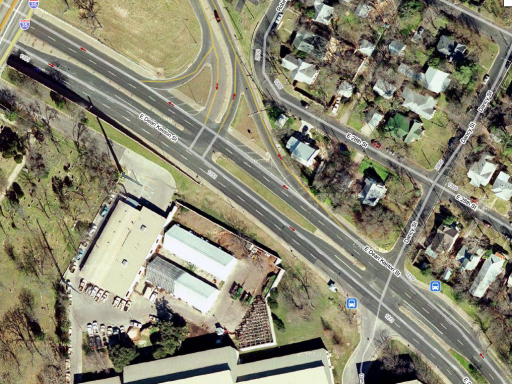
Google Maps image of Dean Keaton at I-35

When I got home from the recent road trip, I discovered that Dean Keaton had been restriped, adding reverse-angle parking, bike lanes, zebra stripes, and a generally dizzying array of new road markings. On the day of David Byrne’s recent talk about bikes, I rode this newly restriped stretch of road and found it to be a disaster for bikes.

The image above shows how the street looked before restriping. To be fair, this is an inherently difficult situation to make bike-friendly, especially westbound: there is a pullout for a city bus, an offramp, an onramp, and two places where traffic is turning across the lane. Not visible here is the fact that this is all happening on a downhill, so both bikes and cars are likely to be moving relatively fast (this stretch is signed as 30 mph, but the limit is rarely observed). Also not visible is another intersecting offramp just to the west.

As shown here, the street has two lanes, with a third lane for merging offramp traffic. After restriping, there is one lane on the left, a no-man’s-land denoted by zebra stripes, and a bike lane on the right; there’s a second lane for merging offramp traffic.

The way the bike lanes have been striped makes them an absolute hazard. The bike lanes zig-zag across onramp and offramp traffic in a way that minimizes the crossing distance. This runs contrary to both my own intuition and effective cycling methods, where the cyclist holds a straight line across the onramp/offramp. Worse perhaps is the quality of the pavement: although the pavement in the main travel lanes is in good shape, pavement in the bike lane is very rough.

As a cyclist, I am skeptical of bike lanes in general. They seem to be designed to cater naïve riders, who don’t know how to conduct themselves in traffic, and more than that, to motorists, who don’t want to be forced to deal with bikes at all. Many motorists will interpret the existence of a bike lane as a requirement that bikes ride in it, even when it is impassable. And naïve riders will follow bike lanes, even when they’re laid out poorly. That said, there can be good bike lanes and bad bike lanes. This is a bad one. A motorist taking the onramp or offramp will come up fast on a cyclist staying inside the lane, who is swerving and cutting perpendicularly across the motorist’s path at the same time. The choppy road surface set aside for the cyclist clearly reflects our second-class status. And the plethora of dashed lines, zebra stripes, chevrons, etc, all serve to confound everybody.

That night, I went to David Byrne’s presentation. One of the speakers was the City of Austin Bicycle Coordinator, Annick Beaudet. She spoke proudly of some of the city’s new bike facilities. Including this one. I can understand a city bureaucrat taking pride in seeing a project to completion, but I have to wonder: has she actually ridden this stretch of road?

See also: How not to design a bike lane.

Ride more bikes

In the severe hailstorm that hit Austin back in May, our car took a beating—some of the dings were so sharp that the paint cracked at the point of impact. When I took it in to get a repair estimate, they told me they were going to have to replace the hood and roof. In short, major repairs.

We finally got around to taking the car in to get the repairs done, and as of today, have been without a car for three weeks. The experience has been instructive.

I’ve lived in Austin without a car before. That was as a renter, and it definitely involved compromises. It would be much more difficult to live here as a homeowner without a car.

I’ve only had to bum a ride once during these three weeks. And there are certainly a few car-based errands that we’ve deferred. But for the most part, we’ve managed pretty handily, and more importantly, it’s been a reminder that most of the short 1/2/3 mile errands we run can be accomplished just as well by bike.

It’s a little embarrassing that we got out of the habit of using our bikes for errands in the first place. We didn’t quit riding them entirely, but we didn’t ride them nearly as much as we might have. It’s hard to put a finger on why this is. Too lazy to ride? Perhaps in part. Another dumb reason might be our garage door. When we moved into this house, the garage (where we store the bikes) could only be locked or unlocked from inside. So to get the bike out I’d go into the garage, open the door, pull the bike off the wall, put it outside, come back in, lock the garage, go through the house, go out the front door, and lock that. This is not a huge inconvenience in the grand scheme of things, but it adds just enough friction to the process that we’re more often inclined to say “fuck it” and take the car. We had the garage door fixed a few months back, so we don’t have that trivial hurdle to overcome. And now we’ve been booted out of our bad habits by circumstances. I’m optimistic we won’t fall back into them.

Scroll to Top